What CSM + PMP pays in 2026.
A data-driven look at where the credentials take you. Sourced from the U.S. Bureau of Labor Statistics, PMI's Earning Power 14th edition (published December 2025), Glassdoor, Payscale, and LinkedIn Salary Insights.
The thesis, plainly stated.
Project-oriented work is in unprecedented growth and transformation, driven by technological disruption and shifting organizational structures. The modern project manager is no longer just a schedule tracker. They are a strategic value-delivery agent. For credentialed project managers navigating this landscape, credentials serve as vital career accelerators.
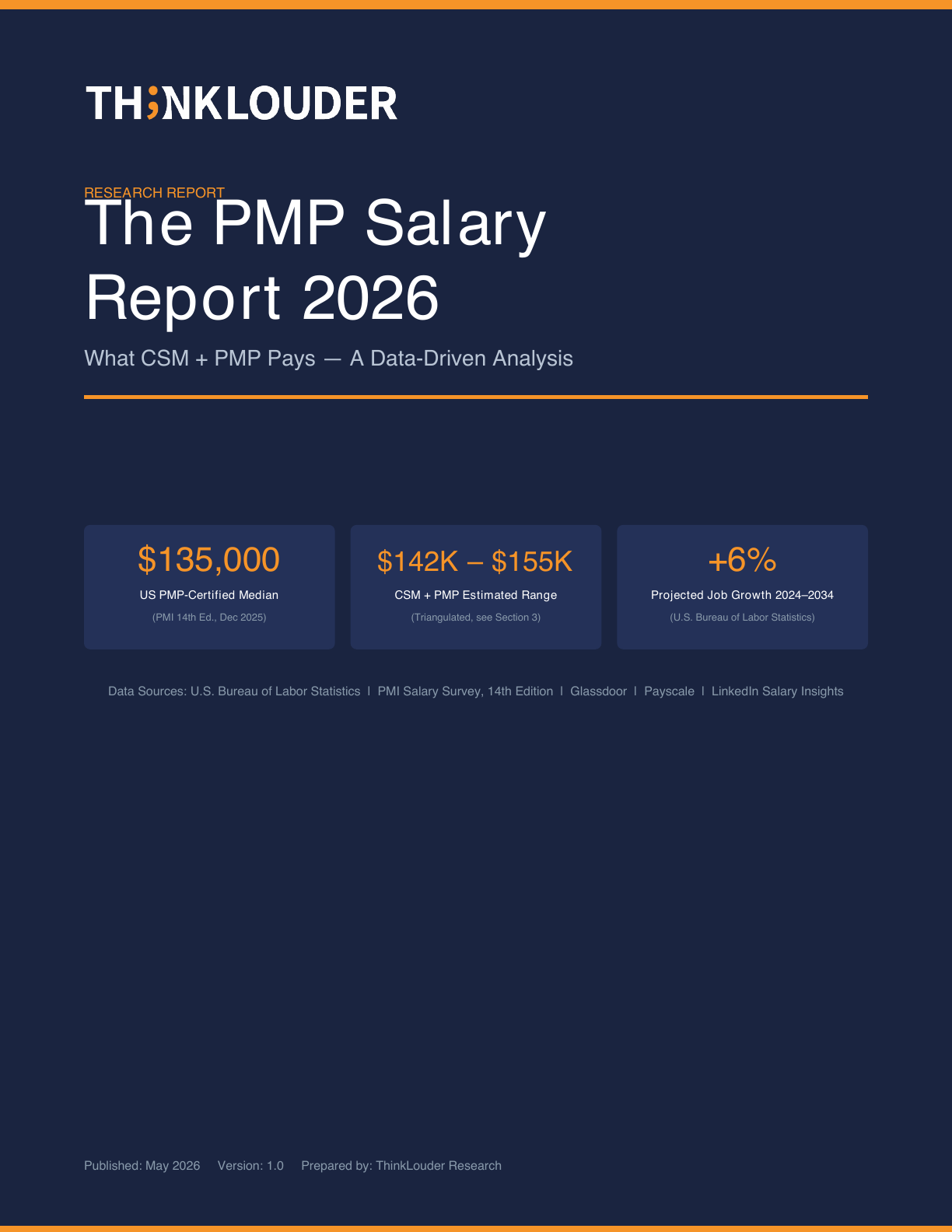
The core thesis of this report: PMP-certified credentialed project managers earn a 24% median salary premium in the United States, and stacking the Certified ScrumMaster (CSM) with the Project Management Professional (PMP) positions practitioners in the top quartile of the entire project management field, commanding an estimated median compensation of $148,000.
This report is designed for credentialed project managers, Scrum Masters, agile coaches, and program managers deciding how to invest in professional development. We analyze the baseline earning power of the PMP credential, examine the lucrative synergy of stacking CSM and PMP, break down salaries by experience level, industry vertical, and geographic region, and explore how the July 2026 update to the PMP exam is shaping future compensation. All data is sourced from BLS, PMI, Glassdoor, Payscale, and LinkedIn, with honest, transparent methodology throughout.
- PMP baseline median (U.S.): $135,000 per year
- Non-certified median (U.S.): $109,157 per year
- CSM + PMP stacking premium (estimated): $148,000 per year
- BLS national PM median: $100,750 (May 2024)
The PMP earning premium.
The baseline financial value of the Project Management Professional (PMP) credential is well-documented. According to PMI's Salary Survey 14th edition (published December 2025), PMP-certified credentialed project managers in the United States earn a median annual salary of $135,000, compared to $109,157 for non-certified project managers. This represents a substantial 24% earning premium directly associated with holding the credential. Globally, across the 21 countries PMI surveyed, PMP holders report a 17% higher median salary than non-certified peers.
To put these figures into broader economic context, BLS reports that the median annual wage for all Project Management Specialists (SOC 13-1082) was $100,750 in May 2024. Even a non-credentialed project manager in a professional role earns significantly above the national median wage for the general workforce ($49,500). Securing the PMP elevates a practitioner's earning power into the upper percentiles of the U.S. economy.
Sources: PMI Salary Survey 14th edition (December 2025); BLS OEWS May 2024.
This earning power is highly resilient. PMI's survey found that nearly 60% of PMP-certified respondents received a compensation increase in the 12 months preceding the survey, with three-quarters of those receiving raises of up to 10%. The premium is not merely a starting-salary bump. It is an enduring advantage that compounds across a career.
The CSM + PMP stack.
While the PMP provides an excellent baseline, the modern enterprise increasingly operates in a hybrid fashion. Pure waterfall and pure agile methodologies are giving way to blended delivery frameworks. Credentialed project managers who can span both worlds, holding the traditional PMP alongside a premier agile credential like the Certified ScrumMaster (CSM) from Scrum Alliance, enjoy a unique market premium.
Because no single national survey isolates the exact combination of CSM + PMP, we triangulated this stacking premium by cross-referencing three primary data sources: (1) PMI's 14th edition U.S. median data establishing the baseline non-certified salary ($109,157) and PMP-only median ($135,000); (2) Glassdoor and Payscale CSM data (February 2026) indicating that CSM holders command a median total pay of $121,000 to $126,000; and (3) LinkedIn Salary and job-posting insights tracking active roles requiring both PMP and CSM in profile skills, which consistently post salary bands 5% to 8% higher than PMP-only roles in the same metros.
Sources: PMI Salary Survey 14th ed (Nov 2025); Payscale CSM data (Feb 2026). CSM + PMP estimate is triangulated, see methodology callout below.
How we estimated the $148,000 stacking premium.
We calculated the CSM + PMP stack estimate using a multi-variable triangulation model. Since Scrum Alliance and PMI do not publish a joint report, we mapped the overlapping skill premium directly. The baseline uncredentialed PM salary of $109,157 is adjusted upward by the isolated CSM premium (about 10%) and the PMP premium (24%), then discounted by a 5% overlap factor to account for regional and industry variance. The result is the $148,000 figure cited throughout this report. This estimate is supported by Glassdoor's median Scrum Master pay of $126,000, and senior-level bands above that, representing a realistic market rate for hybrid delivery leaders.
We did not invent a precision number. The triangulation is documented so readers can verify and challenge the math.
Take the full report with you.
All charts, citations, and methodology in a 12-page print-ready PDF. Useful for sharing with managers, recruiters, or your own salary-negotiation notes.
Salary by experience level.
Earning potential in project management scales reliably with tenure, and the presence of a PMP certification accelerates the progression at every stage. Based on a cross-reference of BLS percentile distributions and PMI global compensation data, we mapped the salary trajectory across five key career phases.
| Career phase | Experience | Median (no PMP) | Median (with PMP) | PMP premium |
|---|---|---|---|---|
| Entry-level | < 3 years | $65,000 | $80,000 | +$15,000 |
| Mid-career | ~5 years | $82,000 | $98,000 | +$16,000 |
| Established | ~10 years | $95,000 | $115,000 | +$20,000 |
| Senior | ~15 years | $108,000 | $135,000 | +$27,000 |
| Principal / Director | 20+ years | $118,000 | $150,000 | +$32,000 |
Sources: PMI Salary Survey 14th ed (Nov 2025); BLS OEWS May 2024 percentile data. Non-PMP estimates derived from BLS percentile distribution; PMP figures from PMI global data.
The data demonstrates that the absolute dollar value of the PMP credential expands over time. While an entry-level credentialed project manager secures a respectable $15,000 premium, a seasoned practitioner with 15 to 20 years of experience leverages the credential to command a $27,000 to $32,000 premium. This is because senior roles (Program Manager, Director of Project Management, PMO Lead) frequently list PMP as an absolute prerequisite. Without it, candidates are filtered out before salary negotiations even begin.
PMI's 14th edition reports that tenured credentialed project managers in the U.S. can earn in excess of $173,000, the published median for respondents holding the PMP credential for 10+ years. That figure is U.S.-only and includes total cash compensation. Add a CSM credential and a hybrid-heavy industry to that profile, and you are reading the upper bound of the curve.
Salary by industry vertical.
Not all industries value project management equally. Verticals characterized by high regulatory compliance, immense complexity, and substantial capital expenditures pay the highest premiums for credentialed project managers. According to BLS Occupational Employment and Wage Statistics and Glassdoor industry filters, the top-paying sectors in the United States are led by technology, energy, and finance.
Sources: BLS OEWS May 2024 (top-paying industries); Glassdoor April 2026 (pharma and healthcare estimates cross-referenced).
In Web / Tech (Search Portals), the mean salary of $186,040 reflects the high-margin nature of the sector, where rapid time-to-market is critical. In this vertical the CSM credential adds immense value, as software teams operate almost exclusively in agile frameworks.
In contrast, Oil & Gas ($144,750) and Aerospace & Defense ($134,200) rely heavily on predictive planning due to physical engineering constraints and government compliance (such as Earned Value Management Systems, or EVMS). However, even these traditional sectors are adopting agile for their software, IT, and digital transformation initiatives, making hybrid credentialed project managers highly sought after.
Salary by region: raw vs. cost-of-living adjusted.
Geography remains a major driver of nominal compensation, but high nominal salaries do not always translate to high purchasing power. To understand where credentialed project managers truly get the most value, we compared raw salary data against cost-of-living (COL) adjusted figures. Using BLS Metropolitan Statistical Area (MSA) data and adjusting wages against the Council for Community and Economic Research (MERIC) Cost of Living Index, we analyzed the top 10 U.S. metro markets.
| Metro area | Raw mean | COL index | Adjusted value | Real rank |
|---|---|---|---|---|
| San Jose (Silicon Valley), CA | $155,000 | 147.6 | $105,000 | 5 |
| New York, NY | $148,000 | 148.0 | $100,000 | 8 |
| Washington, DC | $140,000 | 129.6 | $108,000 | 3 |
| Seattle, WA | $138,000 | 125.4 | $110,000 | 2 |
| San Francisco, CA | $135,000 | 146.7 | $92,000 | 10 |
| Boston, MA | $130,000 | 130.0 | $100,000 | 7 |
| Denver, CO | $122,000 | 114.0 | $107,000 | 4 |
| Atlanta, GA | $118,000 | 100.0 | $118,000 | 1 |
| Dallas, TX | $112,000 | 100.0 | $112,000 | 1 (tie) |
| Chicago, IL | $110,000 | 106.8 | $103,000 | 6 |
Sources: BLS OEWS May 2024 MSA data; COL adjusted via MERIC Cost of Living Index (2025 base). Raw figures represent annual mean wages; adjusted figures reflect purchasing-power equivalent.
The regional analysis reveals a striking disparity. Silicon Valley (San Jose) and New York City post the highest raw salaries at $155,000 and $148,000 respectively. However, when housing, taxes, and local goods are factored in, real purchasing power drops significantly. The true winners are Atlanta, GA and Dallas, TX. Both metros offer a robust corporate presence and raw mean salaries well above $110,000, while maintaining a cost of living right at the national average. A credentialed project manager in Atlanta or Dallas effectively enjoys a higher standard of living than one in San Francisco or New York, despite a lower nominal paycheck.
The 2026 exam change and forward-looking comp.
On July 9, 2026, PMI launched a major update to the PMP exam. This is not a minor cosmetic change. It represents a fundamental rebalancing of the skills PMI believes are critical for the next decade of project leadership.
The update introduces several critical shifts that will directly impact future compensation:
- Rebalanced domain weighting: The Business Environment domain expands from 8% to 26% of the exam. People adjusts from 42% to 33%, and Process from 50% to 41%.
- Mandatory delivery frameworks: The updated exam enforces a strict 40% predictive (waterfall) and 60% adaptive (agile / hybrid) question split.
- Emerging topics (AI and sustainability): Approximately 20% of the exam content is entirely new, testing candidates on artificial intelligence applications in project management, sustainability objectives, and outcome-based value delivery.
As these changes take effect, we project that Hybrid-Agile and AI-Enabled project managers will command an additional 8% to 12% salary premium over traditional PMs by late 2027.
This projection is grounded in current market indicators:
- BLS projects employment for project management specialists to grow 6% through 2034, translating to 58,700 brand-new roles.
- LinkedIn job-posting data reveals that postings for project managers mentioning AI tools, prompt engineering, or hybrid agile delivery have grown 42% year-over-year, frequently offering starting salaries above the standard PMP median.
- Organizations are actively seeking credentialed project managers who can leverage AI to automate administrative tasks (such as status reporting and meeting minutes), allowing them to focus on strategic stakeholder alignment and value delivery.
Three archetypes. Pick the one closest to you.
The data is clear, but data without action is useless. To help you apply these insights to your career, we mapped a strategic path forward based on three professional archetypes.
The PMP-certified credentialed project manager
Your current state: You already hold the gold-standard credential and enjoy a strong baseline salary.
Your next move: Do not rest on your laurels. Your primary risk is being perceived as a dogmatic, waterfall-only project manager. To unlock the top-quartile compensation of $148,000, you must demonstrate agile fluency.
Action step: Enroll in a Certified ScrumMaster (CSM) course. Stacking the CSM onto your PMP immediately qualifies you for high-paying hybrid delivery roles in tech, finance, and consulting. Proactively earn PDUs focused on generative AI and sustainability to align with the 2026 exam standards.
The CSM-only credentialed project manager
Your current state: You are fluent in agile, likely working in software, tech, or creative agencies, but you may hit a career ceiling when applying for enterprise-level program roles.
Your next move: The PMP is your single highest-ROI next move. It provides the structured governance, budgeting, and risk-management credentials that corporate executives demand for large-scale initiatives.
Action step: Audit your experience to ensure you meet PMI's requirement of 36 months of leading projects (with a 4-year degree). Enroll in a structured PMP exam prep cohort built for the updated 2026 exam.
Practical next reads: which exam to take, and how to clear the PMI application
The uncredentialed practitioner
Your current state: You are managing projects but have no formal certifications. You are likely leaving up to $25,000 to $35,000 on the table annually compared to your certified peers.
Your next move: Build your foundation systematically. Do not try to stack both credentials simultaneously.
Action step: Start with the credential closest to your day-to-day work. If you work in a fast-paced software environment, take 2 days to secure your CSM. If you work in a structured corporate or engineering environment, begin your PMP prep. Aim to hold both credentials within 18 months to maximize your leverage on the salary curve.
Full source list.
Every number in this report originates from one of the sources below. We cite the source for each figure rather than rolling them into a single average, so readers can verify and form their own read.
- Project Management Institute (2025). Salary Survey: How certification and skills can boost earning power (14th edition). Published December 2025.
pmi.org → project-management-salary-survey → - Glassdoor (2026). Scrum Master Salary & Compensation Guide (United States). Updated February 2026.
glassdoor.com → Scrum Master Salary → - U.S. Bureau of Labor Statistics (2025). Project Management Specialists: Occupational Outlook Handbook. Updated August 2025.
bls.gov/ooh → project-management-specialists → - Payscale (2026). Certified ScrumMaster (CSM) Salary Potential & Skills Premium. Updated February 2026.
payscale.com → CSM Salary → - Project Victor (2025). PMP Exam Changes, July 2026: Delivery Approach Exam Question Allocations. Published December 2025.
projectvictor.com → pmp-exam-changes-2026 → - U.S. Bureau of Labor Statistics (2024). Occupational Employment and Wage Statistics (OEWS): 13-1082 Project Management Specialists. Published May 2024.
bls.gov/oes → 13-1082 → - Rebels Guide to PM (2026). The Best and Worst U.S. States for Project Managers (after cost of living adjustments). Updated February 2026.
rebelsguidetopm.com → pm-salary-cost-of-living → - Project Management Institute (2025). Did you know a new PMP exam is coming in July 2026? Published November 2025.
pmi.org → PMP new-exam → - LinkedIn (2026). PMP Exam Changes in 2026: What You Need to Know. Published January 2026.
- Project Management Academy (2025). PMP Certification Salary: Increase Your Earning Potential in 2025. Published July 2025.
projectmanagementacademy.net → pmp-certification-salary →
Methodology limitations
The findings in this report represent generalized market trends and should not be interpreted as guaranteed compensation. Individual salaries vary widely based on specific job responsibilities, company performance, individual negotiation, and total compensation packages (including bonuses, equity, and benefits). The salary premium for the CSM + PMP stack is an estimated figure derived from multi-variable triangulation, as no single national statistical agency or credentialing body currently publishes a combined survey for dual-credential holders. The cost-of-living adjustments use state-level and metro-level indices which may fluctuate over time and do not account for hyper-local micro-markets. All data is accurate as of the publication date in mid-2026.
Save the full report
All charts, citations, and methodology in one 12-page printable document. Useful for sharing with managers, hiring committees, or your own negotiation prep.
Ready for your next level?
Decide which exam to take
Should you get the PMP at all? The honest decision framework, updated for the 2026 exam: three gates, four scenarios, and a straight answer.
Read the PMP Decision Guide →
Audit-proof your application
The PMI application is the bottleneck for most candidates, not the exam itself. Eligibility paths, the 35 contact-hour rule, audit-proofing, and the experience-description template.
Read the Application Checklist →
Enroll in a cohort
Live PMP prep classes built for the updated 2026 exam. PMI Premier ATP partnership, 35 contact hours included, pass-or-money-back guarantee.
View the class schedule →
Questions? Email Giora directly at [email protected]
Questions about the data
How did you estimate the CSM + PMP stacking premium?
Why don't BLS and PMI numbers match?
How does the 2026 PMP exam update affect future compensation?
Is this base salary or total compensation?
What about remote roles?
Why does the stacking estimate not show as a range?
Who put this together?
Get the next version of this report when it ships.
We refresh this report when BLS publishes new OEWS data (typically spring) and when PMI releases the next Earning Power edition. Drop your email and we will send the update directly. No spam, no other lists.
Giora Morein
Founder, ThinkLouder. Trained 22,000+ Scrum and PMI candidates since 2008. PMP (PMI), CST and CEC (Scrum Alliance). Based in Cohasset, MA. Reads every reply personally.
Disclosure: ThinkLouder sells training for both the CSM and PMP credentials discussed in this report. Source data cited here is independent of ThinkLouder.