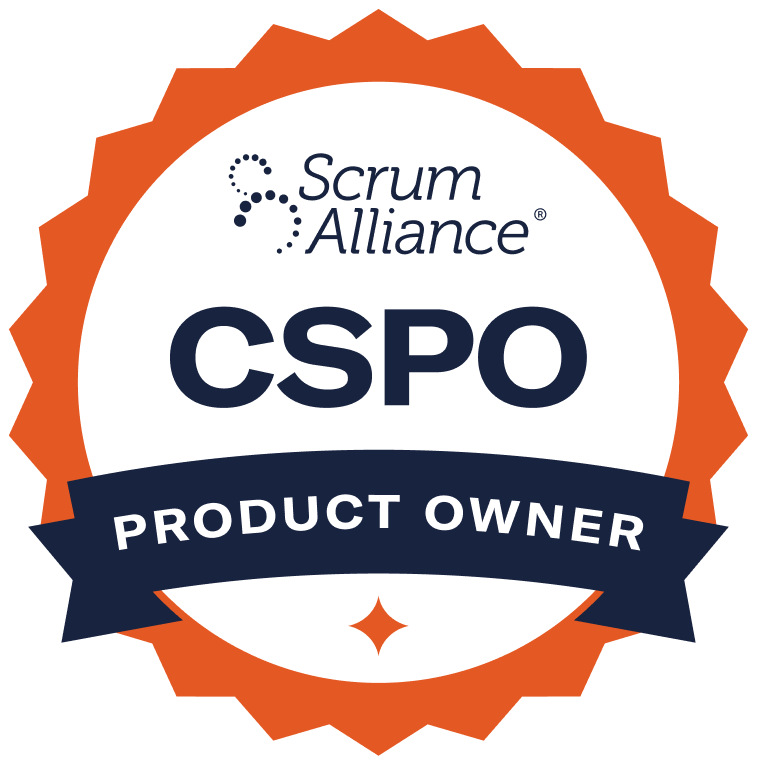
CSPO vs Product Owner Certification
CSPO: 2-day course, no exam, $349. PSPO: exam required, rigorous assessment. Choose CSPO for agile collaboration, PSPO for product ownership depth.
Answered by Giora Morein, Certified Scrum Trainer. ThinkLouder has trained 55,000+ practitioners since 2015.
CSPO certification is awarded after completing a 2-day course with no exam. PSPO (Product Owner from Scrum.org) requires passing an exam. The difference matters: CSPO emphasizes agile practices and team collaboration, while PSPO tests deeper product ownership knowledge and decision-making.
Key Differences
CSPO (Certified Scrum Product Owner)
- No exam required
- Awarded upon course completion
- Focuses on agile principles and Scrum framework
- Costs $349–$549 depending on format
- Renews every 2 years with 20 SEUs
PSPO (Professional Scrum Product Owner)
- Exam required (80 questions, 60-minute time limit)
- Emphasizes product ownership knowledge and decision-making
- More rigorous assessment of your capabilities
- Similar pricing to CSPO
- Renews every 2 years
When to Choose CSPO
Choose CSPO if you want to ground yourself in Scrum fundamentals and agile team dynamics. You'll spend two days in a classroom learning how Product Owners actually work with developers, stakeholders, and the backlog. No exam means you're not stressed about passing a test; you're focused on absorbing the practices. This works well if you're new to product ownership or transitioning from a different role.
We've trained over 55,000 professionals since 2015, and most who take CSPO first find it builds confidence before attempting a more rigorous certification.
When to Choose PSPO
Choose PSPO if you want to demonstrate mastery of product ownership theory and decision-making under pressure. The exam forces you to think critically about trade-offs, prioritization, and stakeholder management. It's the harder path, but employers and teams often see it as proof you understand the role deeply.
If you're already experienced as a Product Owner, PSPO might be the better fit. You'll validate what you already know.
The Real Difference
Here's the honest take: CSPO teaches you how to be a Product Owner in a Scrum team. PSPO tests whether you understand product ownership as a discipline. One is about practice, the other about knowledge. Your choice depends on whether you need the hands-on foundation (CSPO) or the credential that signals depth (PSPO).
Many practitioners get both. Start with CSPO if you're new, then move to PSPO once you've run a few sprints. Or go straight to PSPO if you've already got product experience.
What ThinkLouder Offers
We provide comprehensive CSPO training with instructors who've taught thousands of Product Owners. Classes start at $349 and run over two days, either in-person or online. You'll walk out certified and ready to apply what you learned on Monday morning.
If you're deciding between certifications, check out our detailed comparison of CSM vs CSPO to see how Product Owner training fits with Scrum Master training. For a deeper dive into CSPO and PSPO specifics, read CSPO vs PSPO: Key Differences Explained.
Ready to get started? Check our schedule page for upcoming classes.
One short email, every other Friday. Real-world Scrum lessons, no fluff. Unsubscribe anytime.
More from ThinkLouder
Related questions
CSM vs CSPO: Which Certification is Better?
CSM requires an exam and costs $349–$549. CSPO has no exam, same cost. Pick CSM for team leadership, CSPO for product strategy.
CSPO vs PSPO: Key Differences Explained
CSPO certification is awarded after a 2-day course with no exam, while PSPO requires passing an exam. Learn the key differences.
How long does it take to get CSPO certification?
CSPO certification takes 2 days of training with no exam. You're certified upon course completion. Here's what happens next.
Is there an exam for CSPO certification?
No exam required for CSPO. Certification awarded after a 2-day course. Renew every 2 years with 20 SEUs.
Browse upcoming Scrum classes
CSM, CSPO, A-CSM, A-CSPO. Live classes from a Certified Scrum Trainer who's been doing this for 25+ years.