What people get wrong about this
PMP just costs $555 for the exam, so it's pretty cheap.
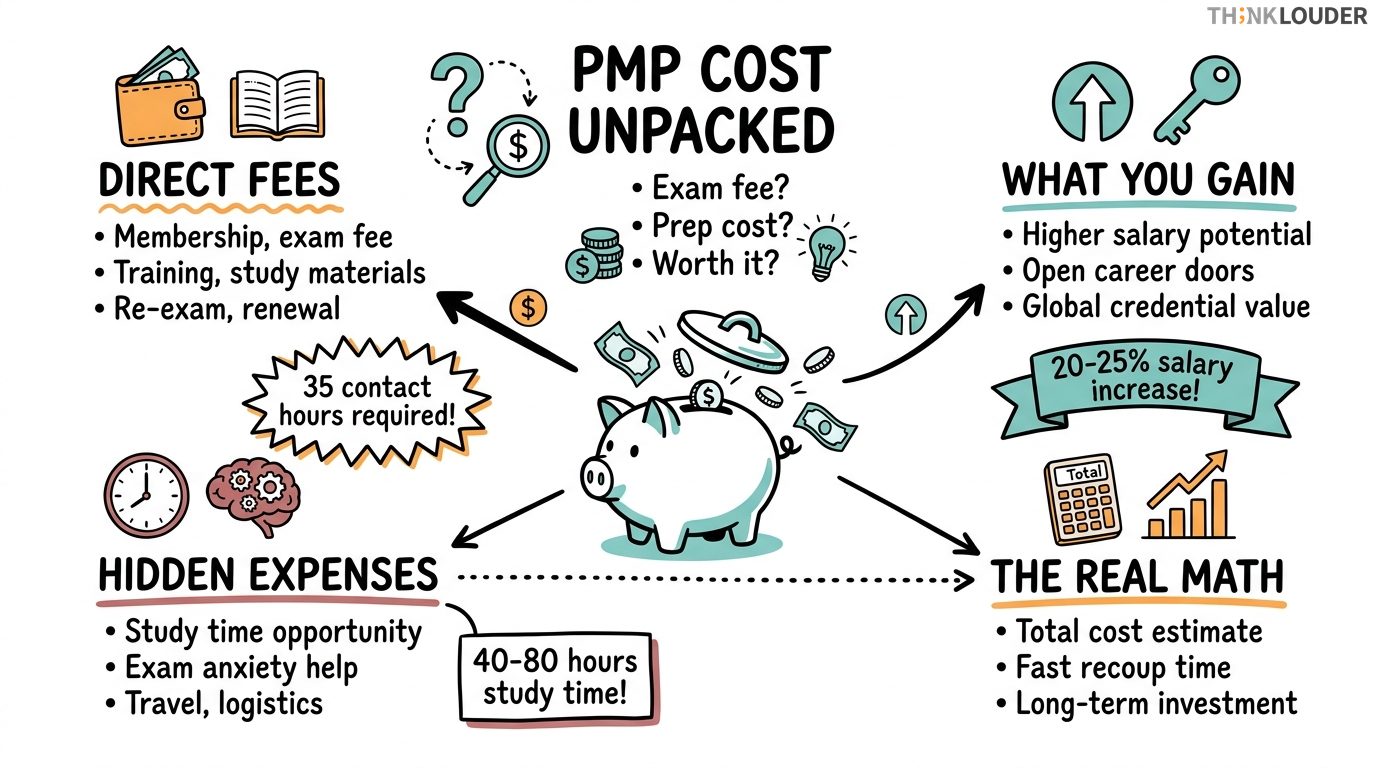
The exam fee is only the tip. Add $1,200–$2,500 for required training, $30–$200 for study materials, membership fees, and 40–80 hours of your own time. Total investment is typically $1,500–$3,000, and that doesn't count opportunity cost.
Once I pass the exam, I'm done paying.
You renew every three years for $60 plus the cost of earning 60 PDUs. Most people accumulate them naturally through work and learning, but if you don't stay intentional, you'll end up buying additional training to hit the requirement.
Everyone who gets PMP sees a big salary bump right away.
PMP typically pays off over time and often after a job change. Some industries and roles see immediate gains; others see the value compound over years. The real benefit is optionality: more doors open, which means more negotiating power eventually.
What You're Actually Paying For
The PMP exam itself costs $555 if you're a PMI member, or $755 if you're not. That's the baseline. But that number alone doesn't tell you much, because you can't just walk into the exam cold. The PMI requires 35 contact hours of formal project management education before you're eligible to sit, and most people spend weeks or months studying beyond that.
So when someone asks "How much does PMP certification cost?", they're really asking three separate questions: What's the exam fee? What'll I spend on prep? And is it worth it? Let me walk through each one.
The Direct Costs
PMI Membership and Exam Fee
First, membership. It costs $139 per year to join PMI. You don't technically need to be a member to take the exam, but the exam is $200 cheaper if you are, so your break-even is less than two years. Most people join, take the exam within 12 months, and renew annually after that.
Once you're a member, the exam fee is $555. If you're not a member, it's $755. The exam itself is 180 questions delivered over 230 minutes (three hours and 50 minutes), with two scheduled 10-minute breaks.
Training and Study Materials
Here's where costs climb. You need 35 contact hours of formal education before you're eligible. That requirement exists because PMI wants to ensure you've actually studied the framework, not just crammed the night before.
You can meet those 35 hours through:
- A live or virtual instructor-led course (typically $1,200–$2,500)
- Self-paced online training ($500–$1,200)
- A boot camp or intensive workshop ($1,500–$3,000)
- Employer-sponsored training (free to you, but your company pays)
On top of the course, most people buy study materials: practice exams ($50–$200), study guides ($30–$80), flashcard apps ($10–$30). Add it up and you're looking at $1,500–$2,500 just to get to the exam door.
Re-examination and Renewal Fees
If you don't pass on your first attempt, the re-exam fee is the same as the initial exam: $555 for members. About 40% of test-takers pass on the first try, so budget for the possibility.
Once you hold the credential, renewal costs 60 PDUs (Professional Development Units) every three years plus a $60 renewal fee paid to PMI. PDUs come from training, conferences, volunteer work, or on-the-job learning. Most people accumulate them naturally, but if you're not intentional about it, you might need to buy additional training to hit 60.
The Hidden Costs (and They're Real)
Study Time Is Opportunity Cost
You'll spend 40–80 hours studying for this exam. That's real time. If you're doing it nights and weekends, that's time you're not spending with family, on side projects, or resting. If your employer gives you study time during work hours, that's paid time away from your current project.
I'll be honest with you: the time cost often exceeds the money cost. A course might run $2,000, but if you're spending 60 hours on prep and you bill at $75 an hour, that's another $4,500 in opportunity cost. Some employers front the training and give you study time; others don't. Know which one you're in before you commit.
Exam Anxiety Adds Real Expense
Some people pay for tutoring ($50–$150 per hour) or small-group coaching ($200–$500) to boost confidence before the exam. That's optional, but it happens. If you're anxious about the exam, it's a real line item.
Location and Delivery Method Matter
If you take a live boot camp, you might travel. Hotel, airfare, meals, and lost work hours add up. Virtual courses eliminate travel but require a quiet space and good internet. Self-paced study is cheapest but requires the most discipline.
The ROI: What You Get Back
Salary Impact
The data here is messy because salary depends on industry, geography, experience level, and company size. But the general pattern is clear: PMP holders earn more. Studies from PMI and Burning Glass Technologies (data accessed January 2024) show PMP-certified professionals earn 20–25% more than non-certified peers in the same role. That's roughly $12,000–$18,000 per year for someone earning $60,000 baseline.
If you're in tech or finance, the bump is higher. If you're in nonprofits or government, it's lower. Your mileage will vary.
Career Doors
Many organizations, especially government contractors, won't hire you as a project manager without PMP or equivalent credential. It's not a nice-to-have, it's a requirement. If you're blocked from roles you want because you lack the cert, the ROI calculation is simple: get it.
For internal advancement, it signals that you've invested in the discipline. Your employer sees you as serious about the craft, not just someone who fell into project management. If you're comparing PMP to other paths, check out our guide on SAFe certification and whether your organization needs it, since some teams go that route instead.
Longevity in the Market
PMP is the most widely recognized project management credential globally. It holds value across industries and geographies. If you move companies, change roles, or relocate, you carry it with you. That portability is worth something, especially if you're early or mid-career.
The Real Math
Let's say you spend $2,500 on training and exam fees, and another $1,500 in opportunity cost (study time). That's $4,000 total.
If you earn $60,000 now and move to $72,000 after certification (a 20% bump), you recoup that $4,000 in about 2.4 months. Over a 10-year career, that credential pays for itself roughly 30 times over.
But that assumes you get the salary bump, which depends on market, industry, and your own negotiation. Not everyone sees immediate salary movement. Some see it after a job change. Some see it over years through compounding raises.
The safer way to think about it: PMP is an investment in optionality. It opens doors that would otherwise stay closed. Whether those doors lead to higher pay, better roles, or just more choices depends on your industry and ambition.
What to Do Right Now
If you're considering PMP, start here:
-
Check your employer's tuition reimbursement policy. Many companies cover 50–100% of training costs. If yours does, the math shifts dramatically in your favor.
-
Verify the requirement for your target roles. Look at job postings for the positions you want in 2–3 years. If PMP appears in "required" rather than "preferred", it's probably worth doing.
-
Assess your study capacity honestly. You need 35 contact hours plus 40–80 hours of independent study. If you're in a busy season at work or dealing with major life changes, wait until you have bandwidth.
-
Compare training providers. ThinkLouder and other PMI-Approved training providers offer different formats: live instructor-led, self-paced, and hybrid. The best choice depends on how you learn and what your schedule allows. We've trained over 55,000 practitioners since 2015, and we start at $349 for self-paced options.
The cost of PMP certification is real, but it's not arbitrary. You're paying for a credential that opens doors, signals competence, and typically pays for itself within a few years. Just make sure it's the right door for you to open.
Ready to explore options? Check out ThinkLouder's PMP training schedule to see what formats and cohorts fit your timeline.
How it works in practice
- 1Check your employer's tuition policy
Many companies cover 50–100% of PMP training costs. If yours does, the out-of-pocket investment drops significantly. Ask HR before committing to a course.
- 2Verify PMP is required for your target roles
Search job postings for positions you want in 2–3 years. If PMP appears in 'required' rather than 'preferred', it's a blocker worth removing. If it's optional, weigh the decision more carefully.
- 3Assess your study capacity
You need 35 contact hours of formal training plus 40–80 hours of independent study. Be honest about your bandwidth. If you're in a busy season or major life transition, wait until you have real capacity.
- 4Choose a training format that fits your learning style
Live instructor-led courses work best for people who need structure and interaction. Self-paced training suits independent learners. Boot camps compress the timeline but demand intensive focus. Pick one that matches how you actually learn.
- 5Budget for the full cost, including opportunity cost
Add exam fee, training, materials, and a realistic estimate of study time. If study time is worth $75/hour and you'll spend 60 hours, that's $4,500 in opportunity cost on top of direct expenses. Know the real number before you start.
One short email, every other Friday. Real-world Scrum lessons, no fluff. Unsubscribe anytime.