What people get wrong about this
PMP is a Scrum certification, so if I get PMP I'm set for Agile work
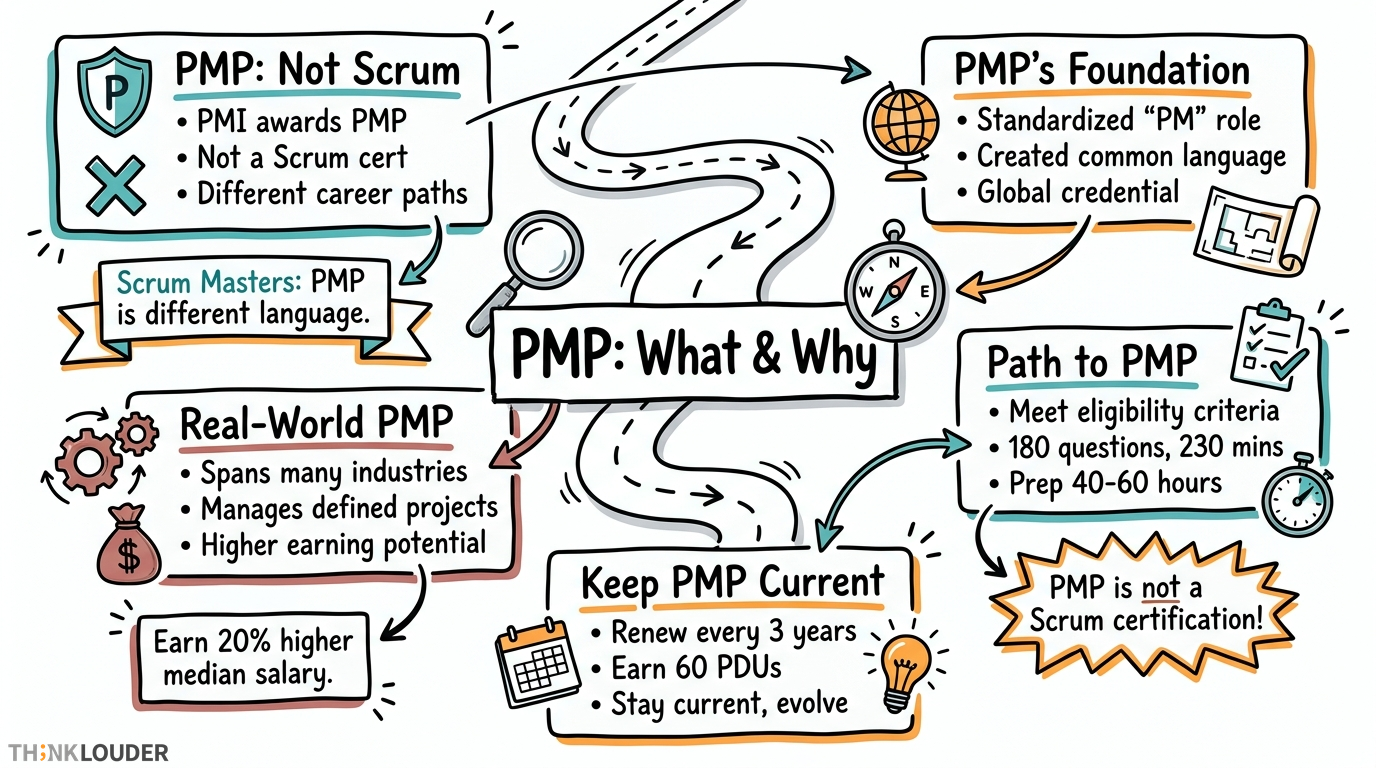
PMP is awarded by PMI and covers project management across methodologies, including waterfall. Scrum credentials (CSM, CSPO) come from Scrum Alliance and are built for Agile teams. They're different paths for different work.
Once I pass the PMP exam, I'm done. The credential is mine forever
PMP requires renewal every three years. You need to earn 60 PDUs (Professional Development Units) and pay a renewal fee to PMI, or your credential lapses.
PMP is just about knowing project management formulas and processes
The exam is scenario-based and tests how you handle real project situations. You're answering questions like 'Your project is over budget with three weeks left—what's your first move?' not memorizing formulas.
I can get PMP certified if I just study hard and take the exam
You need to meet eligibility first: 36 months of documented project leadership experience (or 60 months without a bachelor's degree) plus 35 contact hours of formal project management education. You apply to PMI and they approve you before you can sit for the exam.
PMP stands for Project Management Professional. It's a credential awarded by the Project Management Institute (PMI), and it signals that you've met a specific bar: documented project leadership experience, formal education in project management, and a passing score on a rigorous exam. That's it. Nothing more mysterious than that.
Now, here's where the confusion usually starts. PMP is not a Scrum certification. It's not awarded by Scrum Alliance. If you're a Scrum Master looking to deepen your Scrum practice, you're looking at CSM, CSPO, or A-CSM credentials instead. PMP is for project managers working across methodologies, waterfall included. The two credential paths serve different audiences and different career trajectories.
Where PMP Comes From
PMI created the PMP in 1984 as a way to standardize what "project manager" actually meant. Before that, the title was all over the place. Someone managing a three-person team and someone orchestrating a $50 million infrastructure build could both call themselves project managers, and there was no way to tell them apart. PMI built the PMP to create a floor, a common language.
The exam itself is 180 questions, delivered over 230 minutes (3 hours 50 minutes), with two scheduled 10-minute breaks. Before you sit for it, you need to meet eligibility requirements: 36 months of project leadership experience if you hold a bachelor's degree, or 60 months without one. You also need 35 contact hours of formal project management education before you apply. That education can come from a PMI-Approved instructor (which ThinkLouder provides), online courses, university programs, or a combination.
The credential is global. PMI administers it in over 200 countries, which is why you'll see it on resumes from Singapore to São Paulo. That consistency matters when you're hiring or when you're moving between organizations.
How PMP Shows Up in Practice
You'll see PMP holders in roles that span industries: construction, IT, healthcare, finance, consulting. The common thread isn't the industry, it's the scope. PMP holders typically manage defined projects with clear start and end dates, budgets, and stakeholders. They're comfortable with Gantt charts, risk registers, scope statements, and formal change control. If your organization runs traditional waterfall projects or hybrid approaches, you'll see PMP credentials.
When you're hiring, PMP tells you something concrete. It tells you the candidate has logged real hours managing projects, passed a test that isn't trivial to pass, and committed to staying current. It's not a guarantee they'll be great, but it's a signal you can trust.
The earning potential is real too. According to PMI's 2023 Salary Survey, PMP-certified professionals earn a median salary roughly 20% higher than non-certified project managers in comparable roles. That gap widens in certain geographies and industries. Again, that's not because the credential magically makes you better, it's because organizations value the screening and the commitment it represents. If you want the full breakdown, we've covered PMP certification and salary in detail.
The Application and Exam Process
Here's the actual path. First, you confirm you meet the eligibility requirements (experience and education hours). Then you apply to PMI, submit your documentation, and they review it. If they approve you, you get an exam eligibility code. You have one year from that approval to schedule and sit for the exam.
The exam itself tests five domains: people (42%), process (50%), and business environment (8%). You're not memorizing formulas, you're answering scenario-based questions. "Your project is 10% over budget and you've got three weeks left. Your sponsor wants a status report by tomorrow. What do you do first?" That's the flavor.
People often ask about study strategy. You'll want to block 40 to 60 hours of focused prep time. That's not a guess, that's what we see from students who pass on the first attempt. Use official PMI study guides, take practice exams (the real exam questions are harder than most practice tests, so don't let a 75% practice score fool you), and if you're not a native English speaker, budget extra time for reading comprehension. The exam is written in English and the language precision matters.
One honest thing: if you're already a Scrum Master running Agile teams, the PMP exam will feel like learning a different language. Scrum and traditional project management use different mental models. You'll need to code-switch during the exam. That's doable, but it takes deliberate prep. If you're considering both credentials, get your Scrum credential first, then layer PMP on top. The reverse is harder. For the step-by-step path to Scrum, see how to become a Scrum Master online.
Maintaining Your Credential
PMP renewal happens every three years. You need to earn 60 Professional Development Units (PDUs) during that cycle and pay the renewal fee to PMI. A PDU is earned through formal education, conference attendance, volunteering in project management roles, or even writing articles on project management topics. Most holders hit this requirement without breaking a sweat, but you do have to stay intentional about it. If you let your credential lapse, you can't call yourself PMP anymore, right?
The PDU requirement exists for a reason. Project management evolves. Tools change, frameworks expand, organizational contexts shift. PMI's bet is that staying engaged with the field keeps your knowledge current. Whether that actually happens depends on which PDUs you choose, but the mechanism is sound.
Stay connected to PMI chapters in your area, attend conferences, take follow-up courses. If you're managing projects in an Agile environment, consider layering in Agile-specific training alongside your PMP maintenance. Many organizations now run hybrid approaches, and the ability to speak both languages is valuable.
When PMP Is the Right Fit
If you manage defined projects with clear scope, timeline, and budget constraints, PMP is a strong credential to pursue. If you're in construction, infrastructure, manufacturing, or traditional IT delivery, it's often expected. If you're moving into a project management role and want a credential that's recognized globally and carries real weight in hiring, PMP delivers that.
If you're running Agile teams and sprints, you're probably looking at a different path. A Certified Scrum Master (CSM) or Certified Scrum Product Owner credential aligns better with that work. Both are valuable. They just answer different questions about how you work.
Related Resources
- Considering how AI impacts project management, explore Can AI Write User Stories? for insights into modern practices.
- Curious how emerging tech impacts your career path? Find out Do Project Managers Need to Learn AI.
How it works in practice
- 1Confirm you meet eligibility requirements
Check that you have 36 months of project leadership experience (or 60 months without a bachelor's degree) and identify how you'll complete 35 contact hours of formal project management education. This education can come from a PMI-Approved instructor, online courses, or university programs.
- 2Complete your 35 education hours
Enroll in a PMI-Approved course or program. These courses cover the five domains tested on the exam and prepare you for the application and exam itself.
- 3Apply to PMI and submit documentation
Submit your application with proof of experience and education hours. PMI reviews and approves or requests clarification. Once approved, you receive an exam eligibility code valid for one year.
- 4Study and prepare for the exam
Block 40–60 hours of focused prep time. Use official PMI study guides, take practice exams, and review scenario-based questions. The real exam tests how you handle project situations, not formula memorization.
- 5Schedule and sit for the 180-question exam
The exam is 230 minutes (3 hours 50 minutes) with two 10-minute breaks. You need a passing score. Results are typically available within 24 hours.
- 6Plan for renewal every three years
Earn 60 PDUs during your three-year cycle through formal education, conferences, volunteering, or writing. Pay the renewal fee to PMI to keep your credential active.
One short email, every other Friday. Real-world Scrum lessons, no fluff. Unsubscribe anytime.