What people get wrong about this
AI adoption means we pick a tool and roll it out to everyone at once.
AI adoption is a phased experiment. You start with one problem, one team, one tool. You measure what actually changes. Then you scale what works. Rolling out everything at once creates chaos and waste.
If people are using the AI tool, adoption is successful.
Usage is not the same as impact. You need to measure whether the tool actually changed the outcome: did refinement get faster, did rework drop, did the team feel more confident? High adoption with zero impact means you have a problem.
AI adoption is a technology project with a finish line.
AI adoption is an ongoing practice. You pilot, measure, adjust, and keep learning. New tools emerge, your team's needs shift, what worked last quarter might not work next quarter. You need a rhythm for reviewing and adapting.
An AI adoption roadmap isn't a 200-slide PowerPoint or a consultant's fantasy. It's a practical, staged plan that moves your team from "we've heard about AI" to "we're using it to solve real problems every sprint."
Think of it like onboarding a new team member. You don't throw them at the codebase on day one. You assess what they need to know, run them through specific scenarios, check in on what's working, and adjust. An AI adoption roadmap does exactly that for your organization, except the "new team member" is a set of tools that'll touch your planning, refinement, standup facilitation, and retrospectives.
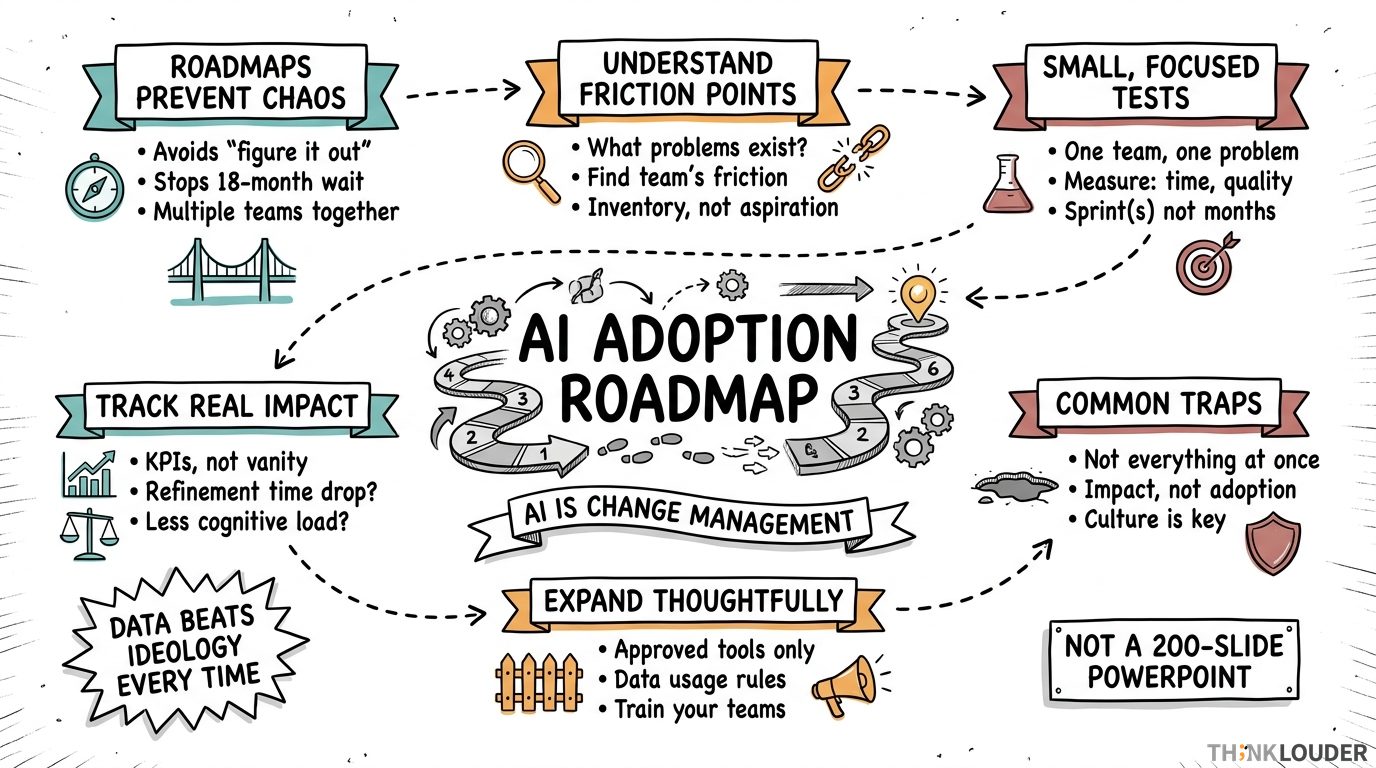
The roadmap sits between two extremes. On one side, teams that say "we'll figure it out as we go" end up with chaos: some people using ChatGPT for story refinement, others ignoring it entirely, nobody knowing what's actually happening. On the other side, teams that wait for a perfect 18-month enterprise rollout miss 18 months of learning. A roadmap keeps you moving forward without burning out.
Where This Matters Most
Years ago we worked with a financial services organization running 34 Scrum teams across six products. They had a mandate to "adopt AI" but no plan. Three months in, half the teams had built internal ChatGPT wrappers, two teams were using Claude for sprint planning, and the security team had no visibility. We built a roadmap with them: start with low-risk assessment, pilot in three teams, measure what actually changed in their velocity and refinement time, then scale. That sequencing saved them from a compliance disaster and gave them real data instead of guesses.
The roadmap matters most when you've got multiple teams that need to move together (so one team's chaos doesn't become another team's problem), compliance or security constraints (financial services, healthcare, regulated industries), a backlog of work and limited capacity (AI tools can help, but you need to know which ones and why), and skeptics in the room. You should have skeptics, right? Data beats ideology every time.
The Core Stages of an AI Adoption Roadmap
Assessment. First, you figure out what you're actually trying to solve. Don't start with "AI is cool." Start with friction. Where does your team lose time? Where do decisions get stuck? Where's the rework? In refinement, is it because stories aren't clear enough? In standup, are people context-switching? In retrospectives, are insights getting lost? Assessment is honest inventory, not aspiration.
Pilot and experimentation. Pick one team, one specific problem, one tool. Not five tools across three teams. One team uses an AI assistant to draft acceptance criteria for a sprint. You measure: Did it save time? Did the criteria get better? Did the team trust it? You run it for one sprint or two, not six months. Then you decide: scale it, modify it, or drop it.
Measurement and learning. This is where most roadmaps fail. Teams pilot something, nobody measures, and six months later nobody knows if it worked. You need KPIs that matter to your sprint, not vanity metrics. Examples: Did refinement time drop? Did rework decrease? Did the team report less cognitive load? Did the Product Owner feel more confident in the backlog? Pick three metrics per pilot, track them, and be honest about the results.
Scaling with guardrails. Once a pilot shows real signal, you expand to more teams. But you don't just say "do what team A did." You set guardrails: what tools are approved, what data can and can't go into them, how teams report what they're using. You also train. Scrum Masters and Product Owners need to understand how AI tools fit into their ceremonies, not just how to paste a prompt into ChatGPT.
Continuous adjustment. An AI adoption roadmap isn't set-and-forget. Every quarter, you review: what's working, what's not, what new tools or techniques have emerged, what's the team feedback. You're not rigid; you're responsive.
Common Pitfalls and How to Avoid Them
"We'll adopt everything at once." You won't. You'll confuse your teams, overwhelm your infrastructure, and spend six months in tool evaluation hell. Pick one problem, one tool, one team. Win there. Then move.
"We'll measure adoption, not impact." Counting how many people use an AI tool tells you almost nothing. You need to know: did it change the outcome? Did refinement get faster or better? Did the team reduce rework? If adoption is high but impact is zero, you've got a problem.
"We'll skip the cultural piece." AI adoption is a change management problem dressed up in technology language. If your team doesn't trust the tool, doesn't understand why it matters, or feels threatened by it, they won't use it right. Invest in clarity, training, and psychological safety. If you're running a team, this is your job.
"We'll treat it like a one-time project." AI adoption isn't a project with an end date. It's an ongoing practice. New tools emerge, your team's needs shift, what worked last quarter might not work next quarter. You need a rhythm for reviewing and adjusting.
Measuring What Actually Matters
Just to adjust the language a little bit. When we talk about "success," we don't mean "we bought an AI tool and people use it." We mean: did the work get better or faster or clearer?
For Scrum teams, that usually breaks down into a few categories.
Sprint execution. Does the team finish more of what they committed to? Does rework go down? These aren't guaranteed to improve with AI, but if they do, you've got signal.
Refinement and planning. Can you get stories ready faster? Are they clearer? Can the Product Owner articulate acceptance criteria without three rounds of back-and-forth? If AI tools help here, your sprint planning gets shorter and your team has more context.
Retrospective insights. Are teams identifying and solving problems faster? Are retros moving from "we need to talk less in standup" to "here's how we're going to change our approach to testing"? This one's harder to measure but matters.
Team confidence. This sounds soft, but it's real. Does the team feel like they understand the problem before they start coding? Do they feel like they're making progress? Burndown is one signal; team sentiment is another.
Pick three of these. Measure them before the pilot, measure them during, measure them after. Be honest about what changed and what didn't.
How to Start Today
You don't need permission or a big budget. You need clarity on one problem and one team willing to experiment.
First, identify the friction point. In your next retro, ask: "Where do we lose the most time or feel the most stuck?" It might be story writing, it might be standup decisions, it might be dependency management. One thing. Write it down.
Second, pick a tool. If you're a Scrum Master or Product Owner, you've probably already played with ChatGPT or Claude. Pick the one your team has easiest access to. Not the fanciest one, the most accessible one.
Third, run a one-sprint experiment. Use the tool on that one friction point. Don't change anything else. Track three metrics: time spent, quality of output, team confidence.
Fourth, retro on it. What worked? What didn't? What would you change?
That's your roadmap starting point. Everything else scales from there.
If you're running multiple teams or an organization-wide initiative, you'll need more structure. Our AI for Scrum Masters and AI for Product Owners credentials walk you through how to integrate AI into your ceremonies and decision-making without losing sight of what Scrum actually is. Most teams we've trained report that clarity cuts their adoption timeline by half. We've trained over 55,000 practitioners since 2015, and this pattern holds across financial services, tech, healthcare, and government.
The roadmap isn't about chasing hype. It's about solving the problems in front of you, measuring whether the solution actually works, and scaling what does. That's it.
How it works in practice
- 1Identify the friction point
In your next retro, ask where your team loses the most time or feels most stuck. It might be story writing, standup decisions, or dependency management. Pick one thing.
- 2Select an accessible tool
Don't chase the fanciest option. Pick the tool your team has easiest access to and can start using immediately, like ChatGPT or Claude.
- 3Run a one-sprint pilot
Use the tool on that one friction point. Don't change anything else. Track three metrics: time spent, quality of output, and team confidence.
- 4Measure and reflect
At the end of the sprint, retro on it honestly. What worked? What didn't? What would you change? Let the data guide the next decision.
- 5Scale with guardrails
Once you see real signal, expand to more teams. Set clear guardrails: approved tools, data boundaries, and training. Don't just say 'do what team A did.'
- 6Review and adjust quarterly
Every quarter, review what's working, what's not, and what new tools or techniques have emerged. AI adoption is ongoing, not a one-time project.
One short email, every other Friday. Real-world Scrum lessons, no fluff. Unsubscribe anytime.