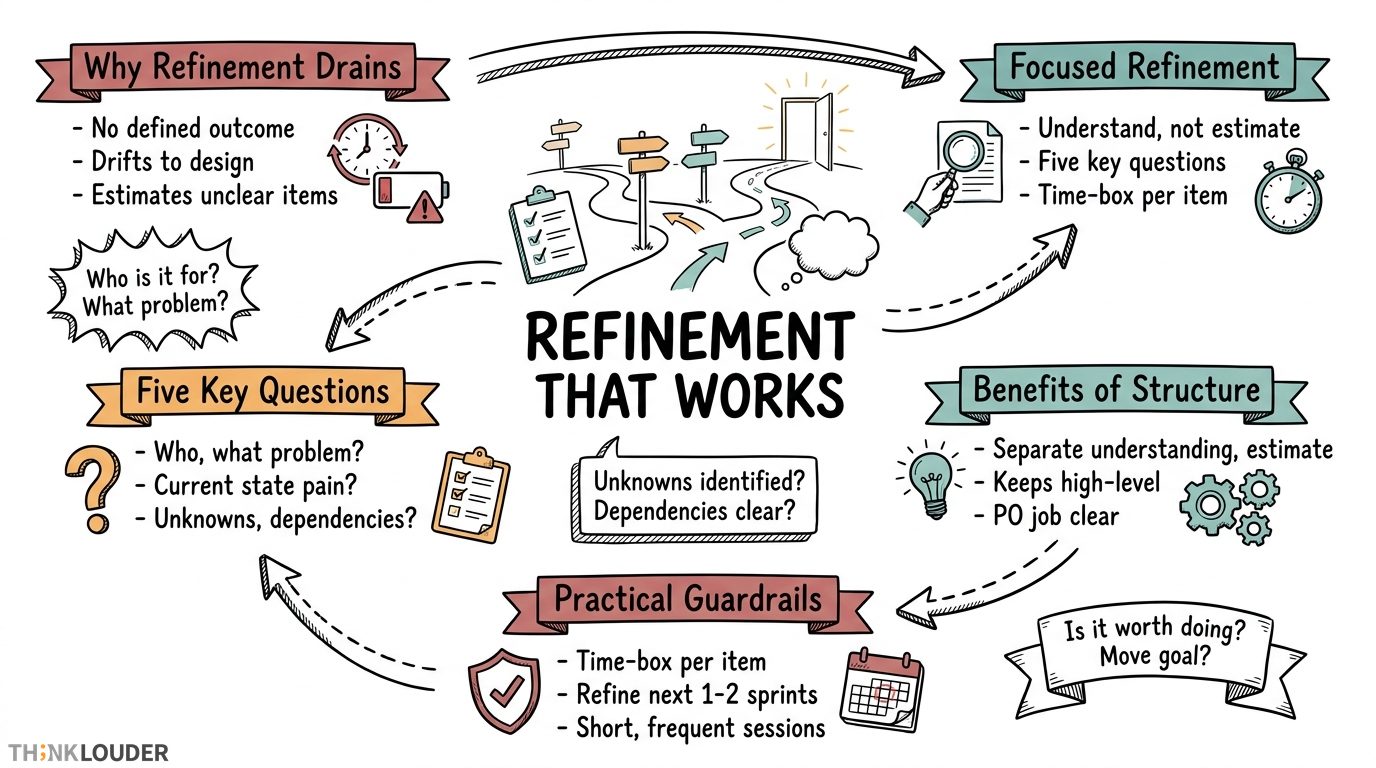
Backlog refinement works when it has one job: make sure the next few backlog items are understood well enough to plan. Not estimated to the point. Not specified to the last field. Understood. The best practice that fixes most refinement problems is running every item through the same five questions, in order, with a 10-minute cap per item, and keeping estimation out of the room until those questions are answered.
Why refinement drains the room
Picture a Tuesday afternoon. Twelve backlog items on the screen. The team opens the first one, someone asks what it means, the product owner explains, a developer suggests a technical approach, two people debate that approach for fifteen minutes, then everybody throws a story point at it and moves on. Ninety minutes later you've "refined" four items and nobody could tell you why any of them matter.
That's not a story problem. That's a facilitation problem. The session had no defined outcome, so it drifted into the two things that feel productive and aren't: designing the solution, and estimating things nobody understands yet.
Refinement done well is short, repetitive, and slightly boring. Same questions, every item, every week. The structure is what protects the energy in the room.
The five refinement questions
Ask these in order for each backlog item. If you can't answer one, stop there. The item goes back to the product owner for more work, and you move to the next one.
1. Do we understand who this is for and what problem it solves for them?
Not "the user." A specific person in a specific situation. A claims adjuster who has to re-key the same policy number into three screens. A parent trying to reschedule a pickup from a phone in a parking lot. If the team can't name the person and the problem, nothing else about the item can be judged, because there's nothing to judge it against.
2. Do we understand how this is handled today, and why that's too slow, too painful, or too error-prone to leave alone?
This is the question that turns a feature request back into a problem. Somebody is living with this today. How? A spreadsheet? A phone call? A workaround that involves a manager's password? Once the team sees the current state, the acceptance criteria almost write themselves, because the acceptance criteria should describe what "better" looks like compared to today. They are not a spec for the developer to follow. They are the boundary of the work and the definition of improvement.
3. Have we identified the unknowns and dependencies?
What would we need to learn, decide, or have in place before this can be worked? An API contract from another team. A legal answer about data retention. A design decision nobody has made. You are not resolving these in refinement. You are naming them, so sprint planning doesn't get ambushed by them. An item with an unresolved dependency isn't ready, no matter how well everyone understands it.
4. Is this sized appropriately, or does it need to be split?
Notice this is a yes-or-no question, not an estimation exercise. The team is asking one thing: can this plausibly be finished inside a sprint, with room for everything else? If the honest answer is "probably not," split it now, while the person who understands the problem is in the room. Splitting later, in planning, is where the good options have already disappeared.
5. Is this worth it?
Does this item move us toward the product goal, or is it on the backlog because somebody asked for it eight months ago and nobody has had the nerve to delete it? This is the question teams skip, and it's the one that makes refinement strategic instead of mechanical. Most backlog items survive by inertia. Give the team explicit permission to answer "no," and then actually remove the item. A backlog that only grows is a wish list, not a plan.
Why this works
It separates understanding from estimation. Most refinement sessions collapse because the team tries to estimate things it doesn't understand yet, and the argument about the number is really an argument about the meaning. Run the five questions first. If you estimate at all, do it afterward, and you'll find it takes a fraction of the time and the numbers are more honest.
It keeps refinement high-level. The detail of how the work gets done belongs in sprint planning, with the people who will do it. If a developer could pick up the item and start coding without a single question, it has too much detail in it, and somebody spent refinement time writing a specification instead of building shared understanding. You want the questions. The questions are the conversation, and the conversation is what makes the work go well.
It gives the product owner a clear job before the meeting. Questions 1, 2 and 5 should be answerable by the product owner walking in. If they aren't, the item isn't ready for refinement, and the session shouldn't be where that gets discovered. Over a few weeks, this quietly raises the quality of what reaches the team.
It makes "not ready" a normal outcome. An item failing question 3 isn't a failure of the meeting. It's the meeting doing its job. The alternative is discovering the dependency on day four of the sprint.
Practical guardrails
- Time-box per item, not per session. Ten minutes. If the five questions can't be answered in ten minutes, that's your signal the item needs more product owner work, not more meeting.
- Refine only the next one to two sprints' worth. Anything further out will change before it's built. Refining it now is waste, and it fills the session with items that fail question 5.
- Keep it short and frequent. Forty-five minutes a week beats three hours once a month. The five questions are fast when the items are fresh and the list is small.
- Write down the answers, briefly. Two or three lines on the item: who, the current pain, the known unknowns. Not a document. Just enough that planning starts from understanding instead of memory.
- Don't let refinement become design. When the conversation turns to how the work should be built, park it. That conversation is valuable and belongs in planning or in a spike, not here.
How to start next week
Don't announce a new process. Take the next refinement session and, for each item, ask the five questions out loud in order. Start with question 5 on the first item, just to see what happens. Most teams find that a third of their backlog doesn't survive the question, and that's the best refinement session they've had in months.
If you want the broader picture of where refinement sits in the product owner's week, the Product Owner role guide covers it. For the mechanics of the items themselves, see how to write user stories, and if you're using AI to prepare items before refinement, the backlog refinement prompt chain is built for exactly that step.
One short email, every other Friday. Real-world Scrum lessons, no fluff. Unsubscribe anytime.