What people get wrong about this
SAFe certification means I'm ready to scale an organization. I pass the exam, I'm done.
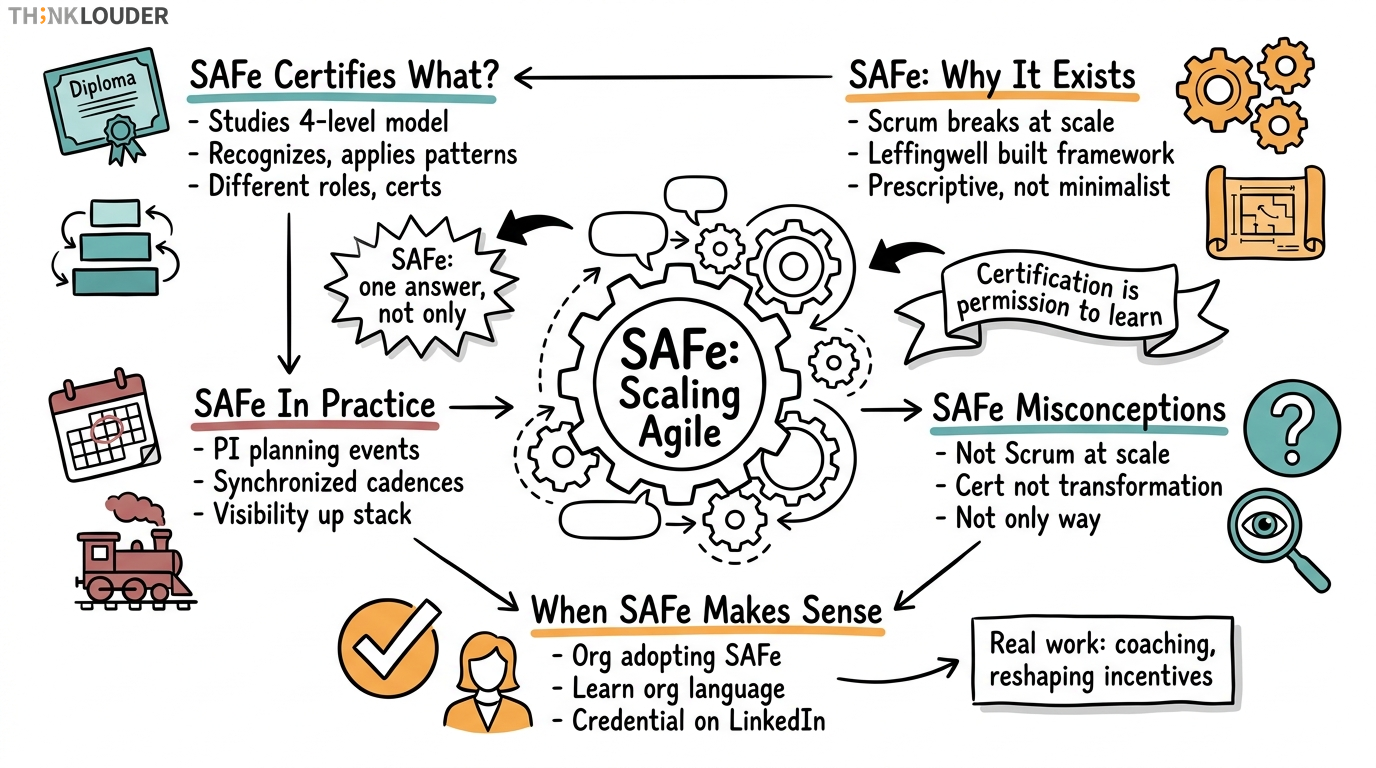
Certification means you understand SAFe's vocabulary and concepts. Transformation is the hard part and takes months or years of coaching, reshaping incentives, and moving decisions closer to the work.
If we're using Scrum, SAFe is just Scrum at a bigger scale.
SAFe uses Scrum as a component but adds layers of program coordination, synchronized planning cycles, and governance that Scrum alone doesn't provide. It's a different operating model, not just Scrum multiplied.
SAFe is the only way to scale Agile. If we're scaling, we need SAFe.
LeSS, Spotify Model, Nexus, and homegrown approaches work for some organizations. SAFe is the most prescriptive and most widely adopted, but not the only path.
I should get SAFe certified before my organization decides whether to adopt it.
Send a small group to a SAFe course first to evaluate fit. Strategy comes before certification. Cert is the tail; deciding if SAFe matches your structure and culture is the head.
SAFe certification is a credential that signals you understand how to scale Agile practices across multiple teams and programs. It's not a Scrum Master cert. It's not a Product Owner cert. It's a framework certification, and that distinction matters on day one.
Let me be direct: SAFe (Scaled Agile Framework) exists because some organizations have 200 people, not 8. When you've got 34 teams across five business units all shipping to the same product, Scrum alone doesn't answer the question of how those teams coordinate, how release planning works across programs, or who owns the roadmap. SAFe is one answer to that problem. Not the only one. But a real one.
What SAFe certification actually certifies
SAFe certification means you've studied a four-level operating model and passed a proctored exam proving you can recognize and apply its patterns. The framework stacks like this: Team level (where Scrum lives), Program level (multiple teams shipping together), Large Solution level (coordinating multiple programs), and Portfolio level (where strategy meets execution).
There are different SAFe credentials depending on your role. A SAFe Agilist (SA) is for coaches and leaders driving SAFe adoption across the organization. A SAFe Practitioner (SP) is for team members and Scrum Masters working inside a SAFe program. A SAFe Product Owner/Product Manager (POPM) is for product leaders. Each one requires a two-day instructor-led course and a passing score on a 90-minute exam.
The prerequisite is usually just showing up to the class. No prior Scrum cert required, though most people taking SAFe already have one. The cost runs $595 to $795 for the course depending on your region and the provider, plus exam fees. That's real money, but it's not a barrier for most organizations serious about scaling.
Where SAFe comes from and why it exists
SAFe was created by Dean Leffingwell in 2011. He'd spent years watching large enterprises try to run Scrum across dozens of teams and watched it fail because Scrum is deliberately silent on how teams coordinate. Scrum says "the team decides." That works great at 8 people. It breaks down at 200.
So Leffingwell built a framework that layers planning cycles, synchronization events, and governance structures on top of Scrum. It's prescriptive. It's not minimalist. It's the opposite of Scrum's "fill in the blanks yourselves" philosophy. And for organizations with hard dependencies between teams, long release cycles, and regulatory requirements, that prescription is a feature, not a bug.
How SAFe shows up in practice
Here's what changes when your organization adopts SAFe. You go from sprint planning happening in isolation to Program Increment (PI) planning: a two-day event where 100 to 150 people from 8 to 12 teams sit in a room and plan their next 10 weeks together. You build dependency maps. You surface conflicts early. Teams commit to shared outcomes, not just individual sprints.
You add a cadence layer: Sprints still happen every two weeks, but they're synchronized. All teams sprint at the same time. All teams demo at the same time. That means if team A's work blocks team B, you know it on day 3, not day 8. You add Agile Release Trains (ARTs): a stable team of teams, usually 5 to 12 teams, with a shared mission and shared release rhythm. Each ART has a Release Train Engineer (RTE), who's like a super-Scrum Master managing dependencies and removing systemic blockers.
You also add visibility. SAFe requires visibility up the stack: executives see portfolio health, business owners see program health, teams see sprint health. That's not inherently bad. But it does mean more reporting, more metrics, more structured communication. If your culture prizes autonomy and minimal process, this feels heavy, right?
What people get wrong about SAFe
First misconception: SAFe is Scrum at scale. It's not. SAFe uses Scrum as a component, but it adds so much structure on top that if you're just looking for "Scrum but bigger," you'll find SAFe over-engineered. The framework assumes you need coordination at the program level, governance at the portfolio level, and synchronized planning. If you don't have those problems, SAFe is overkill.
Second: SAFe certification means you're ready to transform an organization. It doesn't. Certification means you passed a test on SAFe's vocabulary and concepts. Transformation is a different animal. We've trained thousands of SAFe Agilists over the past 15 years, and the ones who succeed are the ones who understand that certification is permission to learn, not proof you've done it. The real work is coaching leaders, reshaping incentives, and moving decision-making closer to the work. That takes months or years, not two days and an exam.
Third: SAFe is the only way to scale Agile. Wrong. LeSS (Large-Scale Scrum), Spotify Model, Nexus, even homegrown approaches work for some organizations. SAFe is the most heavily adopted and the most prescriptive. That makes it easier to implement if you want a blueprint. It also makes it riskier if you blindly follow it without understanding your own context.
When SAFe certification makes sense for your team
If you're a Scrum Master or Agile Coach in an organization with 50+ people shipping software, and leadership has already decided to adopt SAFe, then certification is worth your time. You'll learn the language your organization is speaking. You'll understand the planning cycles and governance structures you'll be working inside. You'll pass the exam and get the credential on your LinkedIn.
If you're an individual contributor or a team lead in a smaller organization, SAFe certification is less critical. Scrum Master certification or CSPO will serve you better. Those credentials are more portable and more fundamental.
If you're an executive or HR manager evaluating whether to invest in SAFe for your organization, don't buy certification first. Send a small group (Scrum Masters, Agile Coaches, maybe one product leader) to a SAFe Agilist course to evaluate whether the framework fits your structure and culture. Then decide if you want to roll it out. Certification is the tail, strategy is the head.
The actual exam and how to prepare
The SAFe exam is 90 minutes, 80 questions, multiple choice. You need 68% to pass. It's proctored online or in person. You get one free retake if you fail, and you can retake it every 30 days after that.
Preparation is straightforward: attend the official two-day course. The course covers all the material on the exam. Read the SAFe reference guide (Leffingwell's book). Take the practice exam on the Scaled Agile website. Most people who attend the course and spend 3 to 4 hours reviewing pass on the first try.
The exam isn't hard if you've done the work. It's not a trick test. It's checking that you understand SAFe's structure, terminology, and core practices. You won't see edge cases or "gotcha" questions. You will see questions like "Which event is used to plan the next PI?" and "What is the primary role of an RTE?" Straightforward.
Maintaining your certification
SAFe certification lasts three years. After that, you need to renew. Renewal requires either retaking the exam or earning 16 Continuing Education Units (CEUs) through approved training, conference attendance, or community involvement. Most people renew by taking an advanced SAFe course (like SAFe for Architects or SAFe DevOps) or by attending a Scaled Agile Summit.
The renewal requirement keeps your credential honest. It's not a one-time badge. It signals ongoing engagement with the framework and the community.
Should you pursue it?
Here's the honest answer: SAFe certification is valuable if your organization is using SAFe or planning to. It's a credential that's recognized in large enterprises, especially in financial services, aerospace, and defense. If you work in those industries or in large organizations with complex dependencies, the cert has real market value.
If you're in a startup, a small-to-medium company, or an organization using Scrum or Kanban without SAFe, CSM or CSPO certification will serve your career better. Those credentials are more portable and more fundamental to Agile practice.
Use your judgment. Talk to people in your organization who've done SAFe training. Ask them if it changed how they work and if they'd recommend it. That conversation will tell you more than any marketing material.
How it works in practice
- 1Attend official two-day instructor-led training
You'll learn SAFe's four-level model, planning cycles, and core practices. The course covers all exam material. Schedule this only after your organization has decided SAFe is the right framework for your scale and structure.
- 2Review the SAFe reference guide and practice exam
Spend 3 to 4 hours studying Leffingwell's book and taking the free practice exam on the Scaled Agile website. This reinforces what you learned in class and surfaces gaps.
- 3Take the proctored 90-minute exam
80 multiple-choice questions, 68% pass rate. You get one free retake. The exam tests vocabulary and core concepts, not edge cases. Most people who attended the course pass on the first try.
- 4Plan for renewal within three years
Renew by retaking the exam or earning 16 CEUs through advanced courses, conference attendance, or community work. The renewal requirement keeps your credential current and signals ongoing engagement.
One short email, every other Friday. Real-world Scrum lessons, no fluff. Unsubscribe anytime.