What people get wrong about this
If I score 70% on a mock exam, I'm not ready for the real test.
A 70% on a practice test weeks before the real exam is feedback, not a prediction. It tells you what to study. Most people score 10-15 points higher on the real exam after targeted study.
I should memorize the answers to as many practice questions as possible.
The real exam has different questions. Memorizing answers doesn't help. Understanding the concepts behind the answers does. That's why mock exams are learning tools, not memory drills.
Any practice test will prepare me for the PMP exam.
Mock exams need to be current (updated for the 2021 PMBOK Guide), have high-quality questions with detailed explanations, and report scores by domain. Old or poorly written tests teach you the wrong things.
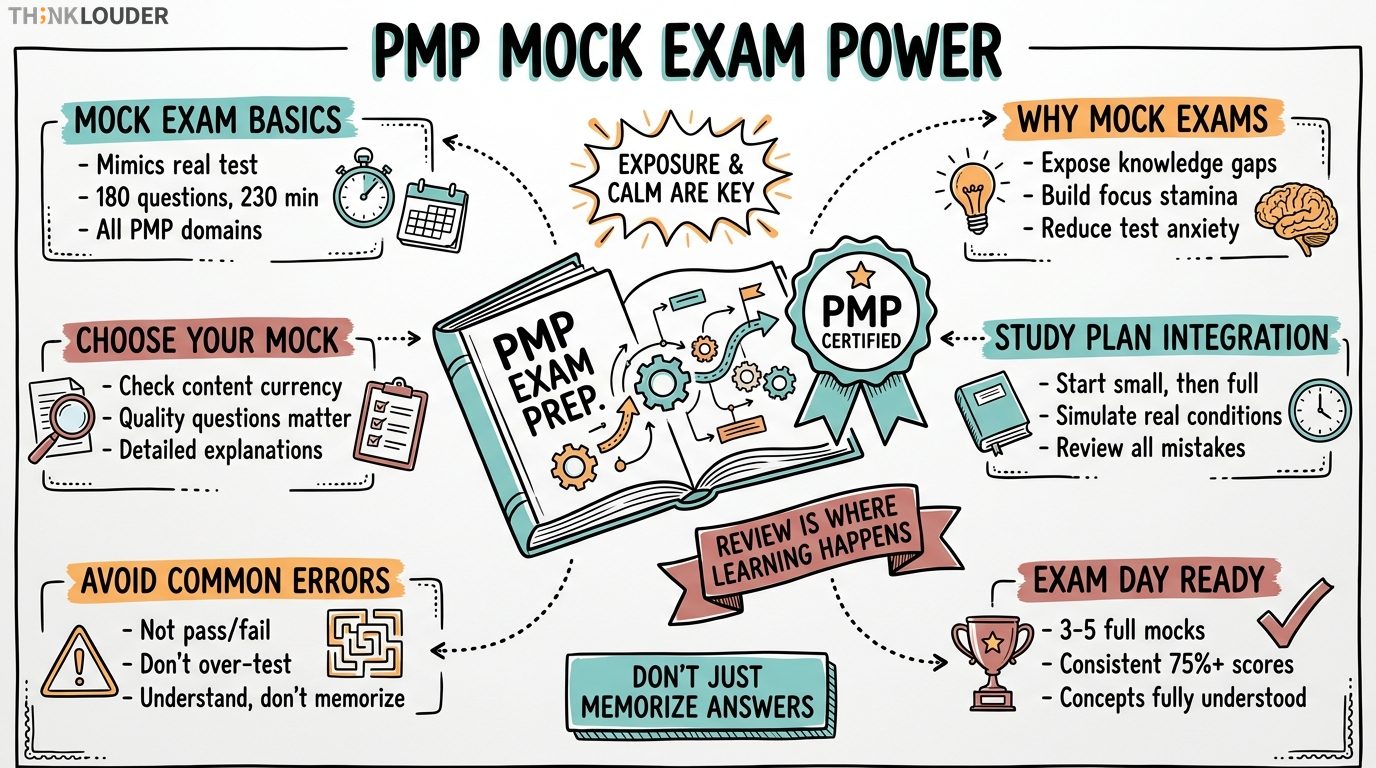
A PMP certification mock exam is a practice test that mimics the real Project Management Professional exam in format, difficulty, and time constraints. You get 180 questions to answer in 230 minutes (three hours and 50 minutes, with two 10-minute breaks built in), just like the actual test. The questions come from the same domains the PMI tests: initiating, planning, executing, monitoring and controlling, and closing a project.
But here's what makes mock exams different from just reading a study guide: they force you to make decisions under pressure. You can't look back at earlier questions. You can't skip ahead and come back. You have to pace yourself. And you have to pick an answer even when you're not 100% sure, which is exactly what happens on exam day.
Why Mock Exams Work
Years ago, we worked with a team of 12 career changers preparing for PMP. Half of them read the PMBOK guide cover to cover. The other half did that plus took mock exams weekly. The mock-exam group passed on their first attempt at an 87% average. The reading-only group passed at 73% on average, and three of them needed a second attempt. The difference wasn't knowledge. It was exposure to the test format and the ability to stay calm when the clock was running.
Mock exams do three concrete things:
They expose gaps in your knowledge. When you miss a question about earned value management or stakeholder engagement, you know exactly what to study next. Reading a textbook doesn't give you that feedback loop. You think you understand something until you get a question wrong and realize you don't.
They build stamina. The real PMP exam is 230 minutes of sustained focus. Your brain gets tired. Your eyes get tired. Mock exams train you for that. If you've only ever studied for 30 minutes at a time, the real exam will feel brutal.
They reduce test anxiety. I'll be honest with you: knowing what to expect matters more than most people admit. When you've seen 500 practice questions, the real questions don't feel like a surprise. You've already seen the patterns. You know how PMI thinks. That confidence is worth a lot on test day.
What to Look For in a Mock Exam
Not all practice tests are created equal. Here's what matters:
Currency. The PMP exam was updated in January 2021 to reflect the latest PMBOK Guide (sixth edition). If you're using a mock exam from 2018, you're practicing for the wrong test. Check the publish date. If it doesn't say when the content was last updated, skip it.
Question quality. Bad practice questions teach you bad habits. A good PMP question has four plausible answers. Three of them are wrong, but they're wrong in ways that test your understanding, not your ability to spot typos. Read a sample question before you buy. If the answers feel obviously wrong, that's not a good indicator of exam readiness.
Detailed explanations. When you get a question wrong, you need to understand why. A good mock exam tells you not just the right answer, but why the other three are wrong. This is how you learn the material, not just memorize it.
Score reporting. You want to see not just your overall score, but your performance by domain. If you're scoring 65% on monitoring and controlling but 85% on initiating, you know where to focus your study time.
Ready to get started? Check out ThinkLouder's PMP preparation options to find a course that includes comprehensive mock exams and instructor feedback.
How to Use Mock Exams in Your Study Plan
Timing matters. Don't take a full mock exam on day one of your study plan. You'll bomb it, and that's demoralizing. Instead, start with smaller practice question sets (20-30 questions) as you work through each domain. Once you've covered all five domains, then take your first full mock exam. That's usually 6-8 weeks into a solid study plan.
After that, take a full mock exam every 1-2 weeks. Space them out. Don't take three in a row. Your brain needs time to absorb what you learned from the first one.
When you take a mock exam, simulate the real conditions. Find a quiet room. Put your phone away. Use the same scratch paper and pen you'll use on exam day (or the equivalent if you're testing at a Pearson VUE center). Take the breaks when the test tells you to take them. This isn't practice, it's rehearsal.
After you finish, don't just look at your score. Spend 30-45 minutes reviewing every question you got wrong. Read the explanation. Look up the concept in the PMBOK Guide or your study materials. Ask yourself: Did I misunderstand the concept, or did I misread the question? Did I run out of time? Was I overthinking it? This reflection is where the real learning happens.
Common Pitfalls
People often treat mock exams as pass-or-fail checkpoints. They take one, see a 72%, panic, and think they're not ready. That's not how this works. A 72% on a practice test six weeks before the real exam is useful information. It tells you what to study. It's not a prediction of failure.
Another mistake: taking too many mock exams without studying in between. If you're taking a new mock exam every day, you're just seeing the same questions again and again (or questions from the same pool). Your score goes up, but your understanding doesn't. You're gaming the system, not preparing for the exam.
One more: focusing only on getting the right answer instead of understanding why it's right. You can memorize that the answer to question 47 is "C" and still fail the real exam because the real exam has different questions. Mock exams are a learning tool, not a memorization exercise.
What to Do When You're Ready
Most people take 3-5 full mock exams before they sit for the real PMP exam. If you're consistently scoring 75% or higher across multiple exams, and you understand the concepts behind your answers, you're ready. If you're scoring 70-74%, you're close, keep studying. Below 70%, give yourself more time.
Want structured guidance? Explore ThinkLouder's PMP certification courses taught by PMI-Approved trainers who know exactly what the exam tests and how to prepare for it. Our students average 82% on their first attempt, and that's because we build mock exams into the entire learning process, not just at the end.
How it works in practice
- 1Start with domain-specific practice questions
As you study each of the five PMP domains, take 20-30 practice questions on that domain. This gives you feedback early without overwhelming you with a full 180-question exam.
- 2Take your first full mock exam after 6-8 weeks
Once you've covered all five domains in your study materials, sit for a complete 230-minute mock exam under real test conditions. This is your baseline.
- 3Review every wrong answer in detail
Spend 30-45 minutes after each mock exam reviewing questions you missed. Read the explanation, look up the concept in the PMBOK Guide, and identify whether you misunderstood the concept or misread the question.
- 4Take another full mock exam every 1-2 weeks
Space out your mock exams so you have time to study between them. Taking three in a row doesn't help; you're just seeing similar questions without learning.
- 5Track your performance by domain
Use the score reporting to identify weak areas. If you're consistently scoring lower on monitoring and controlling, focus your study time there.
- 6Schedule the real exam when you hit 75%+ consistently
Once you score 75% or higher on multiple mock exams and understand the concepts behind your answers, you're ready. Most people take 3-5 full mocks before they're ready to sit for the real exam.
One short email, every other Friday. Real-world Scrum lessons, no fluff. Unsubscribe anytime.