What people get wrong about this
PMP is a Scrum credential, like CSM or CSPO.
PMP is awarded by PMI and tests traditional project management. Scrum certifications come from Scrum Alliance. They're different organizations, different exams, different renewal paths. Don't mix them up.
I just need to take the course and pass the exam.
You have to prove you already have 36 months (or 60 months without a degree) of actual project leadership experience before you even apply. The 35-hour course is a requirement, but it doesn't count toward your experience. You need both.
Once I get PMP, I'm done.
PMP expires every three years. You renew by earning 60 PDUs and paying a fee to PMI. If you don't renew, your certification lapses and you have to retake the exam to get it back.
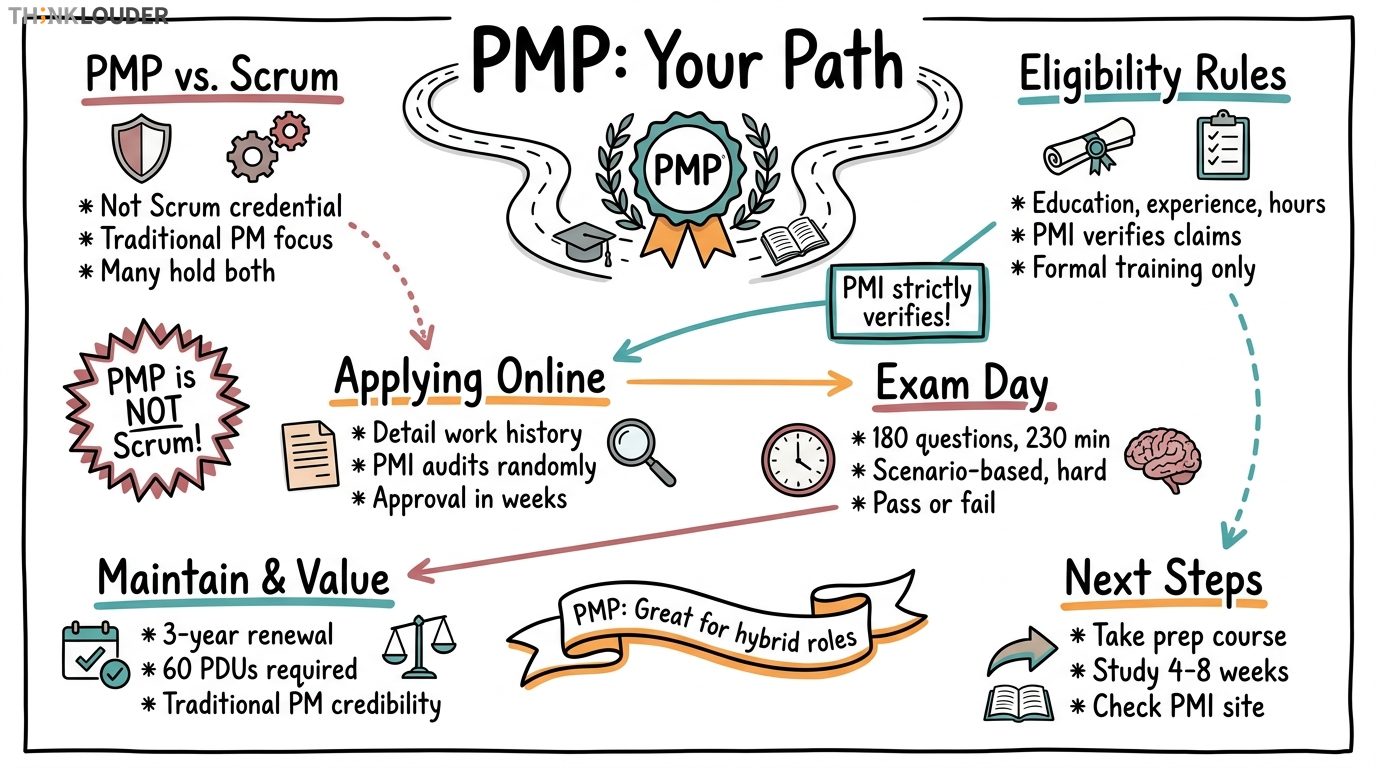
The Project Management Professional (PMP) certification is awarded by the Project Management Institute (PMI), and it's not a Scrum credential. If you're a Scrum Master or Product Owner considering it, just know upfront: PMP is a different track entirely, aimed at traditional project managers rather than Agile practitioners. That said, plenty of people hold both, and understanding the eligibility criteria matters if you're thinking about adding it to your profile.
What You Actually Need: The Three Requirements
PMP eligibility comes down to three things: your education level, your project management experience, and your formal training hours. PMI is strict about this, and they verify claims during the application process.
If you hold a bachelor's degree, you need 36 months of project leadership experience where you were actively leading and directing projects. No "helped out on a project" — you had to be the person responsible for outcomes. If you don't have a bachelor's degree, that requirement jumps to 60 months. Either way, you also need 35 contact hours of formal project management education before you sit for the exam. That's classroom time, instructor-led workshops, or accredited online courses. Self-study books don't count.
Just to adjust the language a little bit. When PMI says "project leadership experience," they mean hands-on directing of project tasks, scope, schedule, and budget. They're looking for evidence that you've managed real constraints and delivered results under pressure, not that you attended project meetings or coordinated calendars.
What the Application Actually Asks
When you apply through PMI's portal, you'll list your work history and project experience in detail. They want dates, project names, team sizes, budgets, and your specific role. You'll also declare your 35 contact hours of formal PM education, with course names and providers. PMI audits applications at random, and if they audit yours, you'll need to provide documentation: transcripts, course certificates, letters from managers or HR confirming your role and dates. It's not casual.
After you submit, PMI reviews your application. Most people get approved within a few weeks. Some get flagged for additional documentation if the experience description is vague or the timeline doesn't add up. Once approved, you get an exam eligibility notice and a window to schedule your test.
The Exam Itself
You'll take 180 questions over 230 minutes (3 hours and 50 minutes), with two 10-minute breaks built in. The questions are scenario-based and test your knowledge of project integration, scope, schedule, cost, quality, resource, communications, risk, procurement, and stakeholder management. It's comprehensive and it's hard. Most people study for 2 to 4 months before sitting.
You need to pass once. There's no partial credit or retake strategy that matters: you either pass or you don't. Your score is reported as Proficient, Proficient with Exceeding, or Below Proficient.
Keeping Your PMP Active
PMP certification lasts three years. After that, you renew by earning 60 Professional Development Units (PDUs) over those three years and paying a renewal fee to PMI. PDUs come from training, conferences, volunteering in project management roles, publishing, or teaching. You don't have to retake the exam, but you do have to show that you're staying current in the field.
Here's the honest part: the PMP is a credential that signals you understand traditional project management frameworks and have real-world experience. It's respected in construction, manufacturing, government contracting, and large enterprises where waterfall or hybrid approaches still dominate. If you're working in a pure Scrum or Agile environment, your Certified Scrum Master (CSM) or Certified Scrum Product Owner (CSPO) credential carries more weight day-to-day. But if you're moving between Agile and traditional PM roles, or if your organization values both, PMP adds credibility.
One more thing: don't confuse PMP with Scrum Alliance certifications. They're run by different organizations, they test different bodies of knowledge, and they require different renewal paths. PMP is PMI's credential. Scrum certifications come from Scrum Alliance, and the eligibility rules are different (usually just a class and an exam, no prior experience requirement for CSM). If you're unsure which fits your career, talk to your manager or an Agile coach about what your organization values.
If you're already deep in Scrum and Agile, PMP is a "nice to have." If you're transitioning into project management from another field, or if your company requires it for certain roles, it's worth the investment. The 35 contact hours of formal education is the real time commitment. The experience requirement just documents what you've already done.
Next Steps
If you meet the eligibility criteria and want to pursue PMP, start by taking a PMI-Approved 35-hour prep course. ThinkLouder offers PMP certification training taught by PMI-Approved instructors who'll walk you through the exam structure, the knowledge areas, and the kinds of scenarios PMI tests. You'll also get study materials and practice exams. After the course, most people study on their own for another 4 to 8 weeks before sitting for the exam.
Check PMI's website for the current exam fee and application deadlines. Application windows can close, so don't wait too long once you've confirmed you meet the requirements. If you're transitioning from Scrum to traditional PM, understanding both credential paths upfront saves time and money.
How it works in practice
- 1Confirm your education and experience level
Check whether you hold a bachelor's degree. If yes, you need 36 months of project leadership experience. If no, you need 60 months. Count only time where you actively led and directed projects, not time spent supporting them.
- 2Complete 35 contact hours of formal PM education
Enroll in a PMI-Approved 35-hour course (instructor-led or accredited online). Self-study and books don't count. Keep your certificate or completion letter for your application.
- 3Gather documentation of your project experience
Write down your work history with project names, dates, team sizes, budgets, and your specific role. Be specific about what you directed and delivered. Have this ready before you apply.
- 4Submit your PMI application
Go to PMI's website, create an account, and complete the PMP application form. List your education, experience, and formal training. Submit and wait for approval (typically 2 to 4 weeks).
- 5Study and schedule your exam
Once approved, you'll get an exam eligibility notice. Use the 2 to 4 months before your test date to study the 10 knowledge areas and practice scenarios. Schedule your exam through PMI's testing partner.
- 6Take the 180-question exam
Show up with your ID, take 230 minutes (with two 10-minute breaks), and answer scenario-based questions on project management frameworks. Pass or fail is reported within a few days.
- 7Plan your three-year renewal cycle
Once certified, track your PDU progress over the next three years. Earn 60 PDUs through training, conferences, volunteering, or teaching. Renew your certificate and pay the renewal fee before expiration.
One short email, every other Friday. Real-world Scrum lessons, no fluff. Unsubscribe anytime.