What people get wrong about this
PMP training is the biggest cost, so I should find the cheapest option.
Training is one piece. The exam fee, study materials, and travel add up fast. A cheap course you fail costs more than an expensive one you pass on the first attempt. Optimize for pass rate, not price.
Once I pay for training and pass the exam, I'm done.
PMP renewal costs $60 every 3 years plus 60 PDUs (Professional Development Units) to maintain your credential. Budget for ongoing renewal activities, not just the upfront cert.
Everyone pays the same amount for PMP certification.
Total cost depends on whether your employer sponsors training, if you need travel, which training format you choose, and whether you pass on the first attempt. Range is $1,500 to $3,500+, not a fixed number.
What You're Actually Paying For
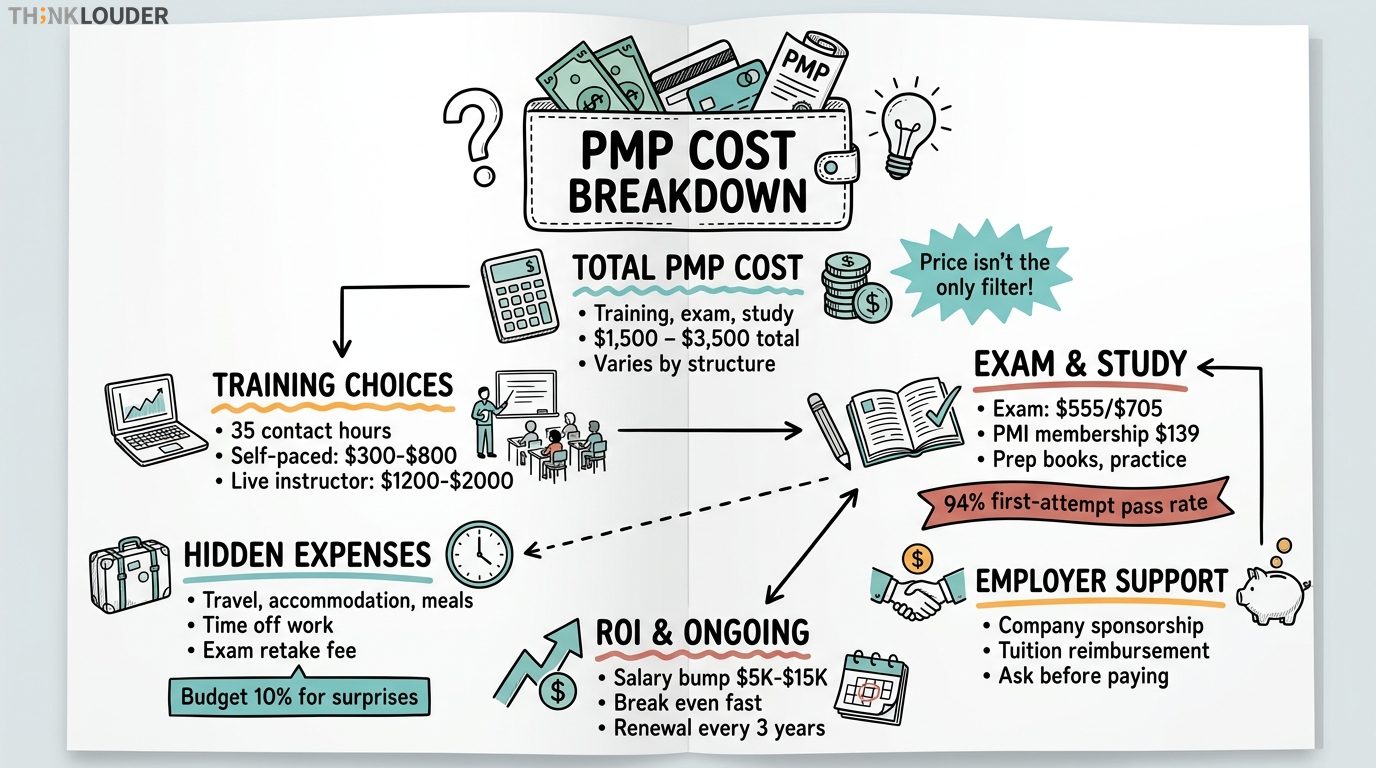
PMP certification isn't one line item. It's training, exam registration, study materials, and often time away from work or travel. Most people land somewhere between $1,500 and $3,500 total, but that range hides a lot of variation depending on how you structure it.
The PMI exam itself costs $555 for PMI members and $705 for non-members (as of 2024). That's the floor. Everything else stacks on top.
Training: The Biggest Variable
You need 35 contact hours of formal project management education before you're even eligible to sit the exam. That's a PMI requirement, not optional. How you get those 35 hours changes the cost picture dramatically.
Online self-paced training typically runs $300 to $800. You work through videos and materials on your own schedule, which is cheap and flexible but requires serious discipline. Most people underestimate how much self-direction you need here.
Live instructor-led training, whether in-person or virtual, usually costs $1,200 to $2,000 for the full 35 hours. You get a trainer answering questions in real time, peer interaction, and structured pacing. That matters if you're the kind of learner who needs accountability. ThinkLouder's PMP training programs run at the higher end of that range because we use PMI-Approved Instructors with real project leadership experience, not just certification coaches.
Bootcamp-style intensive courses compress everything into 3 to 5 days and cost $1,500 to $3,000. They're brutal but fast, and they work well if you've already got strong project management fundamentals.
Exam Registration and Study Materials
Once you've logged your 35 hours, you register with PMI and pay the exam fee. Non-members pay $705; members pay $555. If you're not a member yet, PMI membership costs around $139 for your first year. So if you're new to PMI, add that too.
Then there's study material beyond your training course. Exam prep books run $30 to $60. Practice exams (and you should do multiple) cost $50 to $150 each. Some people buy 2 or 3 practice tests to build confidence. A few premium study platforms bundle everything and cost $200 to $400 total.
None of this is mandatory if your training provider includes it, but most don't include premium practice tests or supplemental books.
The Hidden Costs Nobody Mentions
If you're taking in-person training, travel and accommodation add up fast. A 3-day bootcamp in a major city plus hotel and meals can easily add $800 to $1,500 depending on where you live and where the training is.
Time off work is real too. Even if your employer pays for training, you're losing productivity for 3 to 5 days (or several evenings and weekends if you're doing part-time). Some employers cover training costs outright; others expect you to absorb it. Check before you commit.
If you fail the exam on your first attempt, you pay $555 or $705 again to retake it. Most people pass on the first try, but it happens. Budget for the possibility.
What Employers Actually Cover
Large organizations often sponsor PMP training for managers and senior individual contributors. If your company has a tuition reimbursement program, you might get $1,000 to $2,500 back after you pass. Some companies pre-pay training as part of leadership development.
Smaller companies rarely sponsor it. If you're self-employed or freelance, you're paying entirely out of pocket, though you can usually deduct training costs as a business expense.
The move here is to ask before you pay. If your employer has a certification budget, use it. If not, check whether you can claim it on your taxes (talk to an accountant, not me).
Comparing Training Providers
Price alone is a terrible filter. A $300 online course that you never finish costs more than a $2,000 instructor-led program you actually pass on the first attempt.
What matters: Does the provider have PMI-Approved Instructors? Do they include practice exams? What's their first-attempt pass rate? ThinkLouder's students have a 94% first-attempt pass rate, which means fewer people paying to retake the exam. That's worth more than saving $300 on cheap training.
Ask for references. Call someone who took the course. Real practitioners will tell you whether the instructor was worth the time.
The ROI Calculation
A PMP typically adds $5,000 to $15,000 to annual salary depending on role, industry, and geography. If you're in tech or defense contracting, the bump is bigger. If you're in a smaller market, it's smaller.
So if you spend $2,500 on training and exam, and you get a $7,500 raise, that's a 3x return in year one. You break even in the first 4 months of the new job.
That math only works if you actually use the credential to move into a PMP-required role. If you're just checking a box, the ROI is zero.
Renewal: The Ongoing Cost
PMP doesn't end after you pass. You need to renew every 3 years. Renewal costs $60 to renew your certification plus 60 PDUs (Professional Development Units) to maintain it. You earn PDUs through training, conference attendance, or teaching others. Most people spend $200 to $500 every 3 years on renewal activities.
That's not a one-time cost. Budget for it.
How to Build Your Budget
Start with the non-negotiables: $555 to $705 for the exam, $35 to $139 for PMI membership if you're new, and 35 hours of training. That's your baseline.
Then add what fits your situation. Are you traveling? Add $500 to $1,500. Do you need premium study materials? Add $150 to $300. Does your employer reimburse? Subtract whatever they cover.
Most people should budget $1,500 to $2,500 if they're doing virtual instructor-led training with their current employer paying for travel. If you're paying for everything yourself and need in-person training, budget $2,500 to $3,500.
Then add 10% for things you didn't anticipate. You always find something.
Where to Start
If you're serious about PMP, start by checking whether your employer sponsors training. If they do, take the best option they offer, not the cheapest. If they don't, get a quote from an approved training provider and compare what's included.
Don't optimize for price. Optimize for pass rate and time to value. A $2,000 course you pass on the first attempt costs less than a $1,200 course you have to retake.
How it works in practice
- 1Check employer sponsorship first
Ask whether your company covers training costs or has a tuition reimbursement program. If they do, use it before paying out of pocket. This is often the single biggest cost lever.
- 2Choose your training format
Decide between online self-paced ($300–$800), live instructor-led ($1,200–$2,000), or bootcamp ($1,500–$3,000). Factor in travel costs and your learning style. Instructor-led typically has higher first-attempt pass rates.
- 3Get PMI membership and register for exam
Join PMI ($139 first year) and register for the exam ($555 members, $705 non-members). You need 35 contact hours of training logged before exam eligibility, so don't register until you've completed training.
- 4Budget for study materials
Add $150–$400 for practice exams and supplemental study guides if they're not included in your training. Multiple practice tests improve first-attempt pass rates significantly.
- 5Account for hidden costs
If in-person training is required, add $500–$1,500 for travel and accommodation. If you're taking time off work, factor in lost income or use vacation days strategically.
- 6Plan for renewal
After passing, budget $200–$500 every 3 years for renewal fees and PDU activities (conferences, courses, teaching). This is an ongoing cost, not one-time.
One short email, every other Friday. Real-world Scrum lessons, no fluff. Unsubscribe anytime.