What people get wrong about this
If I don't hear from PMI in 2 weeks, something's wrong with my application.
6 weeks is the normal window. PMI processes applications in batches and reviews experience claims carefully. Hearing back in 2 to 3 weeks is fast, not standard. Most approvals land between week 3 and week 6.
The 6-week wait means PMI is just filing paperwork and rubber-stamping applications.
PMI is verifying your project management experience against their eligibility requirements. They're auditing your claims, checking for gaps or inconsistencies, and sometimes requesting additional documentation. It's a real vetting process.
Once I'm approved, I have unlimited time to schedule and take the exam.
Your authorization letter gives you a 1-year window to sit for the exam. After that year, you'd need to reapply and go through the process again. Most candidates test within weeks of approval, not months.
If PMI asks for more information, I probably won't get approved.
Requests for clarification are normal and don't signal rejection. PMI just needs you to fill in a gap or explain something that wasn't clear on your initial application. Respond thoroughly and you'll move forward.
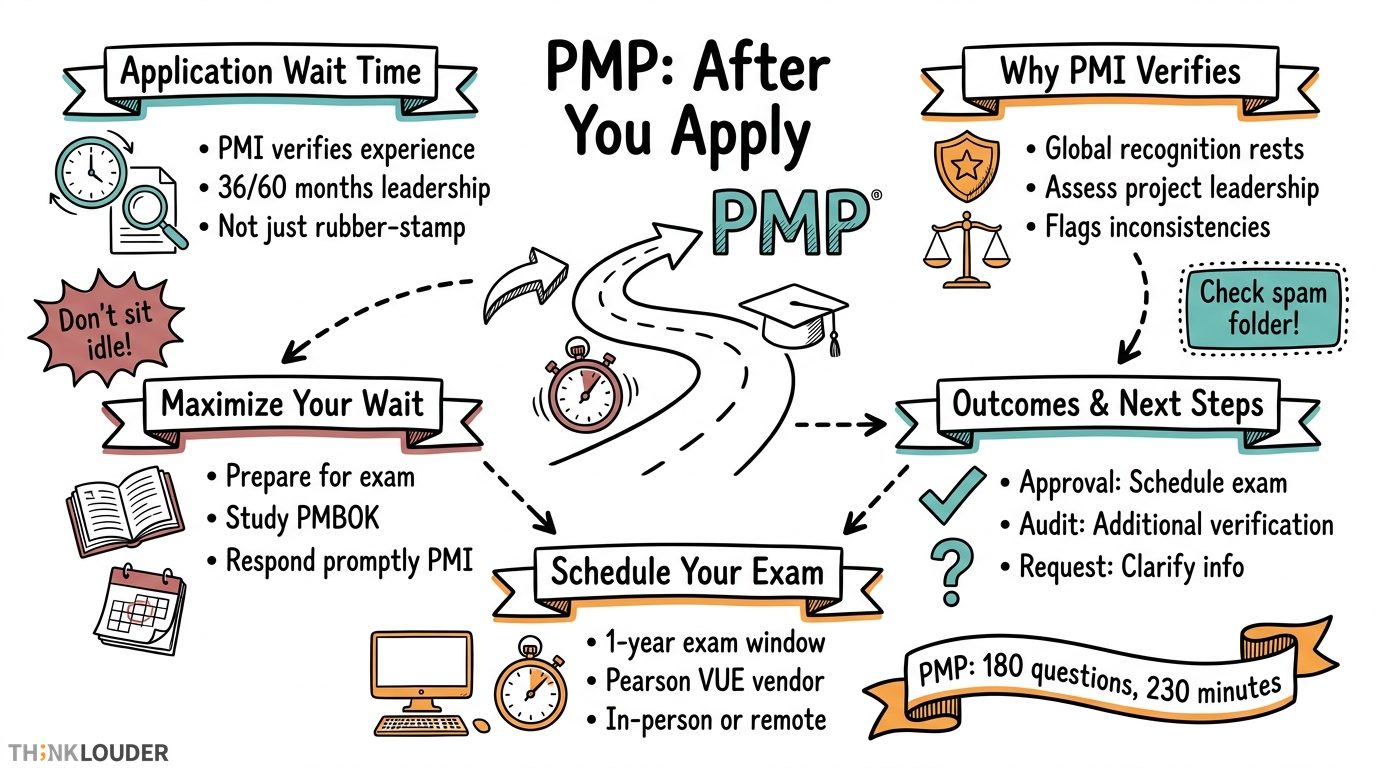
You've hit submit on your PMP application. Now what? The clock starts, and you're waiting to hear from PMI (Project Management Institute). Most candidates get contacted within 6 weeks, but here's what that timeline actually covers: PMI isn't just rubber-stamping your form. They're auditing your project management experience against their eligibility requirements.
To qualify for the PMP, you need either 36 months of project leadership experience (if you hold a bachelor's degree) or 60 months without one. PMI's job during those 6 weeks is to verify that what you claimed on your application holds up. They'll look at your work history, your role descriptions, and sometimes they'll request documentation or clarification. It's not bureaucratic theater. They're protecting the credential's integrity.
Here's the practical reality: not every application takes the full 6 weeks. Some sail through in 2 to 3 weeks if your background is straightforward and your application is clean. Others hit a snag, and PMI reaches out asking for more details about a specific project or role. That's when the clock can stretch.
Why PMI Needs This Time
The PMP is one of the most widely recognized project management certifications globally. That reputation rests on PMI maintaining a real bar for entry. They're not just counting months on a resume, they're assessing whether your experience actually involved the kind of project leadership the credential demands.
When you apply, you're listing projects you've led, the team sizes, the budgets, the methodologies you used. PMI reviewers cross-check your claims against what's typical for your stated role and industry. If you were a junior coordinator claiming to have led a 200-person waterfall transformation, that flags for review. If your timeline shows overlapping full-time roles that don't add up, that gets a second look. This vetting process is what takes time.
Some applications sail through because the experience is clear and well-documented. Others require PMI to ask follow-up questions. You might get an email asking you to clarify a project duration, provide a manager's contact info, or explain how your role in a matrix environment qualified as "project leadership." When that happens, you've got a window, usually 5 to 7 days, to respond. Then PMI reviews your answer, and the clock ticks again.
What You Should Do During the Wait
Don't just sit idle. This is the time to prepare for the actual exam, because once PMI approves your application, you'll get an authorization letter. That letter gives you a 1-year window to schedule and take the exam. The PMP exam is 180 questions delivered over 230 minutes (3 hours 50 minutes), with two scheduled 10-minute breaks. That's a marathon.
Use these 6 weeks to study. Grab a prep course or study guide, work through practice exams, and get familiar with the PMBOK (Project Management Body of Knowledge) framework. The exam tests your knowledge of five process groups (Initiating, Planning, Executing, Monitoring & Controlling, Closing) and ten knowledge areas. You'll need to understand how those fit together, not just memorize definitions.
If you haven't already, explore what PMP training looks like and whether you want instructor-led or self-paced prep. Our PMI-Approved trainers have guided thousands of candidates through this exact phase. Many candidates find that structured prep during the waiting period means they're ready to test within weeks of getting their authorization letter, not months.
Also, if PMI does reach out asking for clarification, respond promptly and thoroughly. Don't give one-word answers. If they ask about a project you led, give them context: the scope, your specific role, the team size, the outcome. The more clearly you document your experience, the faster they can make a decision.
What Happens After 6 Weeks
In most cases, you'll get one of three outcomes:
Approval. PMI sends you an authorization letter (sometimes called an eligibility letter). You're cleared to take the exam. You'll get a unique exam code and instructions on how to schedule your test with Pearson VUE, the testing vendor. From that point, you've got a 1-year window to sit for the exam.
Audit. Less common, but it happens. PMI randomly audits a percentage of applications for additional verification. They might ask for documentation from your employer, project artifacts, or manager confirmation. This doesn't mean you're in trouble, it just means they're doing their due diligence. Respond honestly and thoroughly, and you'll move forward.
Request for Additional Information. PMI identifies a gap or inconsistency in your application. They'll email you specific questions. Answer them directly and send any supporting docs they ask for. Once they receive your response, they'll make a decision, usually within another 5 to 7 business days.
If you don't hear anything after 6 weeks, that's unusual. Check your spam folder first (PMI emails sometimes get flagged). If nothing's there, you can log into your PMI account to check your application status, or contact PMI's candidate services directly. They're responsive.
The Next Step: Scheduling Your Exam
Once you're approved, you'll schedule your exam with Pearson VUE. You can test in-person at a testing center or remotely from home, though remote testing has stricter proctoring requirements. Most candidates test within 2 to 4 weeks of receiving their authorization letter, though you can wait longer if you need more prep time.
One thing to know: the PMP exam isn't adaptive like some other tests. You'll see all 180 questions regardless of how you perform. There's no "if you get this wrong, the next question gets harder." You move through at your own pace, and you'll have time to review and adjust answers before you submit. The passing score is around 70 percent, though PMI doesn't publish the exact cut score publicly.
After you pass, PMI will send you your official certificate, and you're a PMP. You'll need to renew every three years by earning 60 PDUs (Professional Development Units) and paying a renewal fee to PMI. But that's a different conversation.
Why This Matters for Your Career
The wait can feel long, I get it. But those 6 weeks are PMI's way of making sure the credential actually means something. When you're a PMP, your employer and your peers know you've cleared a real bar, not just filled out a form. That's why the PMP is valued across industries, from construction to tech to healthcare.
If you're a team lead or manager considering the PMP, this is the time to start. Get your application in, use the waiting period to study, and you could be testing within 2 months of approval. If you're an HR manager or executive thinking about sponsoring team members for the PMP, understand that the 6-week window is real and normal. Plan your team's development timeline accordingly.
Need help mapping out your PMP path? Check out our PMP certification training options and talk through whether now is the right time for your team.
How it works in practice
- 1Submit your application and gather documentation
Complete your PMP application with accurate project details, role descriptions, and leadership experience. Have any supporting docs (job descriptions, project summaries, manager contact info) ready in case PMI asks for clarification.
- 2Wait for PMI's eligibility review (up to 6 weeks)
PMI audits your experience against the 36-month (bachelor's) or 60-month (no bachelor's) requirement. Most approvals come within 3 to 6 weeks. Check your email (including spam) and your PMI account for updates.
- 3Respond promptly if PMI requests additional information
If PMI asks for clarification, respond within the timeframe they provide (usually 5 to 7 days). Be specific and thorough. Vague answers delay the decision.
- 4Receive your authorization letter and begin exam prep
Once approved, you'll get an eligibility letter with your exam code. Use this time to study the PMBOK framework, work through practice exams, and get comfortable with the 180-question, 230-minute exam format.
- 5Schedule your exam with Pearson VUE
Log into your PMI account, find your exam code, and schedule with Pearson VUE. You can test in-person or remotely. Most candidates test within 2 to 4 weeks of receiving their authorization letter.
- 6Take the exam and pass
You'll see all 180 questions at your own pace over 3 hours 50 minutes (with two 10-minute breaks). Passing is roughly 70 percent. Once you pass, PMI mails your official certificate.
One short email, every other Friday. Real-world Scrum lessons, no fluff. Unsubscribe anytime.