What a Scrum Master Actually Does
Years ago we had 34 teams across a financial services company, and the Scrum Masters were drowning. Not because they had too many teams (they had three or four each, which is standard), but because no one in the organization understood what the role was for. Product Owners thought Scrum Masters were project managers. Developers thought they were status-report collectors. Leadership thought they were the people who "made Agile work."
The Scrum Master is none of those things.
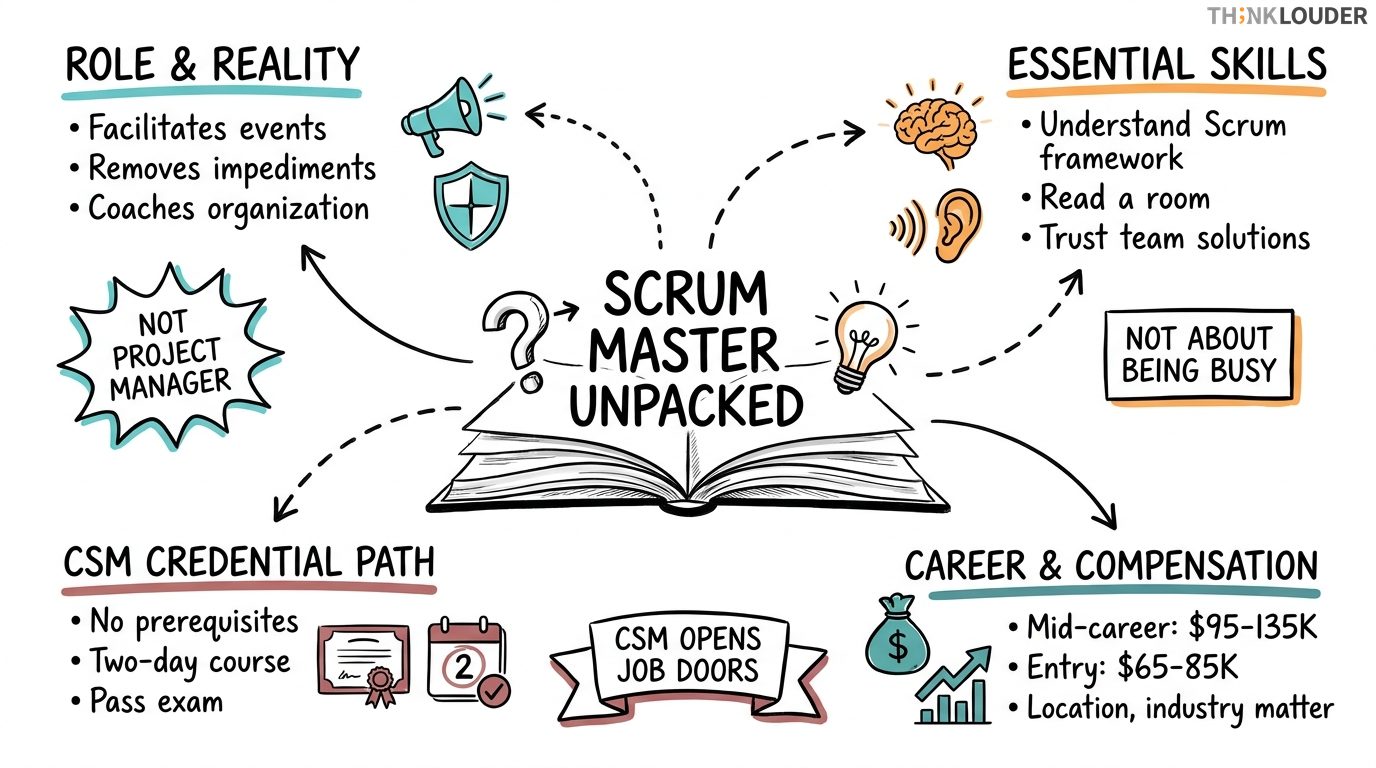
A Scrum Master facilitates the Scrum events (Sprint Planning, Daily Standup, Sprint Review, Retrospective), removes impediments that block the team's work, and coaches the organization on Scrum. That's it. Not bigger. Not smaller. The role exists so the three accountabilities in Scrum (Product Owner, Developers, and Scrum Master) can do their actual work without meetings about meetings or process friction eating the day.
Your day-to-day looks like this: You run Sprint Planning on Monday morning, making sure the team understands the stories they're pulling in and that the work fits the sprint. You facilitate the Daily Standup, which should take 15 minutes and surface blockers, not become a status report. You work with developers who are stuck: a story is unclear, a dependency landed on them unexpectedly, a tool broke. You coach your Product Owner on how to write acceptance criteria that start a conversation, not end one. You hold a Retrospective every two weeks where the team actually talks about what's working and what isn't, and you make sure one or two small changes actually happen next sprint.
Then there's the impediment work. Your developer can't get access to the database server. Your Product Owner is getting pressured by stakeholders to add scope mid-sprint. Your team is in three different time zones and the Standup is at 6 a.m. for someone. You remove friction. You escalate when you need to. You don't solve everything yourself, you coach the team to solve it.
The mistake most new Scrum Masters make is thinking the role is about being busy. It's not. A healthy Scrum Master in a healthy team spends maybe 60% of their time in Scrum events and coaching, and the rest on one or two longer-term things: working with leadership on how to structure work, helping another team, or learning something deeper about how the organization works.
Skills You Actually Need
You don't need to be a technical person. You don't need to have been a developer or a project manager. You need three things.
First: You understand Scrum. Not just the mechanics, you know why the events exist, what they're supposed to produce, and what healthy looks like. That's what the Certified Scrum Master (CSM) certification teaches you. It's not a rubber-stamp credential. It's a two-day workshop where you learn the framework, practice facilitating, and sit an exam. Most people study 20–30 hours before they take it. The certification costs around $349 for the course plus exam.
Second: You can read a room. Facilitation is the core skill. You notice when someone's quiet because they disagree and when they're quiet because they're checked out. You know when to ask a follow-up question and when to move on. You can run a retrospective where people actually say what they think, not what they think the Scrum Master wants to hear. This isn't something you learn in a course, it's something you practice. But a good CSM course teaches you the patterns and gives you a safe place to try them.
Third: You believe the team can solve the problem. The worst Scrum Masters are the ones who think their job is to have all the answers. The best ones ask questions, remove what's in the way, and let the team figure it out. That mindset matters more than any skill you can list.
How to Get the Credential
The CSM is the entry point. Here's what it takes:
- Prerequisite: None. You don't need Agile experience. You don't need a tech background. You don't need to have worked in software.
- Time: Two days in class (either in-person or virtual), plus 20–30 hours of self-study before and after. Most people spend a week total.
- Cost: Around $349 for the course and exam through a Scrum Alliance Licensed Training Provider like ThinkLouder. The exam itself is $150 if you take it separately.
- The exam: 60 questions, 90 minutes, 74% pass rate. It's open-book. You're testing whether you understand the framework and can apply it, not whether you memorized definitions.
- After you pass: You get a three-year CSM credential. Before it expires, you can renew it by earning 20 Scrum Education Units (SEUs), basically by taking more courses, attending conferences, or writing articles about Scrum.
That's the floor. From there, you can get the Advanced Certified Scrum Master (A-CSM) after two years of Scrum Master experience, which goes deeper into coaching and organizational dynamics. You can get certified as an Agile Coach. You can specialize in specific industries or frameworks.
But the CSM is where you start, and it's the credential that opens the door to the job market.
Salary and Job Outlook
Let's be specific about money.
A mid-career Scrum Master in the US makes between $95K and $135K annually. Entry-level (first year, or with CSM but no team experience) starts around $65K–$85K. Senior Scrum Masters, Agile Coaches, or those managing multiple teams or leading transformation work can hit $140K–$180K.
The range depends on three things: location, industry, and whether you have other credentials or experience.
Location matters. San Francisco, New York, and Boston pay 20–30% more than the national average. Remote roles have compressed the gap somewhat, but coastal tech hubs still command premiums. The Midwest and South generally pay 15–20% less than the coasts.
Industry matters. Financial services, healthcare, and tech pay more than nonprofits or government. A Scrum Master at a FAANG company will earn more than one at a mid-size retailer.
Credentials matter. A CSM alone gets you in the door. A CSM plus a CSPO (Certified Scrum Product Owner) credential, or a CSM plus five years of team leadership experience, bumps you up. A Certified Agile Coach credential (which requires a CSM plus 10,000 hours of coaching experience) puts you in a different tier entirely.
On the job market side: there are approximately 14,000–16,000 open Scrum Master roles on LinkedIn and Indeed on any given day. The demand has held steady for the last three years. It's not growing explosively, but it's not shrinking either. Most of that demand is concentrated in tech, financial services, and healthcare. Government and large enterprises are also steady employers.
Other Agile roles for comparison: Product Owners typically earn $100K–$150K at mid-career. Agile Coaches earn $110K–$160K. Traditional Project Managers (non-Agile) earn $85K–$125K. The Scrum Master role sits in the middle of that spectrum.
Career Paths from Here
Scrum Master is not a dead-end role, but it's not a ladder to VP either. Here's what actually happens.
Path 1: Specialist depth. You stay a Scrum Master, but you get really good at it. You work with bigger teams, more complex domains, or multiple teams. You get the A-CSM, then the Agile Coach credential. You might specialize: coaching Scrum Masters, working on organizational transformation, or leading Agile adoption in a specific industry. Your pay goes up, your impact grows, and you stay in the Scrum Master ecosystem. ThinkLouder has trained 55,000+ practitioners since 2015, and a good chunk of them followed this path. You can build a whole career here.
Path 2: Leadership. You move into a team lead, engineering manager, or program manager role. Your Scrum Master experience makes you a better leader, you understand how to coach, how to facilitate, and how to remove friction. You leave the Scrum Master title behind, but the skills stick with you. This is common in tech companies where the Scrum Master role is a stepping stone to management.
Path 3: Consulting. You become an independent Agile consultant or join a firm like ThinkLouder. You work with organizations on transformation, coach their Scrum Masters, run trainings. The CSM is your credential; the real asset is your experience. This path pays well but requires you to build a reputation and network.
Path 4: Hybrid. You stay in your current organization but expand your scope. You move from one team to three teams, then to an Agile Coach role where you work across the organization. You might manage other Scrum Masters. You're still doing Scrum work, but you're also doing organizational work. Your title changes, but you're still in the Scrum ecosystem.
The key: none of these paths require you to leave the Scrum Master role if you don't want to. The role has depth. The question is whether you want to go deeper, move sideways into leadership, or build something else.
Common Misconceptions
Just to adjust the language a little bit. We don't say the Scrum Master is a "project manager." The difference matters because project managers own the outcome. Scrum Masters don't own the outcome, the team does. The Scrum Master owns the process and removes what's in the way of the team owning the outcome. It's a different accountability.
We also don't say the Scrum Master "manages the team." They facilitate for the team. They coach. They don't assign work or approve decisions. The team is self-managing within the boundaries of the sprint.
And here's one that trips people up: the Scrum Master doesn't write the stories or manage the backlog. That's the Product Owner's job. The Scrum Master makes sure the backlog is ready to be refined, makes sure the team understands the stories, and coaches the Product Owner on how to write them. But the Product Owner owns the backlog. (For more on this, see how to run backlog refinement that actually produces clarity.)
One more: the Scrum Master isn't the person who "makes Agile work" in the organization. Scrum works if the team does the work, the Product Owner does the prioritization, and leadership gives them the space and resources. The Scrum Master facilitates the framework. If the organization isn't ready for Agile, no Scrum Master can fix that alone.
Next Steps
If you're considering the role, here's what to do next.
First, shadow a Scrum Master for a day or two if you can. See what the work actually looks like. Talk to them about whether they like it.
Second, take a CSM course. Most are two days, online or in-person. ThinkLouder runs cohorts regularly, and you can check the schedule to find one that fits. The course costs around $349 and includes the exam.
Third, after you pass, get on a team. The credential is the door. The experience is the real education. Most people spend their first year as a Scrum Master learning what the role actually is, which is fine, that's how you build judgment.
If you want to go deeper into the role or explore how it fits into your career, read about Agile coaching or explore the Product Owner role to understand how the two accountabilities interact.
The Scrum Master role is real work. It's not glamorous. It won't make you rich. But if you like coaching people, solving problems, and building teams that actually work well together, it's one of the most satisfying careers in tech and beyond.
One short email, every other Friday. Real-world Scrum lessons, no fluff. Unsubscribe anytime.