What people get wrong about this
Agile means project managers are gone. The team manages itself now.
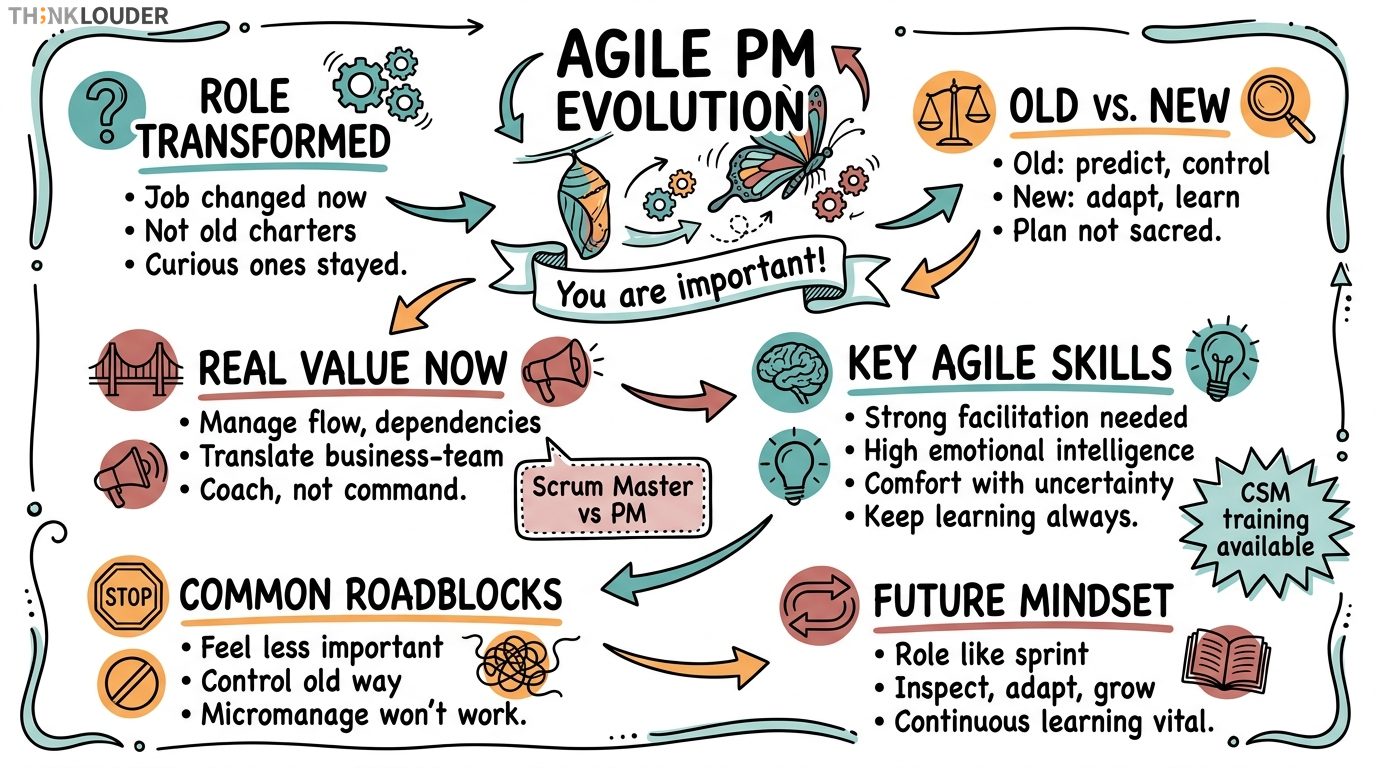
The role changes, not disappears. You stop controlling tasks and start removing obstacles, translating between teams and business, and coaching the team to stay focused.
I need to become a Scrum Master or I'm not relevant anymore.
Some project managers do become Scrum Masters. Most don't. You bring different skills: stakeholder relationships, business context, and the ability to connect teams to what matters. That's valuable whether or not you have the SM title.
Planning and predictability don't matter in Agile.
They matter differently. You're still managing budget, timeline, and scope. You're just doing it in two-week cycles instead of six-month phases, and you're adapting based on what you learn.
The role isn't gone. It's just different.
Years ago, we had about 180 people across 34 teams moving from waterfall to Scrum. The project managers in that group fell into two camps: half of them panicked, thinking their job was disappearing. The other half got curious about what they'd actually do next. The ones who got curious? They're still here, leading better teams than before.
Here's the thing about project managers in Agile: the job title didn't vanish. The job itself transformed. You're not gone. You're just not writing a 40-page project charter anymore, and you're definitely not sitting in a war room updating a Gantt chart every Friday.
What changed, and why it matters
In traditional project management, your job was prediction and control. You'd plan everything upfront, build a schedule, lock down scope, and then spend nine months making sure reality matched the plan. If reality didn't cooperate, you'd escalate, negotiate, and replan. You were the keeper of the baseline.
Agile flips that. Instead of predicting everything upfront, you're building in smaller cycles (usually two weeks), inspecting what you built, and adapting based on what you learned. The plan isn't sacred. Learning is.
So what do you actually do? You become the person who clears obstacles, keeps the team connected to the business, and helps the team stay focused on what matters most. You're not managing tasks. You're managing flow, communication, and the relationship between the team and everyone who cares about the outcome.
Just to adjust the language a little bit. In Agile, there's a specific role called the Scrum Master who owns a lot of this work: removing impediments, coaching the team on Scrum practices, and protecting the team from interruption. But if you're a project manager in an Agile environment and there's no dedicated Scrum Master, or if you're managing multiple teams, you're doing pieces of that work alongside your own responsibilities. (Want to know the difference? Check out Scrum Master vs. project manager for the full breakdown.)
Where you add real value
Three things change when you shift into Agile project management.
First, you're managing dependencies and flow, not just tasks. Your developers aren't handing off work to QA in week 8. They're building, testing, and shipping in the same sprint. That means you're asking different questions: "What's blocking us from finishing this story?" instead of "Are we on track to finish phase two?" You're watching for bottlenecks in real time, not discovering them in a status report.
Second, you're translating between the team and the business constantly. Your product owner is saying "we need this feature by market launch." Your team is saying "we can deliver five story points per sprint." You're the person who helps those two sides actually understand each other. You're not making the decision (that's the product owner's call), but you're making sure both sides have the data they need.
Third, you're coaching, not commanding. If a developer's stuck on a technical problem, you're not solving it. You're helping them find the person who can, or you're creating space for them to solve it themselves. If the team's retro isn't surfacing real problems, you're facilitating a better conversation. If stakeholders are asking for mid-sprint changes, you're helping them understand the cost of that change and whether it's worth it.
The skills that actually matter now
You still need to understand project constraints. Budget, timeline, scope, risk. That hasn't changed. But the way you work with those constraints is different.
You need strong facilitation skills. Standups, sprint planning, retrospectives, stakeholder conversations. These aren't status meetings you run. They're conversations you facilitate. The difference is huge. In a status meeting, you're collecting information and broadcasting it. In a facilitated conversation, you're helping a group of people think together and make a decision.
You need emotional intelligence. I'm a big believer in this one. When a developer pushes back on a deadline, you need to hear what's underneath that pushback. Is it a real technical constraint, or is it burnout? When a stakeholder demands a feature, is it actually a priority, or are they just anxious about something else? You're reading the room constantly.
You need to be comfortable with uncertainty. In waterfall, you had a plan. It might be wrong, but at least you had one. In Agile, you're planning two weeks at a time and adjusting based on what you learn. That's not chaos. It's empiricism. But it takes a different mindset.
And you need to keep learning. Agile practices evolve. Tools change. Your team's needs shift. The project managers who stay relevant are the ones who treat their own role like a sprint: try something, inspect the result, adapt, and try again.
Where people get stuck
When we run CSM training or work with teams in transition, we see the same three mistakes over and over.
Mistake one: thinking you're less important. You're not. You're just important in a different way. You're not the person with the biggest title in the room anymore. You might be the person who knows the most about how the business works, or who has the best relationships with stakeholders, or who can see around corners that the team can't see yet. That's real value.
Mistake two: trying to control the same way you used to. You can't micromanage a Scrum team and expect them to self-organize. You can't lock down scope on day one and expect the team to stay motivated. The more you try to control, the less you get. It's counterintuitive, but it works.
Mistake three: disappearing because you think Agile doesn't need you. Some project managers hear "self-organizing team" and think that means they should step back entirely. That's wrong. The team needs you. They just need you in a different way. They need you to clear obstacles, connect them to the business, and help them stay focused. Show up.
How to actually transition
If you're a project manager moving into Agile, here's what we'd recommend.
Start by understanding Scrum. Not because you're going to become a Scrum Master (though some people do), but because Scrum is the most common framework teams use, and you need to speak the language. Get certified if you can. A Certified Scrum Master certification takes three days and gives you the vocabulary and the fundamentals. It's not just for Scrum Masters. It's for anyone leading in an Agile environment. (The CSM exam has a 90% first-attempt pass rate, so don't worry about the difficulty.)
Then spend time with your team. Sit in their standups. Ask questions about what's blocking them. Understand their rhythm. You'll learn more in two sprints of paying attention than you will in a hundred articles about Agile.
Third, pick one thing to change about how you work. Not everything at once. Maybe it's moving from weekly status reports to a sprint review where the team shows working software. Maybe it's shifting from assigning tasks to asking the team how they want to organize the work. Pick something small, try it, and see what happens.
Finally, find a community. Agile is a practice, not a theory. You get better by doing it and talking to other people who are doing it. Join a local Agile meetup. Take advanced training. Talk to other project managers who've made the transition.
Your job isn't disappearing. It's evolving. And the project managers who lean into that evolution, who stay curious and keep learning, are the ones building the best teams.
How it works in practice
- 1Get the language
Take a CSM or CSPO course to understand Scrum, roles, and ceremonies. You don't need to become a Scrum Master, but you need to speak the vocabulary your team uses. It's the foundation for everything else.
- 2Observe your team's rhythm
Attend standups, sprint planning, and retros for at least two full sprints. Ask questions about what's blocking them and what they need from you. Listen more than you talk.
- 3Identify one obstacle you can clear
Look for something that's slowing the team down that isn't a technical problem. Maybe it's unclear priorities, or a stakeholder asking for mid-sprint changes, or a dependency on another team. Pick one and work it.
- 4Shift one process from command to facilitation
Pick a meeting or a decision that you currently own. Instead of deciding or announcing, try asking the team how they want to handle it. Let them organize the work instead of assigning tasks.
- 5Connect the team to the business
Make sure the team understands why they're building what they're building. And make sure stakeholders understand what the team can deliver and the tradeoffs involved. You're the translator.
- 6Keep learning
Join a local Agile community, read case studies from teams doing similar work, and treat your own role like a sprint. Try something, inspect the result, adapt, and try again.
One short email, every other Friday. Real-world Scrum lessons, no fluff. Unsubscribe anytime.