Key facts at a glance
- Credential
- AI for SM / PO
- Scrum Alliance micro-credentials
- Duration
- 4–8 hours
- Participation based, no exam
- Validity
- Lifetime
- Badge never expires
- Bonus
- SEU Credit
- Includes 2-year membership
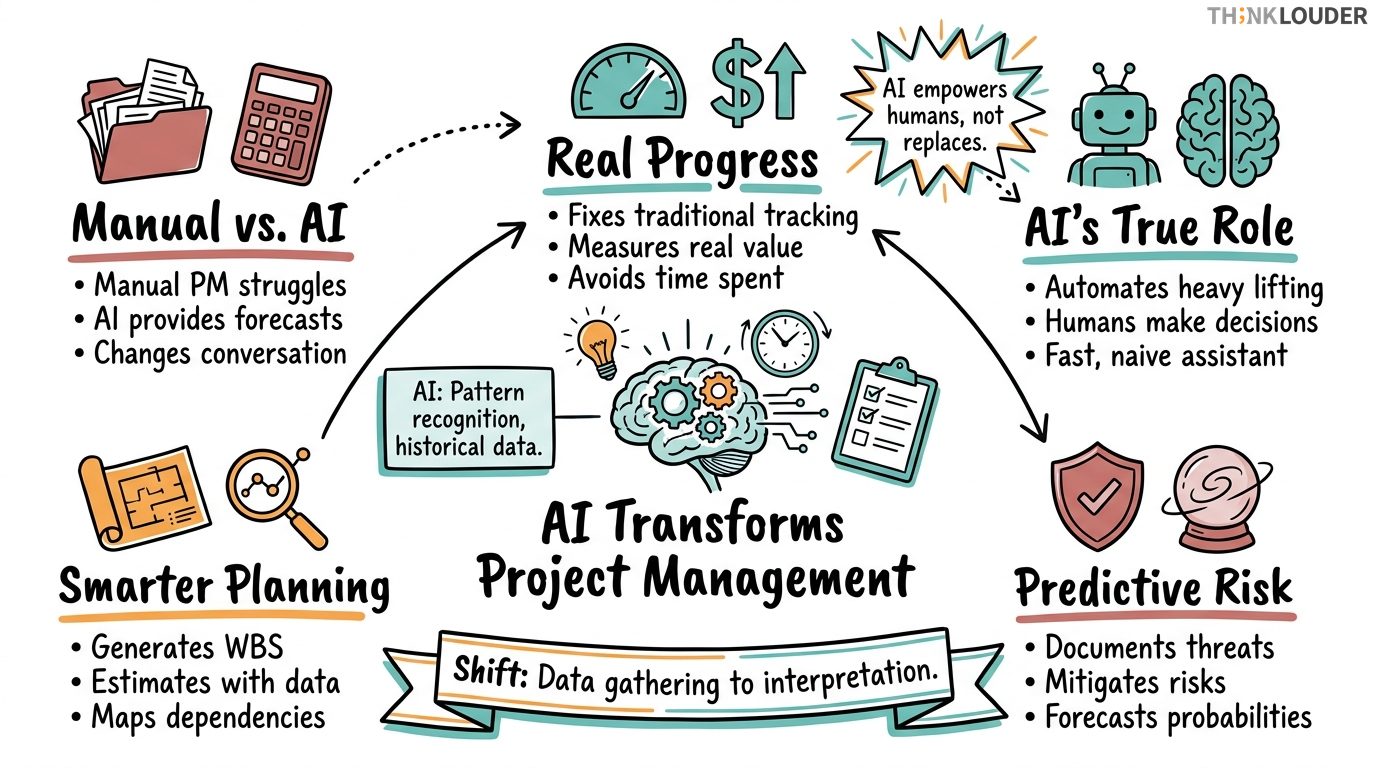
Imagine a product owner walking into a stakeholder meeting with 140 unrefined backlog items, three competing deadlines, and a budget that looks completely disconnected from reality. You'd probably brace for a rough two hours of arguing over scope. That is the reality of manual project management. Nothing more, nothing less.
But what if that same product owner walked in with a mathematically probable forecast, a drafted risk register, and a sorted work breakdown structure generated in four minutes? That changes the conversation entirely.
Artificial intelligence in project management is not about replacing the humans in the room. It is about automating the heavy lifting so the humans can actually make decisions. After training over 45,000 professionals, I can tell you the teams succeeding right now are the ones treating AI as an extremely fast, slightly naive assistant.
What's in this guide
This pillar page serves as the foundation for how we think about AI in the context of project delivery. We will cover the core concepts here, and you can follow these links to our deep-dive guides on specific traditional project management artifacts and how they fit into modern workflows.
Tracking real progress
Traditional tracking often lies. We explore how to fix that in our guide on Earned Value Analysis: Track Real Progress, Not Just Time Spent.
Managing risks
Hope is not a strategy. Learn how to document and mitigate threats with our Risk Register Template: What It Is and How to Use It.
Breaking down work
Big projects fail when they stay big. See how to chunk work effectively in Work Breakdown Structure: Breaking Down Projects Into Manageable Pieces.
Sequencing constraints
Understanding dependencies is crucial, even if the tools are old. Read Critical Path Method: What It Is and Why It Doesn't Belong in Scrum.
The reality of CPM in Scrum
We go deeper into the clash between waterfall sequencing and iterative delivery in Critical Path Methodology in Project Management: What It Actually Is (and Why Scrum Teams Don't Use It).
The Reality of Artificial Intelligence in Project Management
Years ago, we had 250 people across 34 teams trying to modernize a massive banking platform. We tried tracking every single dependency manually across three different Jira instances. Here is what happened: we spent more time updating the tracking sheets than writing code.
What AI actually is for your team
At a fundamental level, AI for project management is pattern recognition applied to your team's historical data. It looks at your past sprints, your past bugs, and your past delays, and it projects those patterns forward. It is a calculator for probability.
What AI is not
Just to adjust the language a little bit. We don't say AI will "manage the project," we say AI will "surface the data." The difference matters because accountability still rests entirely on the Scrum Master, the Product Owner, and the Developers. AI cannot negotiate with an angry stakeholder.
The shift for Scrum Masters and Product Owners
Your job transitions from gathering data to interpreting it. Instead of spending three hours compiling a burn-down chart and hunting down missing time logs, you spend those three hours asking the team why the AI is predicting a 14-day delay on a critical feature.
flowchart LR
  A[Manual Data Entry] --> B[AI Analysis Engine]
  B --> C[Risk Prediction]
  B --> D[Automated Drafting]
  C --> E[Human Decision Making]
  D --> E
  E --> F[Team Execution]
How AI Changes Project Planning Fundamentals
Planning is historically where Agile teams and traditional PMOs collide. AI bridges this gap by translating between the two worlds instantly.
Generating the Work Breakdown Structure
Traditional project managers love a WBS. Scrum teams usually prefer a flat product backlog. AI tools can now take your epic-level user stories and instantly generate a traditional Work Breakdown Structure: Breaking Down Projects Into Manageable Pieces. This gives your PMO the hierarchical view they want without forcing your developers to change how they work.
Estimating effort with historical data
Humans are terrible at estimating. We are optimistic by nature. AI looks at the last 40 times your team estimated a "simple database migration" at 3 story points, notices it actually took 13 points worth of time on average, and flags the discrepancy during Sprint Planning.
Dealing with dependencies
When you have multiple teams working on a single product, dependencies will kill your timeline. AI can scan commit histories, backlog links, and even Slack conversations to map out hidden technical dependencies before they block your current sprint.
Risk Management and Predictive Analytics
Risk management used to be an exercise in imagination. You would sit in a room and guess what might go wrong. AI turns risk management into an exercise in data analysis.
Building an automated Risk Register
Instead of starting from a blank page, you can feed your project brief into an LLM and ask it to identify the top 20 likely risks based on industry data. You then take those outputs and drop them straight into your Risk Register Template: What It Is and How to Use It. It saves hours of brainstorming.
Spotting schedule slips early
By analyzing daily code commits, ticket status changes, and test failure rates, predictive AI can tell you on day three of a 14-day sprint if you are going to miss your goal. It removes the surprise from the Sprint Review.
The Earned Value Analysis connection
For teams that still need to report financial metrics to leadership, AI can automate the complex math behind Earned Value Analysis: Track Real Progress, Not Just Time Spent. It calculates your Cost Performance Index (CPI) in real-time, right? You never have to build another manual spreadsheet for the finance department.
Execution Tracking and the Critical Path
Tracking execution is where the friction between Agile and traditional project management is highest.
Mapping the critical path with AI
Traditional project managers rely heavily on sequencing. AI tools can instantly calculate the longest chain of dependent tasks to find your critical path. But as we explain in Critical Path Method: What It Is and Why It Doesn't Belong in Scrum, this sequential thinking often breaks down in complex, empirical product development.
Why Scrum teams handle this differently
I'll be honest with you. Trying to force a strict critical path onto a Scrum team usually results in fake Agile. We cover this exact dynamic in Critical Path Methodology in Project Management: What It Actually Is (and Why Scrum Teams Don't Use It). However, AI is changing this by making critical paths dynamic. Instead of a rigid Gantt chart, the AI constantly recalculates dependencies every time a developer updates a ticket.
Real-time bottleneck detection
Rather than waiting for the Daily Scrum to hear that a developer is stuck, AI workflow tools can flag bottlenecks by noticing when a ticket has sat in "In Review" for 48 hours while the assigned reviewer is actively working on other tasks.
The Tools Shaping AI Project Delivery
You do not need to build your own neural network to get value out of AI today. The tools are already embedded in the software you use.
Generative AI for documentation
Writing acceptance criteria, summarizing meeting notes, and drafting stakeholder updates are perfect use cases for generative AI. A Product Owner can feed a rough idea into a tool and get a fully formatted user story in seconds.
Predictive models for forecasting
Tools like Jira Intelligence and specialized Agile forecasting add-ons use Monte Carlo simulations. They run 10,000 possible future scenarios based on your historical throughput to tell you there is an 85 percent chance you will finish the release by October 14th.
Workflow automation engines
This is the glue. When a high-priority bug is logged, an AI engine can automatically assign it to the developer who last touched that module, link related documentation, and alert the Scrum Master.
Challenges and Blind Spots to Watch For
Last week in class a senior engineering manager asked if they could just let the AI prioritize the backlog. My answer was absolutely not. Here is why.
The garbage-in trap
If your team has terrible data hygiene, AI will just give you terrible predictions faster. If developers do not update their tickets until the last day of the sprint, the predictive models have nothing to analyze. Your process must be clean for the AI to work.
Over-reliance on AI estimates
AI does not know that your lead developer is going through a divorce, or that the staging environment goes down every Tuesday. Human context is still required. Use the AI's estimate as a baseline for the conversation, not the final word.
Ethical and transparency concerns
When an AI flags a specific developer as a "delivery risk" based on their commit velocity, you are stepping into a minefield. Metrics must be used to improve the system, not to punish individuals. Transparency about what data the AI is using is non-negotiable.
Getting Certified: The AI Micro-Credentials
If you want to prove you know how to apply these tools ethically and effectively within an Agile framework, the Scrum Alliance has formally stepped into this space.
AI for Scrum Masters
Launched in October 2024, this micro-credential focuses specifically on how Scrum Masters can use AI to facilitate better events, clear impediments faster, and coach their teams. It is a 4-to-8 hour participation-based course with no exam.
AI for Product Owners
Also launched in October 2024, the PO version focuses on backlog management, stakeholder communication, and market analysis using AI. Like the Scrum Master version, there is no prerequisite.
The SEU and membership benefits
Both of these micro-credentials hold lifetime validity. You earn a permanent badge. Even better, completing them grants you SEU credit toward your existing CSM or CSPO renewals, and includes a 2-year Scrum Alliance professional membership if you are not already a member.
flowchart TD
  A[Need to level up AI skills?] --> B{What is your role?}
  B -->|Scrum Master| C[AI for Scrum Masters]
  B -->|Product Owner| D[AI for Product Owners]
  C --> E[4-8 hours, No Exam]
  D --> E
  E --> F[Lifetime Badge + SEUs + 2-Year Membership]
Next Steps for Your Agile Practice
We have seen this fail when organizations buy a massive enterprise AI tool and mandate its use without changing how the teams actually work. Do not do that. Start small.
Assess your current baseline
Look at your backlog right now. Is it clean enough for an AI to read? If your user stories are just titles with no descriptions, fix your basic habits first. AI cannot read your mind.
Train the team
Do not expect your team to figure this out on their own time. Bring them to a professional environment where they can learn the frameworks safely. Check out our training schedule to find an upcoming session that fits your timezone. If you have more than a dozen people, look into our private team training options so we can customize the AI scenarios to your actual product.
Update your toolkit
Start experimenting with one specific AI use case this week. Have your Product Owner use it to draft acceptance criteria, or have the Scrum Master use it to summarize the Retro action items. If you need to build your foundational Agile knowledge first, explore our core certifications to get the basics down before layering AI on top.
Related Resources
- Beyond project planning, explore AI in Stakeholder Communication to refine your messaging.
One short email, every other Friday. Real-world Scrum lessons, no fluff. Unsubscribe anytime.