What people get wrong about this
We need an AI adoption strategy because AI is new and everyone's doing it.
You need a strategy because you've identified a specific business problem that AI can solve, and you need a plan to make sure your team actually uses it and sees the benefit.
Adoption strategy is about buying the right tool and rolling it out to everyone.
Adoption strategy is about the people, process, and measurement. The tool is just the last 20% of the work. The other 80% is change management, training, and making sure people know why they're using it.
We'll measure success by how much money we save or how fast things get done.
Measure adoption first: How many people are using it? How often? Are they using it right? Once adoption is real, then measure business impact. No adoption, no impact.
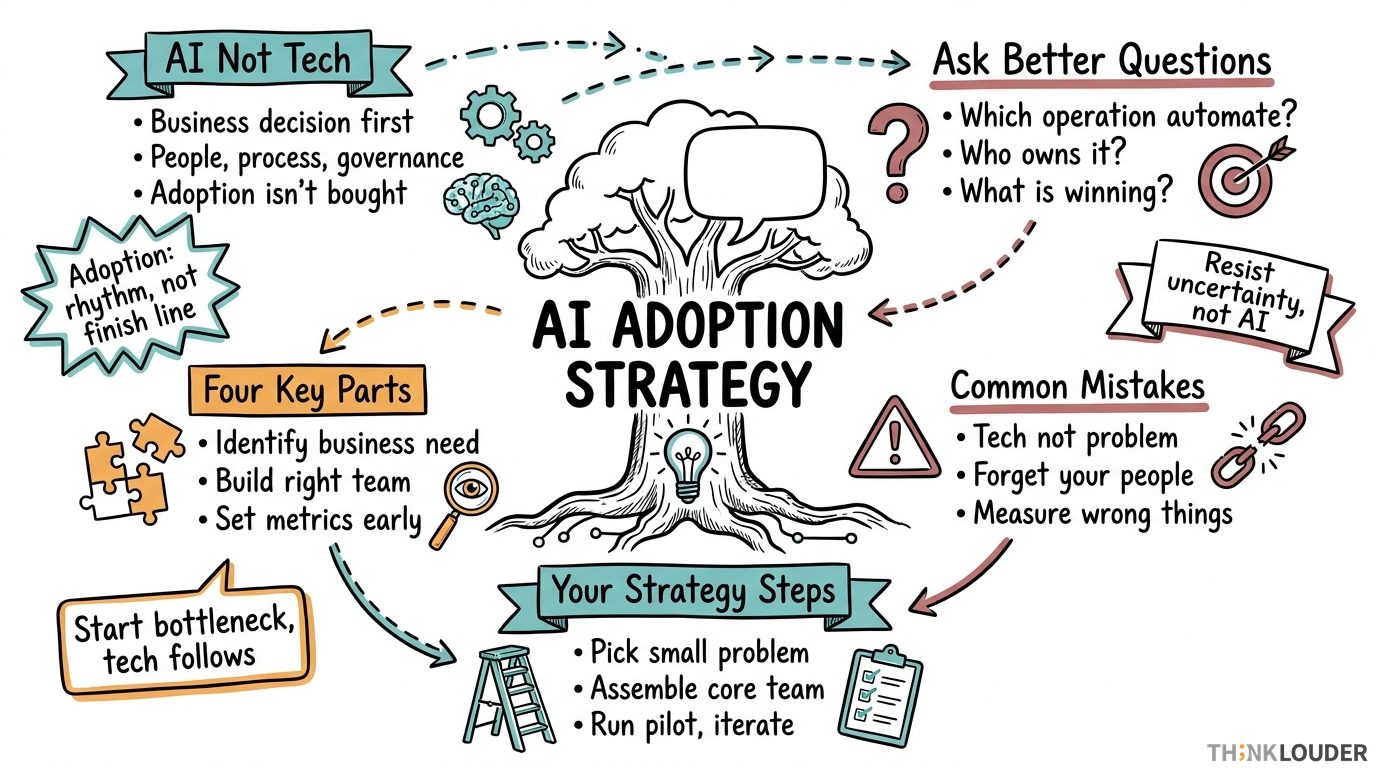
An AI adoption strategy isn't a technology roadmap. It's a business decision about where and how your organization will use AI to solve real problems, paired with the people, process, and governance moves needed to make it stick.
Here's the distinction that matters: you can buy AI tools tomorrow. You can't buy adoption. Adoption is what happens when your team knows why they're using it, how it changes their work, and what success looks like on Monday morning.
Years ago we worked with a 120-person financial services firm that bought a predictive analytics platform. Six months later, nobody was using it. Not because the tool was bad. The leadership team never answered three questions: Which department owns this? What problem does it solve that we care about? How do we measure whether it's working? Without those answers, adoption was dead before it started.
Where This Comes From
AI adoption strategy borrows from change management, but it's sharper and more specific. It says: don't just change for change's sake. Change because you've identified a bottleneck, you've picked the right tool, you've built the team to support it, and you've defined what "success" looks like in numbers, not vibes.
The mental model is simple. You're not asking "Should we use AI?" (that's a yes, and the question is stale). You're asking: "Which part of our operation would break open if we automated it, augmented it, or got better data on it? Who owns that? What does winning look like? And what's going to get in the way?"
How It Shows Up in Practice
A real adoption strategy has four moving parts, and they all have to work together.
First, you identify the business need. Not "AI is hot." Not "our competitor is using it." Concrete: "Our customer support team spends 40% of their time on repetitive questions. If we automate triage, we free up 16 hours per week to handle complex cases." That's a need. That's measurable. That's something you can build a case around.
Second, you build the right team. Not just data scientists. You need the person who owns the process (usually the department head), someone who understands the data, someone who can handle the technical side, and someone who's going to coach people through the change. Last week in class a Product Owner asked me how many people you need to own an AI adoption. My answer was: at least one person per stakeholder group who'll be affected. If you've got support teams, product teams, and leadership, you need at least three people in the room. The team doesn't have to be huge, but it has to be representative.
Third, you set metrics before you start. Not after. Before. What does success look like? Faster response time? Fewer errors? Lower cost per transaction? Lower employee burnout? Pick 2-3, attach numbers to them, and measure them monthly. If you can't measure it, you can't know if it's working, and if you can't know if it's working, you can't convince people to stick with it when it gets hard.
Fourth, you plan for resistance. People don't resist AI. They resist uncertainty. They resist feeling left behind. They resist change that looks like it'll make their job harder or less secure. So you build in communication, training, and a clear story about what's changing and why. "We're automating the boring stuff so you can do the interesting stuff" lands different than "We're implementing AI." Right?
Common Pitfalls
Let me sharpen a few things we see go wrong.
Pitfall one: Starting with technology instead of the problem. "We bought this AI platform, now what do we do with it?" That's backwards. Start with the bottleneck. The technology follows. If you lead with the tool, you'll end up automating the wrong thing or solving a problem nobody has.
Pitfall two: Forgetting to bring your people along. You can't adopt AI by announcement. You adopt it by showing people how it changes their day, giving them time to learn it, and celebrating small wins early. We had a team of 8 content creators who were told they'd use AI to draft copy. Nobody got training. Nobody saw examples. Three months later, they were still writing everything by hand. The tool was fine. The adoption plan was nonexistent.
Pitfall three: Measuring the wrong things. You'll get pressure to measure "cost savings" or "efficiency gains" right away. That's not wrong, but it's not the full picture. Measure adoption rate first. How many people are actually using it? How often? Are they using it the way you intended? Once adoption is real, then you measure business impact. If nobody's using it, the business impact is zero.
Pitfall four: Treating adoption as a one-time event. It's not. It's ongoing. Your first cohort of users learns the tool. Then you onboard the next cohort. Then you find new use cases. Then you retire the old ones. Adoption is a rhythm, not a finish line.
How to Build Your Strategy
If you're starting an AI adoption effort, here's the move.
First, pick one small problem that AI can help with. Not your biggest problem. A real one, but a contained one. A team of 6-12 people. A process that takes 20-40 hours per week. Something where you can see a win in 90 days.
Second, assemble your team. The process owner, a technical person, someone from HR or L&D to handle change, and a sponsor with budget authority. That's your core four.
Third, define your three metrics. Response time, error rate, or cost per unit. Pick the ones that matter to your business. Measure them now, before you implement anything, so you've got a baseline.
Fourth, run a pilot with your first group of users. Eight weeks, not twelve. Get feedback. Iterate. Then scale.
Fifth, build a communication plan. Why are we doing this? What's changing? How does it affect my day? What support do I get? Tell that story once a week for the first month, then every other week. People need to hear it multiple times before it sticks.
If you're running an agile transformation or managing a larger organizational change, adoption strategy becomes even more critical. The same principles apply, but the complexity grows. That's where understanding AI adoption challenges can save you months of false starts. You might also want to look at how AI adoption frameworks differ from strategy, so you know which one fits your situation.
The Reality
I'll be honest with you: adoption fails when leadership loses patience or when the team never got trained. It succeeds when you pick the right problem, you bring your people with you, and you measure progress in weeks, not months.
Your AI adoption strategy isn't about the AI. It's about your people, your process, and your ability to change how work gets done. Get those three right, and the technology is just the tool. Get them wrong, and you've got expensive software nobody uses.
Start small. Measure it. Iterate. Scale what works. That's not a strategy, that's just how you actually adopt anything.
Related Resources
- Once your AI adoption strategy is underway, learn what changes when using AI in Stakeholder Communication.
How it works in practice
- 1Pick one small problem AI can solve
Not your biggest problem. A real bottleneck affecting 6-12 people that takes 20-40 hours per week to handle. Something you can win on in 90 days.
- 2Assemble your core team
The process owner, a technical person, someone from HR or L&D to handle change, and a sponsor with budget authority. Four people, all aligned on the problem.
- 3Define three metrics and measure them now
Pick the outcomes that matter: response time, error rate, cost per unit. Get a baseline before you implement anything so you can see the before and after.
- 4Run an eight-week pilot with your first group
Implement with a small cohort. Collect feedback weekly. Iterate fast. Don't wait for perfection. Get real data on what works and what doesn't.
- 5Build a communication cadence
Tell the story weekly for the first month, then every other week. Why are we doing this? What's changing? How does it affect my day? People need to hear it multiple times.
- 6Scale what works to the next group
Once your pilot shows adoption and impact, bring the next cohort of users in. Repeat the training, iterate on feedback, and keep measuring.
One short email, every other Friday. Real-world Scrum lessons, no fluff. Unsubscribe anytime.