What people get wrong about this
AI will write our stakeholder emails, so we can just send them without reading.
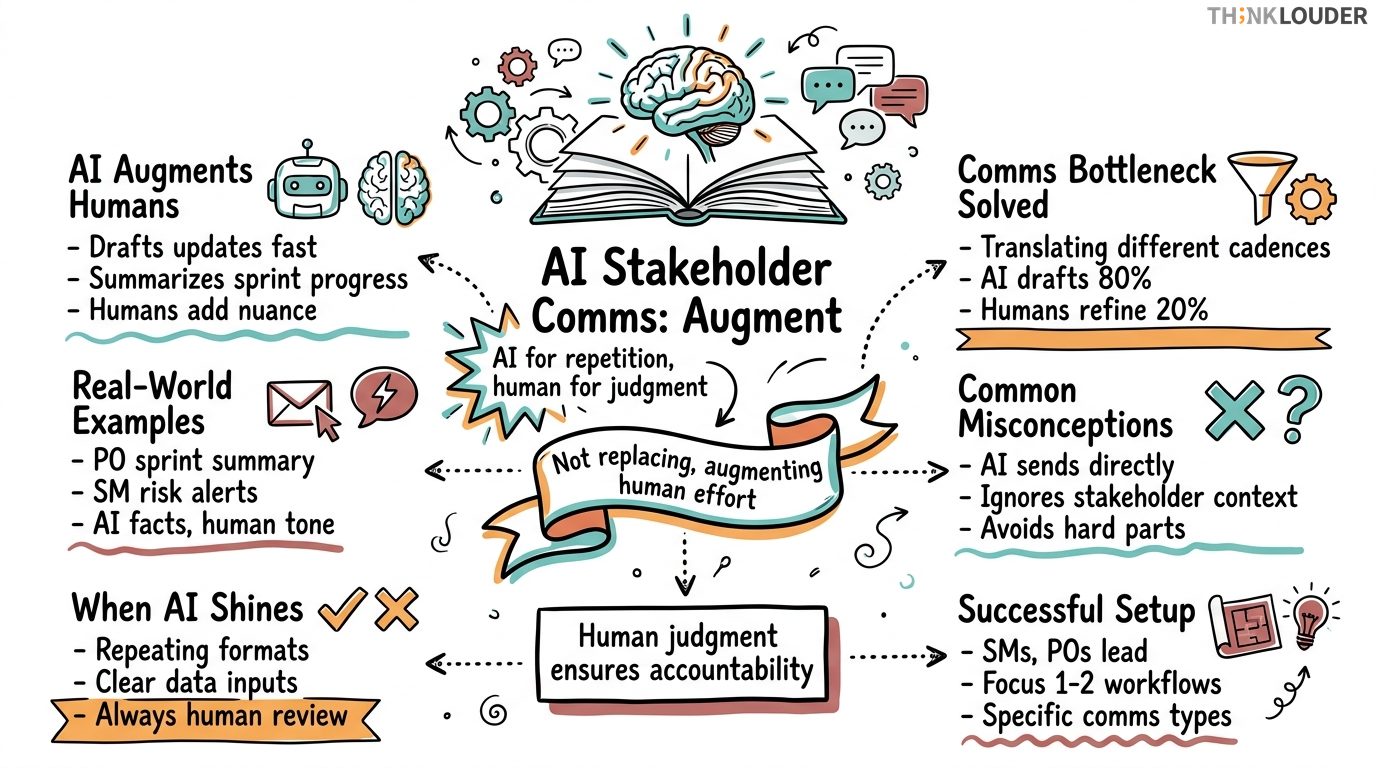
AI generates a first draft. A human has to read it, adjust tone and context, and approve it before sending. If you skip that step, you'll send messages that miss nuance or sound tone-deaf.
Using AI for stakeholder comms means we don't have to think about what we're saying anymore.
AI handles the repetitive scaffolding so you can focus on the judgment calls: which stakeholders need a personal touch, which risks need a conversation instead of an email, when to break the pattern.
AI works equally well for all stakeholder communication.
AI works great for repeating, structured updates (Friday standups, sprint summaries). It doesn't work for fragile relationships, high-stakes conversations, or messages that need nuance. Use your judgment on which comms get AI and which don't.
What we're actually talking about
AI in stakeholder communication means using language models, chatbots, and automation to draft updates, summarize sprint progress, flag risks to leadership, and respond to common questions without a person writing every single message from scratch. Not replacing your Product Owner or Scrum Master. Augmenting the time they spend on repetitive communication work so they can focus on the hard conversations.
Years ago, we had a Product Owner managing 12 teams across three business units. Every Friday, she'd spend 90 minutes copying sprint metrics into email templates, writing the same "here's what we shipped, here's what's blocked" narrative six different ways for six different stakeholder groups. She wasn't thinking. She was typing. An AI tool that could generate a first draft of that Friday update, pulling from Jira, would've freed her to actually think about which risks mattered most and which stakeholders needed a real conversation, not a template.
That's the move. Not "AI writes all our stakeholder comms." It's "AI handles the repetitive scaffolding so humans can handle the nuance."
Where this comes from
Stakeholder communication in Scrum has always been a bottleneck. Your team ships work every two weeks. Your stakeholders live in different cadences: executives want monthly business impact, finance wants quarterly forecasts, customers want real-time visibility. A Scrum Master or Product Owner becomes a translator, repackaging the same sprint data in five different formats for five different audiences.
Add AI into that picture, and suddenly you can generate a draft stakeholder update in 30 seconds. The tool pulls your sprint metrics, your completed stories, your blockers, and it writes a first pass. It's not perfect. It misses context. But it's 80% there, and a human spends five minutes refining it instead of 45 minutes building it from scratch.
The mental model is straightforward: AI is fast at repetition and pattern-matching. Humans are good at judgment, context, and knowing when to break the pattern. Use the AI for the repetition. Keep the human in the loop for the judgment call.
How it actually shows up
Your Product Owner runs a sprint review. Thirty minutes of demos, questions, feedback. Two hours later, she needs to send a summary to the exec sponsor who couldn't attend. Instead of opening a blank email and writing from memory, she uses a tool: paste the sprint goal, paste the story titles and acceptance criteria, select "executive summary" as the template, and get a 200-word recap in 20 seconds. She reads it. Adjusts the tone (it's too cheerful for a release that shipped late). Adds a sentence about the one blocker that matters. Sends it.
Or your Scrum Master notices velocity has dropped 30% over two sprints. He could spend an hour crafting an email to leadership explaining the root cause. Instead, he uses an AI tool to draft a risk summary: "Velocity declined from 45 to 31 points over sprints 14 and 15. Root cause: three team members onboarded to the project, reducing capacity by 40%. Mitigation: we expect velocity to stabilize by sprint 17. Recommend: adjust release forecast by two weeks." He reads it. Adjusts one phrase. Sends it. Leadership gets a clear, structured message instead of a rambling paragraph.
The pattern: AI drafts the structure and fills in the facts. The human adds judgment, tone, and context.
What people get wrong
Most teams start with the wrong assumption: "AI will write our stakeholder comms, and we'll just send them." That's how you end up with tone-deaf, context-blind messages that confuse stakeholders or miss the real risk. AI doesn't know your stakeholders. It doesn't know that your CFO cares about cash flow but your VP of Engineering cares about team morale. It doesn't know that last month's late delivery eroded trust, so this month you need to over-communicate progress, not under-communicate.
The other mistake is thinking AI saves time by replacing the hard part. It doesn't. The hard part is knowing what to say and why. The easy part is writing it down. AI saves you time on the easy part so you can focus on the hard part. If you're not doing the hard part, you're just getting faster at the wrong thing.
Just to adjust the language a little bit: we don't say "AI writes stakeholder updates." We say "AI generates a first draft of stakeholder updates, and humans review, refine, and send them." The difference matters because the moment you remove human judgment from stakeholder communication, you lose accountability. Stakeholders need to hear from a real person who owns the message, not a bot that generated it.
When it works, and when it doesn't
This works when:
- You have a repeating format (Friday standup, sprint review summary, blocker escalation) and you want to save time on formatting and data entry.
- Your stakeholders are comfortable with a slightly more structured, less personalized tone (executives often prefer this).
- You have clear data to feed the AI (sprint metrics, story status, blockers) so it's not making things up.
- You have a human review and adjust before sending.
This doesn't work when:
- Your stakeholder relationships are fragile and they need a personal, tailored message. A template (even a good one) signals that you don't care about them specifically.
- Your risk or blocker requires nuance and context that's not in your Jira board. "We're blocked on the API integration" needs a conversation, not an AI-generated email.
- You're using AI to avoid a hard conversation. If you need to tell a stakeholder that the release is slipping three months, that's not an email. That's a meeting. AI doesn't fix that.
The setup that actually works
Here's what we've seen succeed: Scrum Masters and Product Owners set up one or two AI workflows for the comms that happen every sprint, every time, the same way. Friday stakeholder update. Sprint review summary. Weekly blocker report. For those, AI drafts a first pass in seconds. The human spends five minutes refining it. Everyone wins.
For the comms that are unpredictable or high-stakes (the "we're three sprints behind" conversation, the "we need to cut scope" negotiation), they don't use AI at all. They write it themselves or they have a conversation. AI isn't better at that. It's worse.
If you're running a Certified Scrum Master or Certified Scrum Product Owner program, this is worth teaching because it reframes how teams think about their communication workload. Not "AI replaces writing." It's "AI handles the routine so humans can focus on the relational."
For a deeper look at how AI fits into broader project management and team decision-making, check out AI for Project Management: The Complete Guide for Agile Teams. It covers the tools, the patterns, and the pitfalls across the full delivery cycle.
The trust question
I'll be honest with you: stakeholders notice when they're reading an AI-generated email. Not always consciously, but they notice the tone is flatter, the examples are more generic, the message feels less like it was written for them specifically. That's fine if your stakeholder relationship is transactional (you just need to keep them informed). It's a problem if the relationship is fragile or if trust is already low.
The move: use AI for the stakeholders who are fine with a structured, predictable update. Use humans for the stakeholders who need to feel like you're talking to them specifically. You'll know the difference in your first sprint review.
One more thing: transparency matters. If you're using AI to draft a message, you don't need to announce it. But you also don't need to hide it. If a stakeholder asks, "Did you write this?" the honest answer is, "I drafted it with AI and reviewed it before sending." That's different from "I wrote it." And stakeholders can tell the difference.
Getting started
Start small. Pick one recurring communication (Friday standup, sprint review summary, blocker report) and draft a template. Feed that template to an AI tool along with your sprint data and see what it generates. Spend five minutes refining it. Send it. Ask yourself: did this save time? Did it read well? Would I send this to a stakeholder without changes?
If the answer is yes to all three, you've found a workflow worth automating. If not, adjust the template or the data you're feeding the AI, and try again.
If you want to go deeper on how Scrum teams structure communication across multiple stakeholders, the AI for Product Owners micro-credential covers this in the context of modern tooling and decision-making. It's a 4-8 hour, participation-based credential with no exam, and it counts toward CSM or CSPO renewal. We've trained over 55,000 practitioners since 2015, and this is one of the most requested topics in our programs right now.
Related Resources
- Ready to move beyond communication tactics? Explore what a true AI adoption strategy means for your organization.
- Ready to move beyond theory? Explore our AI Adoption Framework for practical deployment steps.
- If you're struggling to implement AI, understand AI Adoption Challenges: What Actually Gets in the Way.
How it works in practice
- 1Identify one repeating communication
Pick a stakeholder update that happens every sprint, the same way, every time. Friday standup. Sprint review summary. Weekly blocker report. Not the unpredictable stuff yet.
- 2Draft a template with your data
Write out the structure you want (goal, completed work, blockers, next steps). Feed that template to an AI tool along with your sprint metrics and story data. Generate a first draft.
- 3Review and adjust the output
Read what the AI generated. Fix the tone. Add context. Remove generic phrases. Spend five minutes refining, not 45 minutes writing from scratch.
- 4Send and measure
Send the refined message. Did it save time? Did stakeholders respond well? Would you send this again without major changes? If yes, you've found a workflow worth repeating.
- 5Keep humans in the loop for high-stakes comms
Don't use AI for fragile relationships, late releases, scope cuts, or any message where tone and context matter more than speed. Write those yourself or have a conversation.
One short email, every other Friday. Real-world Scrum lessons, no fluff. Unsubscribe anytime.