What people get wrong about this
An AI adoption framework is just picking a tool and rolling it out to everyone.
A framework is the thinking before, during, and after deployment. It aligns your business goal, assesses your readiness, manages change with your team, pilots the idea, and measures what actually happened. Tool selection is one small piece.
If we build the framework right, adoption will happen automatically.
Adoption is a people problem, not a planning problem. Your team needs to understand why this matters, trust the tool, and see how it fits into their work. A perfect framework fails if you skip the change management piece.
We'll know if AI adoption worked by looking at tool usage metrics.
Usage metrics are noise if they don't connect to the business outcome you said mattered. If you bought AI to reduce code review time by 30%, measure code review time. If it's to catch bugs earlier, measure bug escape rate. Measure the outcome, not the activity.
What an AI adoption framework actually is
Let me start with something concrete. Three years ago we had a 40-person product team at a financial services firm. They'd decided to use AI to automate their QA process. They bought the tool, installed it, and... nothing happened. The testers didn't know how to prompt it. The backlog wasn't structured in a way the AI could parse. The leadership team expected it to cut costs by 60% in month one. Six months later, they'd spent $180K and gotten maybe 15% efficiency gain. What went wrong? They had a tool. They didn't have a framework.
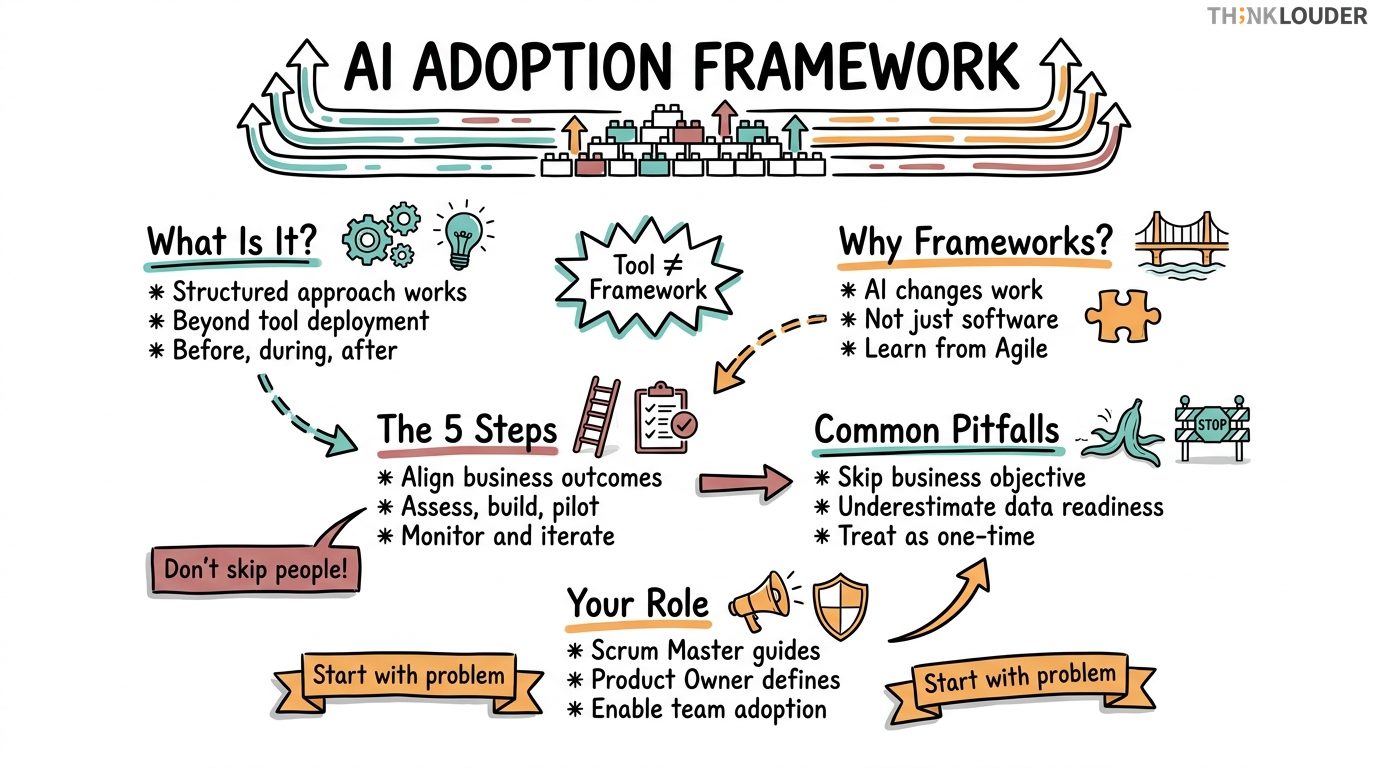
An AI adoption framework is a structured approach to bringing AI into your organization in a way that actually sticks. It's not just "buy this tool and use it." It's the thinking that comes before, during, and after you deploy. It answers: What problem are we solving? Do we have the technical foundation? Who needs to change how they work? How do we know it's working?
Right? It sounds obvious when you say it out loud, but most organizations skip it. They see a vendor demo, get excited, and jump straight to implementation. Then they wonder why their teams resist or why the ROI never materializes.
Where this comes from
The framework concept isn't new to tech. You've probably heard of software adoption frameworks, change management frameworks, digital transformation frameworks. The AI version borrows from all of them but adds a specific wrinkle: AI is fundamentally different from traditional software because it requires different skills, carries different risks, and often changes how people do their core work.
Scrum Masters and Product Owners have been managing change for years, right? You know that shipping a feature isn't the same as the team adopting it. An AI adoption framework applies that same discipline to AI tools and capabilities.
How it shows up in practice
Most frameworks break down into four or five moves:
First, you align your AI initiative to actual business outcomes. Not "we want AI." But "we want to reduce code review time by 30% so developers ship faster" or "we want to surface customer churn signals two weeks earlier so we can intervene." The business objective comes first. Then you ask: Can AI solve this? What would success look like in dollars or hours?
Second, you assess what you've got. Your data quality. Your infrastructure. Your team's skill level with AI tools. Your governance and compliance constraints. This is where a lot of teams get humbled. You can't run an LLM-based customer service bot if your data infrastructure is a mess or if your compliance team hasn't cleared it. This step isn't glamorous, but it's where you find out what's actually possible in your context.
Third, you build stakeholder and team buy-in. This is the change management piece. Your developers might worry AI will make their jobs obsolete. Your QA team might resist if they think you're automating them out. Your compliance and security teams need to understand the risk profile. You can't skip this. We've seen it fail when leadership pushed AI adoption without bringing the people doing the work along.
Fourth, you pilot. You pick one small, bounded problem. You run a 2-4 week sprint with a cross-functional team. You measure what happens. You learn. Then you decide: Do we scale this? Do we kill it? Do we pivot? Pilot projects are where you find out if your assumptions hold up in reality.
Fifth, you monitor and iterate. After deployment, you're tracking: Is it being used? Is it delivering the outcome we predicted? Are there unintended consequences? Is the team adapting to it, or are they finding workarounds? This isn't a one-time rollout. It's continuous learning.
The reason this matters on Monday morning is simple: without this structure, you'll spend money on AI tools that don't get used, or worse, tools that get used but don't move the needle. You'll burn out your team trying to figure it out on the fly. You'll face skepticism from leadership when ROI doesn't show up in quarter one.
Common pitfalls
Most teams stumble on a few predictable things:
Skipping the business objective step. You pick a tool because it's trendy, then try to find a problem for it. That's backwards. Start with the problem.
Underestimating data and infrastructure readiness. AI needs clean, structured data. If your data is siloed or poor quality, the AI won't work. You can't spray-paint over this problem.
Treating adoption as a one-time event. "We deployed AI in March" is not adoption. Adoption is when your team uses it regularly, understands its limits, and has made it part of how they work. That takes months, not weeks.
Not accounting for the people side. The best technical framework fails if your team doesn't understand why they're doing this or doesn't trust the tool. Change management isn't optional.
Measuring the wrong things. You bought an AI tool to save time. So measure time. Don't measure "number of AI prompts used" or "adoption rate" without connecting it back to the business outcome you said mattered.
How this connects to your role
If you're a Scrum Master, your job in an AI adoption framework is to keep the team moving, surface resistance early, and protect them from scope creep. You're also the person who notices when the tool isn't being used and brings that back to the team for a real conversation.
If you're a Product Owner, you're the one who articulates the business outcome clearly and helps prioritize which AI initiatives to tackle first. You're also responsible for writing stories and acceptance criteria in a way that the AI tool can actually help with.
If you're leading a team or organization through this, you need to be clear about why you're adopting AI, what success looks like, and what's not going to change. People need to know: Is this replacing my job, or is it changing what I do? Ambiguity kills adoption.
For teams running Scrum or Kanban, an AI adoption framework fits naturally into your existing rhythm. You can run it as a time-boxed initiative inside your normal sprints, or you can treat it as a separate work stream for the first few months until it's embedded.
Getting started
If your organization is considering AI adoption, start here: Pick one small, high-value problem. Get agreement from the people who do that work. Run a 3-4 week pilot with a clear success metric. Learn from it. Then decide next steps.
Don't try to boil the ocean. Don't adopt AI everywhere at once. Pick one thing, do it well, and let the wins build credibility for the next move.
If you're training teams on this or coaching organizations through AI adoption, ThinkLouder now offers the Scrum Alliance AI for Scrum Masters micro-credential, which covers adoption strategy, risk management, and how to coach teams through the change. It's 4-8 hours, no exam, and counts toward CSM renewal.
The core principle is this: AI is a tool. A framework is what makes it work.
Related Resources
- To understand the foundational elements of integrating AI, explore our guide on AI Adoption Strategy: What It Actually Means and How to Start.
- To understand the common roadblocks, read our new article on AI Adoption Challenges.
- Once deployed, explore AI in Stakeholder Communication to understand its impact on internal and external messaging.
How it works in practice
- 1Define the business outcome, not the tool
Write down what problem you're solving and how you'll know it's solved. 'Reduce code review time by 30%' or 'Surface customer churn signals two weeks earlier.' Avoid 'we want to use AI.' Start with the outcome.
- 2Assess your readiness
Check your data quality, infrastructure, team skill level, and governance constraints. Be honest about gaps. If you don't have clean data or compliance sign-off, you can't skip those steps.
- 3Bring stakeholders and the team along
Talk to the people who'll use the tool, their managers, and anyone who owns systems it'll touch. Address fears directly. Explain why you're doing this and what won't change. Ambiguity kills adoption.
- 4Run a bounded pilot
Pick one small problem. Assign a cross-functional team. Time-box it to 2-4 weeks. Measure the outcome. Learn what works and what doesn't before you scale.
- 5Monitor, measure, and iterate
After deployment, track whether the tool is being used, whether it's delivering the outcome you predicted, and whether the team is adapting or finding workarounds. Treat adoption as ongoing, not a one-time event.
One short email, every other Friday. Real-world Scrum lessons, no fluff. Unsubscribe anytime.