What people get wrong about this
AI adoption fails because our team resists change.
Your team resists unclear change that looks risky. Show them a small win first, then expand. Resistance is rational self-protection, not obstruction.
If the AI tool works, we can roll it out company-wide tomorrow.
A working tool on clean data in a pilot doesn't mean it'll work at scale on messy real-world data. Audit your data and document your workflow before you expand.
The hard part is getting AI to integrate with our systems.
Integration is maybe 30% of the work. The hard part is mapping your actual workflow and deciding where AI actually helps instead of just automating busywork.
The Real Problem With AI Adoption
Years ago, we worked with a 120-person organization that spent $340,000 on an AI platform. Six months in, they'd trained maybe 15 people. The tool sat unused. The CTO blamed "resistance to change." The VP of Operations blamed "unclear ROI." Nobody was wrong, exactly, but everybody was missing the actual bottleneck.
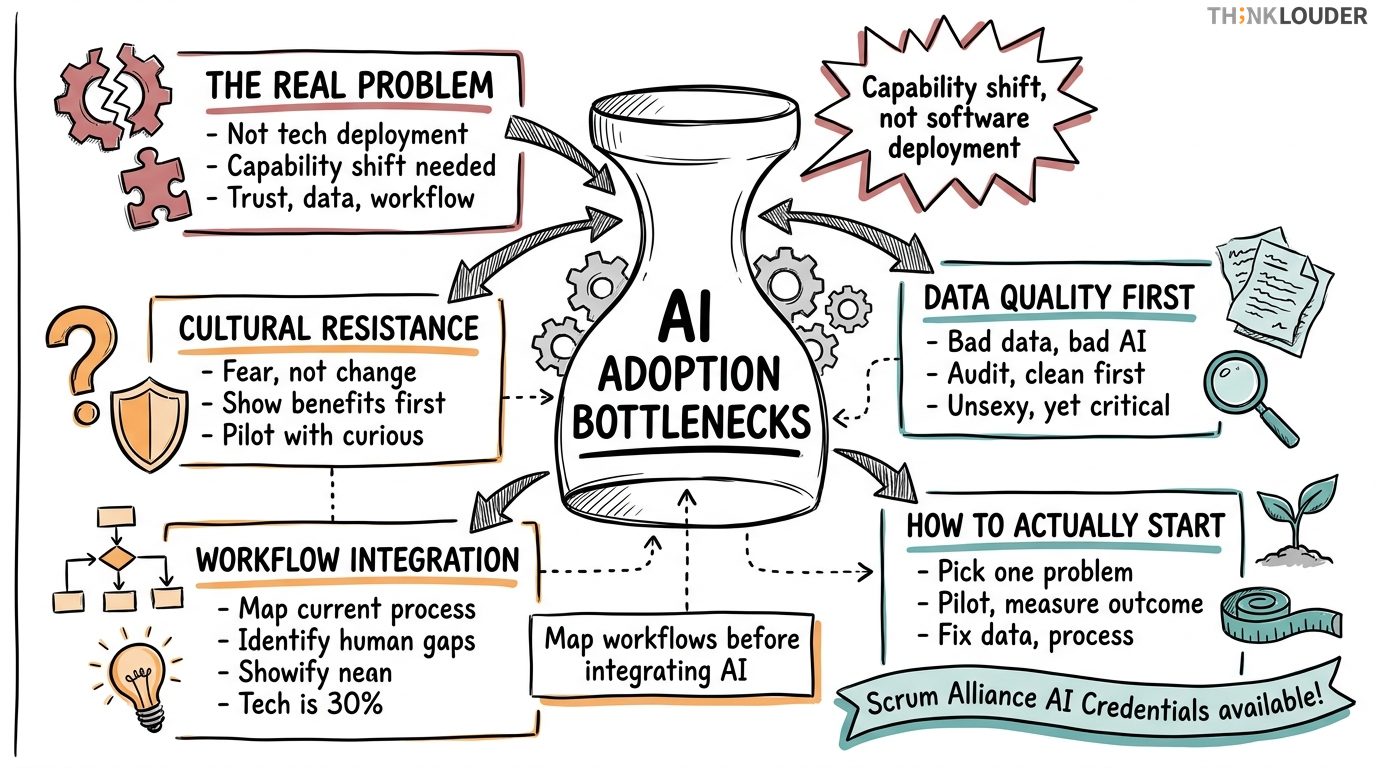
AI adoption fails almost never because the technology doesn't work. It fails because organizations treat it like a software deployment instead of a capability shift. You can't install AI the way you install Slack. You have to build it into how your teams actually work.
Let me sharpen the language a little bit. When we talk about "AI adoption challenges," we're really talking about three things that almost always jam up at the same time: people don't trust it yet, the data feeding it is a mess, and it doesn't slot into existing workflows without friction. Fix one and ignore the other two, and you're still stuck.
Where Cultural Resistance Actually Comes From
Here's what I hear in class: "Our team is resistant to change." That's not quite right. Your team isn't resistant to change. Your team is resistant to unclear change that might make their jobs harder or less secure.
When a Scrum Master or Product Owner introduces AI tooling without showing how it saves time or improves the work itself, people push back. That's not obstruction. That's self-protection. And it's rational.
The move is this: before you roll out any AI tool, run a small pilot with 4 to 6 people who are curious, not mandated. Let them use it for two weeks. Ask them what broke, what helped, what felt weird. Then take that feedback to the broader team, not as "here's what you're getting," but as "here's what we learned, and here's how we're adjusting before full rollout."
Cultural adoption isn't about convincing people to like change. It's about showing them the change works before they have to bet their productivity on it.
Data Quality: The Unsexy Blocker Nobody Talks About
You can't build good AI on bad data. And almost every organization has bad data somewhere.
I worked with a Product Owner last year who wanted to use AI to predict which features would land in the next quarter. Sounds smart, right? But the backlog had three years of inconsistent tagging, half the stories had no acceptance criteria, and nobody could agree on what "done" meant across teams. The AI tool would've given her confident-looking predictions built on a foundation of sand.
So we stopped. We spent two sprints cleaning up the backlog data first. Boring work. Nobody celebrates it. But after that, the AI predictions actually meant something.
The honest truth: data governance isn't exciting. It doesn't get budget easily. But it's the difference between an AI tool that helps and one that confidently misleads you. Before you adopt AI, audit your data. If 30% or more of your records are incomplete or contradictory, you've found your real first project.
Technical Integration Isn't the Hard Part
This one might surprise you. Most of the time, getting AI to work with your existing systems is straightforward. APIs exist. Connectors exist. That's not where teams get stuck.
They get stuck when they try to integrate AI into workflows that aren't actually documented. A Scrum Master asks, "How do we use AI in sprint planning?" and nobody can answer because sprint planning isn't actually a defined process yet, it's just "what we do on Monday."
Before you integrate AI, you need to map the actual workflow. Write down the steps. Name the decisions. Identify where a human is guessing or making calls based on intuition. That's where AI can add real value, not as a replacement but as a decision-support tool.
Then you build the integration. The technical part is maybe 30% of the effort. The workflow design is 70%.
How to Actually Start
If you're a Scrum Master or Product Owner looking to bring AI into your team's work, start with this sequence:
First, pick one small problem. Not "use AI everywhere." Pick something specific: "We spend 90 minutes every sprint refinement arguing about story size" or "Our release notes take two days to write." Something that costs you time or creates friction right now.
Second, run a two-week pilot. Grab 3 to 5 people who are genuinely interested (not drafted). Use an off-the-shelf AI tool. ChatGPT, Claude, whatever. No custom builds. See what works, what breaks, what feels wrong.
Third, measure the actual outcome. Not "people liked it." Did it save time? Did it improve quality? Did it reduce rework? If the answer is no to all three, stop and pick a different problem.
Fourth, fix your data and process before scaling. If the pilot worked, don't just roll it out. Audit the data that will feed the AI at scale. Document the workflow. Train three people deeply so they can train others.
Fifth, build feedback loops. After three months of use, ask the team what's working and what's not. Adjust. AI adoption isn't a one-time event. It's a capability you build and refine over quarters.
This approach takes longer than a big-bang rollout. But it also doesn't leave you with a $340,000 tool that nobody uses.
The Scrum Alliance AI Credentials
If you're serious about bringing AI into your Scrum practice, the Scrum Alliance AI for Scrum Masters and AI for Product Owners micro-credentials are worth your time. They're 4-8 hours, no exam, and they count toward CSM and CSPO renewal. More importantly, they're built by people who've actually done this work, not consultants selling a framework.
They cover the exact problem we've been talking about: not just the AI tools themselves, but how to integrate them into ceremonies, how to handle team dynamics around adoption, and how to measure what actually matters.
One More Thing
Use your judgment on pace. Some teams are ready to move fast on AI adoption. Others need more time to build trust. Your job as a Scrum Master or Product Owner is to read your team and move at the speed that keeps people engaged and safe, not at the speed that looks good in a board presentation.
Related Resources
- If you're ready to move past challenges, learn how to build your AI Adoption Strategy.
- Ready to move beyond challenges? Discover our AI Adoption Framework for effective deployment.
How it works in practice
- 1Pick one small problem
Not "use AI everywhere." Choose something specific that costs you time or creates friction right now. One thing you can measure in two weeks.
- 2Run a two-week pilot with volunteers
Grab 3 to 5 genuinely interested people. Use an off-the-shelf tool. No custom builds. See what works, what breaks, what feels wrong.
- 3Measure the actual outcome
Did it save time? Improve quality? Reduce rework? If the answer is no to all three, stop and pick a different problem.
- 4Audit data and document process before scaling
Fix your data quality and write down the workflow. Train three people deeply so they can train others. Don't skip this step.
- 5Build feedback loops and adjust quarterly
After three months of use, ask the team what's working and what's not. AI adoption is a capability you build and refine over time, not a one-time event.
One short email, every other Friday. Real-world Scrum lessons, no fluff. Unsubscribe anytime.