What people get wrong about this
This certification is about replacing Scrum Masters with AI robots.
The credential teaches you how to use AI to automate the mechanical work (summaries, pattern spotting, prompt generation) so you can spend more time on what robots can't do: coaching, conflict resolution, and reading the room.
I need to be technical or know how to code to take this.
You need to understand Scrum and be willing to experiment with tools. The technical details are the trainer's job. Most Scrum Masters who get the most value ask 'where could this save us time?' not 'how do I build this?'
This replaces my CSM credential or makes it obsolete.
This is an add-on to CSM or A-CSM, not a replacement. It assumes you already know Scrum fundamentals and deepens one dimension: how AI fits into the work you're already doing.
If I use AI to draft acceptance criteria or retro prompts, I'm cutting corners.
AI gives you a starting point in 30 seconds instead of 30 minutes. The real work still happens: the questions, the refinement with your team, the pushback. You're not replacing the conversation, you're removing the blank-page problem.
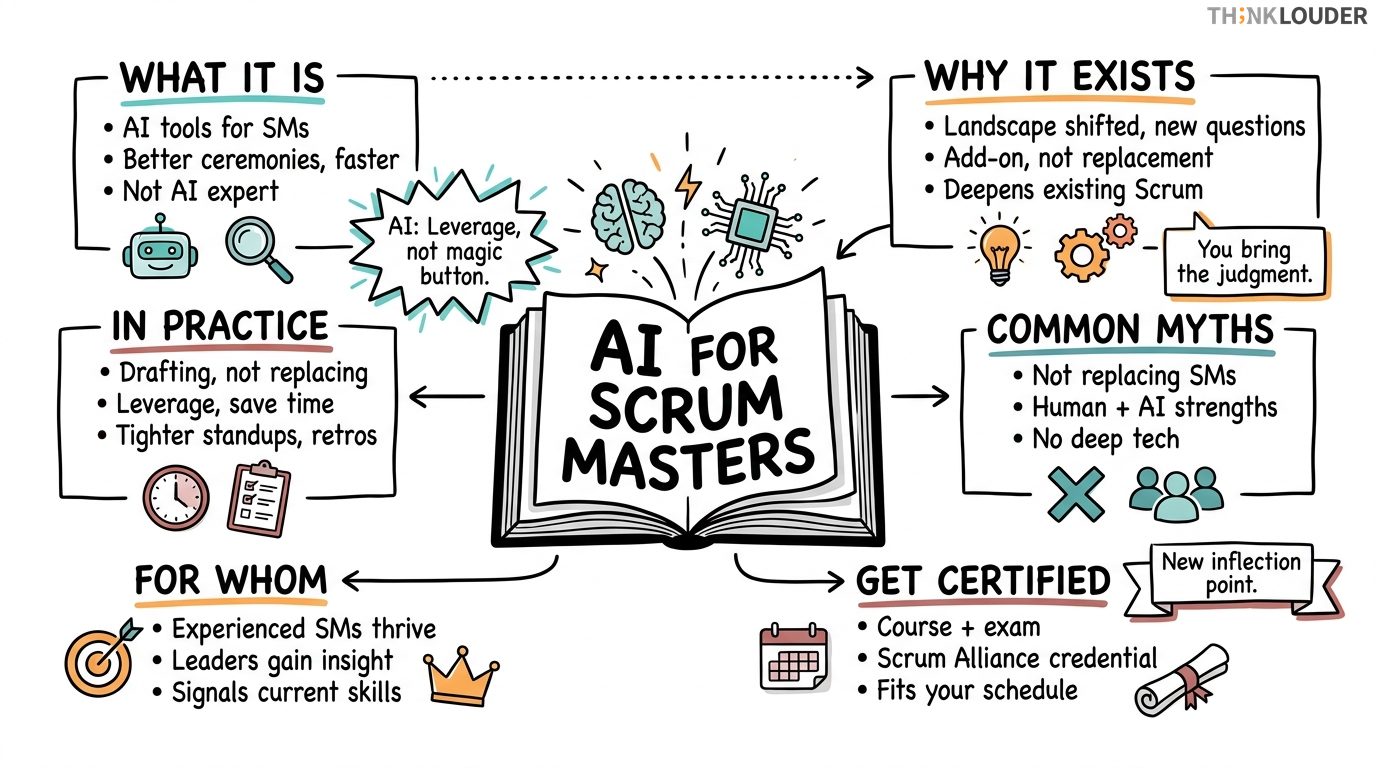
The AI for Scrum Masters micro-credential, launched by Scrum Alliance in October 2024, teaches you how to use AI tools and techniques in your day-to-day work as a Scrum Master. It's not about becoming an AI expert. It's about understanding where AI can help you run better ceremonies, spot team friction faster, and make smarter decisions with data.
Think of it like this: A few years ago, we trained Scrum Masters who'd never used a shared backlog tool. They thought they had to manage everything in email and spreadsheets. Once they saw how a tool changed their Monday morning, they couldn't imagine going back. AI is the same inflection point right now. Most Scrum Masters aren't using it yet. The ones who are are already pulling ahead.
Where This Credential Came From
Scrum Alliance created this micro-credential because the landscape shifted. Scrum Masters were getting asked questions they'd never heard before: "Can AI help us forecast velocity?" "Should we use a chatbot to summarize retro notes?" "How do I know if an AI tool is actually making us faster, or just busier?"
The credential isn't a replacement for your CSM (Certified Scrum Master) or A-CSM (Advanced Certified Scrum Master). It's an add-on. It assumes you already understand Scrum fundamentals and deepens one specific dimension: how AI fits into the work you're already doing.
The curriculum covers three core areas. First, how to evaluate and select AI tools without getting distracted by hype. Second, practical workflows: using AI to generate backlog summaries, spot team patterns in standup data, or draft retrospective prompts that actually land. Third, the guardrails: when AI helps and when it gets in the way.
How It Shows Up in Practice
Last week in a training, a Scrum Master asked me: "If I use AI to write acceptance criteria, am I cheating?" My answer was no, but let me sharpen this a little bit.
Acceptance criteria frame the conversation with your developers. They don't replace it. If you use AI to draft criteria, you're still going to sit with your Product Owner and your team and refine them. The AI saves you the blank-page problem. You get a starting point in 30 seconds instead of 30 minutes. Then the real work happens: the questions, the pushback, the "wait, what about this edge case?"
That's where most Scrum Masters get stuck right now. They see an AI tool and think it's either a magic button or a threat. The truth is simpler: it's a leverage point. Use it right and you get your time back. Use it wrong and you ship garbage criteria and blame the tool.
Here's what we're seeing in teams that've integrated AI well. Their standups are tighter because the Scrum Master uses AI to flag patterns in the notes before the meeting starts: "Hey, we've mentioned the same database blocker four days in a row. Let's unblock that first." Their retros move faster because prompts are personalized to the team's actual history, not generic templates. Their backlog stays cleaner because refinement sessions start with an AI-generated summary of related stories, so the team doesn't waste 15 minutes re-reading context.
But here's the honest part: this only works if your team trusts the Scrum Master and you're already running solid ceremonies. If your standups are already theater, AI won't fix that. If your retros are blame sessions, an AI prompt won't change the culture. The credential teaches you the tools, but you bring the judgment.
Common Misconceptions About This Certification
One thing we hear a lot: "This sounds like it's replacing Scrum Masters with robots." It's the opposite. The certification teaches you how to use AI so you can focus on the stuff robots can't do: coaching your team through conflict, reading the room when someone's checked out, knowing when to push back on a deadline and when to find a way to make it work. AI handles the mechanical stuff. You handle the human stuff.
Another one: "I need to be technical to take this." You don't. You need to understand Scrum and be willing to experiment. That's it. We've trained 45,000+ professionals, and the ones who get the most from AI training are the ones who ask "where could this save us time?" not "how do I build this?" The technical details are the trainer's job.
Who This Is For
If you're a Scrum Master who's been in the role for a year or more, this credential adds real value. You already know how to run ceremonies. Now you learn how to run them better with AI in your toolkit.
If you're a team lead or manager supporting Scrum Masters on your team, this credential helps you understand what's possible and what's hype. You can ask smarter questions about tool investments and spot when an AI solution is actually solving a problem or just adding complexity.
If you're a career changer moving into Scrum Master roles, we'd recommend getting your CSM first. That teaches you the foundation. Then add the AI credential once you've run a few sprints and know what your actual pain points are.
If you're an HR leader or executive thinking about Agile transformation, this credential signals something important: your Scrum Masters are staying current. It's not flashy. It's practical. That matters.
How to Get It
The credential comes from Scrum Alliance, just like CSM and CSPO. You'll take a course (we offer AI for Scrum Masters training that covers the material), then sit for an exam. It's not a multi-day commitment like CSM. It's designed to fit into your schedule.
The exam is pass-or-money-back. If you don't pass, you get your money back and can retake it. That's the guarantee.
When you're ready to explore our training options, look for the AI for Scrum Masters course. We run cohorts regularly, and you can join live or self-paced depending on how you learn best.
One last thing: this credential is still new. Not many Scrum Masters have it yet. That's actually an advantage for you. If you're thinking about it, now's the time. In two years, it'll be table stakes. Get ahead of it.
What's Next
If you're curious whether this credential fits your role right now, ask yourself three questions. First: am I already solid on Scrum fundamentals and running real ceremonies? Second: do I have specific pain points in my week that feel like they could be automated or accelerated? Third: am I willing to experiment with tools and learn what works for my team?
If you answered yes to all three, check out our upcoming AI for Scrum Masters courses. We've trained thousands of practitioners, and the feedback is consistent: the Scrum Masters who take this course come back saying they got 3-5 hours a week back. That's real.
If you're also exploring how AI fits into other Scrum roles, check out AI for Product Owners, which covers how POs use AI for backlog prioritization and data analysis without abandoning Scrum fundamentals.
Start by exploring the certification options to see how this fits with your current credentials. Then reach out to schedule a conversation about whether now is the right time for your team.
Related Resources
- Considering other certifications? Explore the Price of PMP Certification to understand its costs.
How it works in practice
- 1Assess your Scrum foundation
Make sure you're solid on CSM fundamentals and running real ceremonies. The AI credential assumes you already know how to facilitate a standup, run a retro, and coach a team. If you're still building those skills, get your CSM first.
- 2Identify your specific pain points
Where in your week do you feel like you're doing work that could be accelerated or automated? Backlog summaries taking too long? Spotting team patterns manually? Generating retro prompts from scratch? Pick one or two real problems, not hypothetical ones.
- 3Explore AI tools in your current workflow
Before enrolling, spend a week experimenting with one AI tool in your actual work. Use it for one ceremony or one backlog task. See what it does well and where it falls short. This gives you context for the course.
- 4Enroll in the AI for Scrum Masters course
Take the course live or self-paced, depending on your learning style. The curriculum covers evaluation, practical workflows, and guardrails. Budget 8-12 hours total, spread over 2-3 weeks.
- 5Run one experiment with your team
Pick one AI workflow to introduce to your team. Document what changes: Did standups get shorter? Did retro notes improve? Did the team trust the tool? Use this data to decide what to scale.
- 6Sit for the exam
The exam is pass-or-money-back. Study the course materials, review the guardrails (when AI helps and when it doesn't), and take the test. Most Scrum Masters pass on the first attempt.
One short email, every other Friday. Real-world Scrum lessons, no fluff. Unsubscribe anytime.