What people get wrong about this
Critical path methodology is how we schedule sprints and manage dependencies in Scrum
CPM is a waterfall technique for fixed-scope, sequential projects. Scrum teams use backlogs, sprints, and velocity instead. CPM assumes you know all the work upfront; Scrum assumes you'll discover it as you go.
If I calculate the critical path once, I can rely on it for the whole project
CPM is only as accurate as your estimates. When dependencies change or estimates slip (which they do), your critical path becomes outdated. It's useful for initial planning, not ongoing prediction.
Tasks with float don't matter, so I can ignore them
Float only works if the team respects dependencies and doesn't let slack tasks slip arbitrarily. In practice, people often work on non-critical tasks longer than planned, which erases the float and makes them critical anyway.
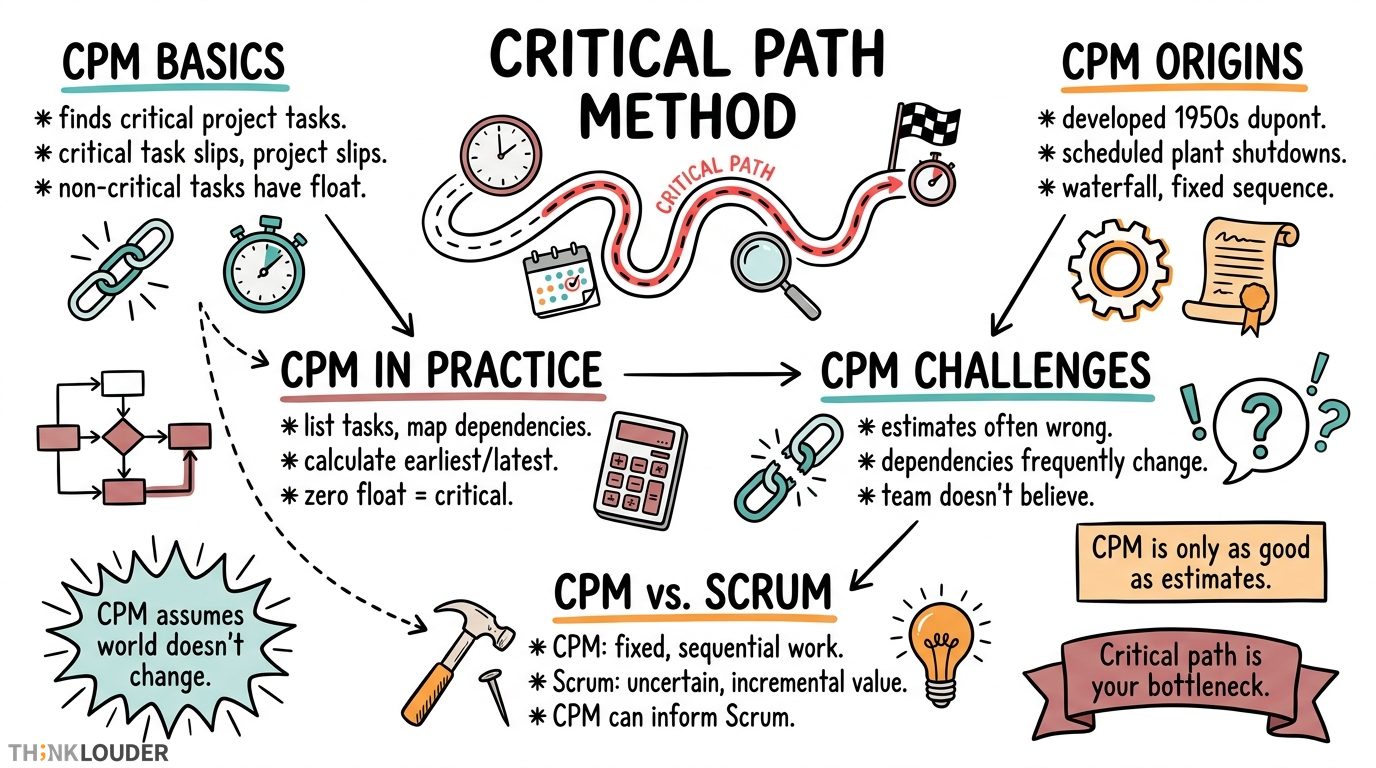
Critical Path Methodology (CPM) is a scheduling technique that identifies which tasks in a project must be completed on time for the entire project to finish on schedule. If any task on the critical path slips, your project end date slips. Tasks off the critical path have some flexibility, called float or slack, which means they can slip a few days without affecting the overall deadline.
Here's the thing: if you're running Scrum, you probably don't need to think about CPM at all. But if you're managing a complex, sequential project with hard dependencies and a fixed deadline, CPM is how you find the bottleneck.
Where Critical Path Methodology Comes From
CPM was developed in the late 1950s by DuPont engineers and Remington Rand to schedule maintenance shutdowns in chemical plants. They needed a way to figure out which tasks, if delayed, would push the entire shutdown past the maintenance window. The math was simple: map every task, draw the dependencies, calculate forward and backward through the network, and the longest path from start to finish is your critical path. No slack, no room for delay.
It's a waterfall concept, full stop. Tasks happen in sequence. You know all the tasks upfront. You know how long each one takes. CPM assumes the world doesn't change much between now and delivery.
That's why Scrum teams don't use it. Scrum assumes uncertainty. You discover work as you go. Dependencies emerge during the sprint. Your backlog isn't a fixed sequence; it's a queue that changes based on feedback and learning. If you tried to run CPM on a Scrum backlog, you'd be redrawing the critical path every three days, and the tool becomes useless.
How Critical Path Methodology Actually Works in Practice
Let's say you're building a bridge. You've got 47 tasks. Some can happen in parallel (foundation work and permitting), but most depend on prior work. Concrete has to cure before you pour the deck. The deck has to be done before you install railings.
You list every task, estimate its duration, and map dependencies. Then you calculate two things for each task: the earliest it can start, and the latest it can start without delaying the project. The difference between those two numbers is your float. A task with zero float is on the critical path. A task with three days of float can slip three days without hurting the deadline.
Once you know the critical path, you manage it obsessively. You don't worry much about the tasks with float. You pour resources into the critical tasks. You watch them like a hawk.
The math is mechanical. Forward pass: calculate the earliest start and finish for every task. Backward pass: calculate the latest start and finish. The tasks where earliest finish equals latest finish are on the critical path.
Where Teams Get Stuck with Critical Path Methodology
Three things go wrong with CPM in practice.
First, the estimate is wrong. You think the concrete cure takes five days; it actually takes seven. Now your critical path is invalid, and your deadline is already at risk. CPM is only as good as your estimates, and most teams underestimate by 20 to 40 percent. You can't fix that with a better spreadsheet.
Second, dependencies change. You discover mid-project that task B actually depends on task C, not the other way around. Or a new regulatory requirement forces you to insert a task you didn't plan for. Every time the network changes, you recalculate the critical path. If this happens weekly, CPM stops being a planning tool and becomes a reactive status report. It's describing what happened, not predicting what will happen.
Third, people don't believe it. You tell a team member that their task is not on the critical path, so it's okay if it slips by a few days. They slip it by a week because they were busy with something else. Now the slack is gone, and suddenly their task is critical. Or they finish early, and instead of pulling forward the next task, they start something else entirely. Float only works if the team respects the dependency logic, and most don't.
CPM vs. Scrum: When to Use What
Use CPM when you've got a fixed scope, fixed deadline, sequential work, and you need to know exactly which tasks will break the deadline if they slip. Construction, manufacturing, infrastructure, regulatory compliance projects. The work is largely predictable, dependencies are real and hard, and the cost of delay is high.
Use Scrum when you're building something new, you don't know all the requirements upfront, you need to learn as you go, and you want to deliver value incrementally. Software, product development, research, anything where the customer might change their mind or where you discover better approaches mid-project.
If you're a Scrum Master managing a software team and someone mentions critical path, you can nod and move on. Your tool is the sprint, the backlog, and velocity. If you're a project manager running a construction or infrastructure program, CPM is your language.
That said, even in Scrum-based environments, there are moments when CPM thinking is useful. If your team has a hard external deadline (a regulatory filing, a conference launch, a hardware release window), and you're trying to figure out which dependencies will bite you, sketching out a critical path for the next two or three sprints can clarify risk. You won't maintain it religiously, but the exercise of thinking through dependencies and float is valuable. When you're managing complex release dependencies across multiple teams, that kind of dependency mapping becomes especially important.
The Honest Limitation
CPM assumes you can predict the future. You can't. The longer your project, the less accurate your estimates become. A five-day task estimate is probably close. A five-month estimate is a guess. CPM doesn't account for the unknown unknowns, the tasks you didn't plan for, the person who gets sick, the vendor who ships late, the requirement that changes halfway through.
What CPM does well is surface which tasks matter most. It forces you to name dependencies explicitly. It shows you where parallelization is possible. It tells you where to focus your risk management effort. Use it for that. Don't use it to pretend you know the future.
If you're leading an Agile team and you want to understand how dependencies and sequencing work at a deeper level, learning CPM concepts is useful. It helps you think about flow, bottlenecks, and resource constraints. But the mechanics of CPM, the Gantt charts and float calculations, are a waterfall artifact. Your Product Owner and team don't need to master them. What they need is a shared understanding of which work blocks which other work, and how to surface that risk early in the sprint.
For teams scaling Scrum across multiple teams or managing complex release dependencies, frameworks like SAFe and LeSS do address sequencing and dependencies, but they do it through backlog refinement and cross-team coordination, not through critical path calculation. The thinking is similar, the tooling is different.
How it works in practice
- 1List every task and estimate duration
Write down all the work, break it into discrete tasks, and estimate how long each one takes. Be honest about uncertainty. If you're guessing, say so.
- 2Map task dependencies
For each task, identify which other tasks must finish before it can start. Draw it out as a network or flowchart. This is where the real thinking happens.
- 3Calculate forward pass
Starting from day one, calculate the earliest each task can start and finish based on its dependencies. This tells you the minimum project duration.
- 4Calculate backward pass
Starting from the deadline, work backward to find the latest each task can start and finish without delaying the project. This tells you where you have wiggle room.
- 5Identify the critical path
Tasks where earliest finish equals latest finish have zero float. These are your critical path. Any delay in a critical task delays the whole project.
- 6Manage critical tasks ruthlessly
Focus your risk management, resources, and oversight on critical tasks. Don't worry as much about tasks with float, but monitor them to make sure float doesn't disappear.
One short email, every other Friday. Real-world Scrum lessons, no fluff. Unsubscribe anytime.