What people get wrong about this
I have to pay for a CSPO exam after I finish the course.
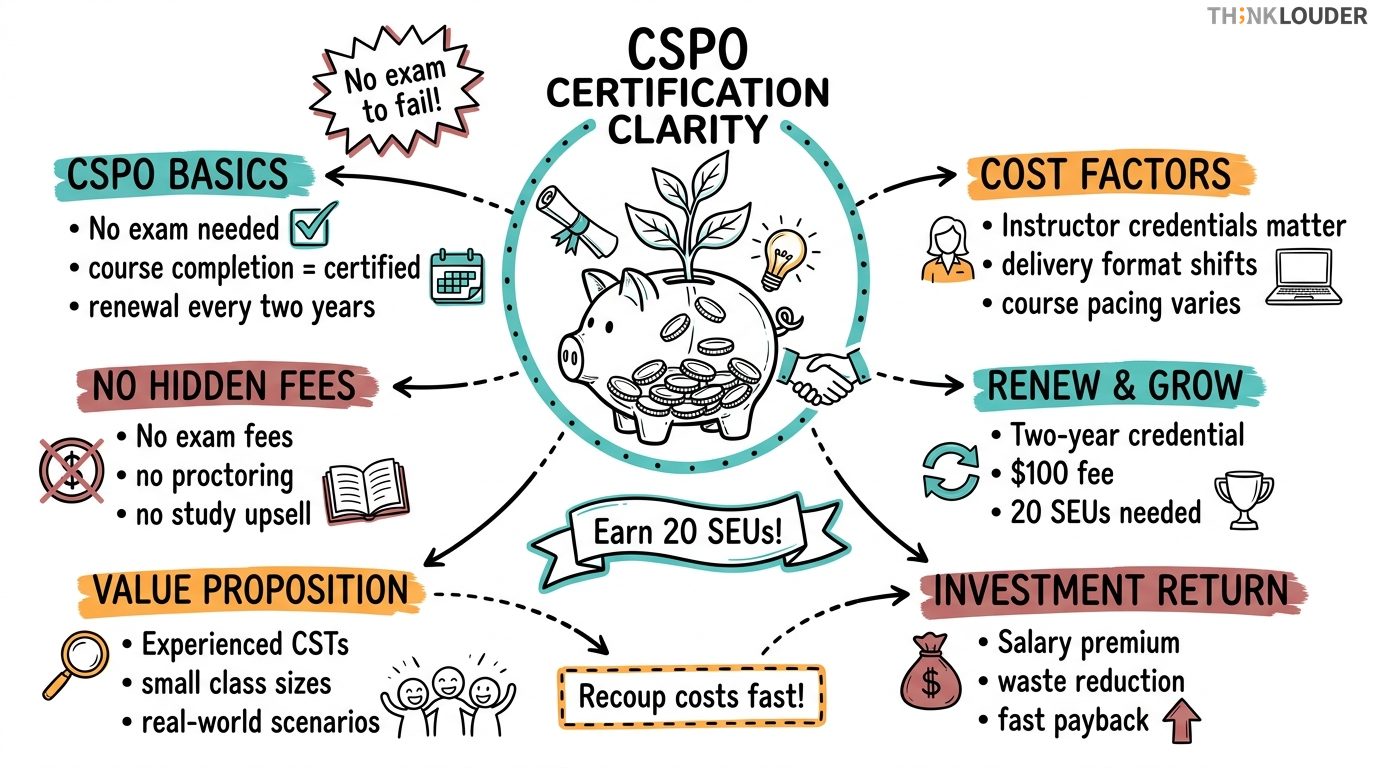
CSPO has no exam. You're certified when you complete the two-day course with full attendance and instructor sign-off. The Scrum Alliance doesn't charge an exam fee because there's nothing to sit.
Once I pay for CSPO, I'm certified for life.
Your CSPO credential lasts two years. To renew, you'll pay $100 and earn 20 Scrum Education Units through approved training or speaking. Most product owners do this by taking one additional course every two years.
CSPO and PSPO are the same thing, just different names.
CSPO is from Scrum Alliance. PSPO is from Scrum.org. They're separate credentials with different renewal requirements. Know which one your organization actually wants before you sign up.
A Certified Scrum Product Owner (CSPO) certification from Scrum Alliance runs you somewhere between $349 and $599 for the two-day course, depending on the provider and delivery format. Then every two years, you'll pay a renewal fee (currently $100) to keep the credential active. That's it. No exam to fail and retake. No hidden proctoring fees. No study material upsell.
But here's what trips people up: they're comparing CSPO to something like AWS certifications or PMP, where you pay for a course AND then pay separately to sit an exam. CSPO doesn't work that way. You complete the course, the instructor signs off on your attendance and engagement, and you're certified. The Scrum Alliance issues your credential on the spot.
Where the CSPO Cost Variation Comes From
Three things move the needle on what you'll pay.
Instructor credentials matter. A Certified Scrum Trainer (CST) like Giora Morein has gone through a rigorous vetting process with Scrum Alliance. There are roughly 250 CSTs globally. When you take a course from a CST, you're getting someone who's trained 45,000+ professionals and holds a 4.9/5 rating from 5,582+ verified Trustpilot reviews. That depth of experience and accountability typically shows up in the course design and how the instructor handles real-world scenarios your team's facing. It also typically costs a bit more, but the difference is usually $100–$200, not $1,000.
Delivery format shifts costs. In-person courses in major cities (New York, San Francisco, London) often run higher than online cohorts, partly because venues and catering cost money. Virtual training lets providers drop some overhead, so you'll sometimes see lower pricing online. But you're also losing the hallway conversations and the ability to work through a real backlog item with the instructor in real time. Your mileage will vary on whether that tradeoff matters.
Boot camp vs. standard pacing. A few providers offer condensed one-day or half-day CSPO sprints. Those are cheaper upfront but pack a lot into a short window. Standard two-day courses give you breathing room to actually practice writing stories, refining acceptance criteria, and handling pushback from stakeholders. Most people retain more from the two-day format.
What You Don't Pay For
One quick reset: CSPO has no exam. You won't see a line item for "exam fee" because it doesn't exist. The Scrum Alliance doesn't charge to sit an exam because there is no exam. Your instructor evaluates whether you've met the learning objectives during the course itself. If you've shown up, engaged, and demonstrated that you understand the role, you're certified.
You also won't pay for mandatory study materials. Some providers bundle workbooks or templates, but they're not a separate charge. And you don't need to buy Scrum.org study guides or third-party exam prep courses. That's not how CSPO works.
The Renewal Piece
Here's the part people forget until year two: your CSPO credential lasts two years. To keep it active, you'll need to pay the renewal fee ($100) and earn 20 Scrum Education Units (SEUs) through approved training, speaking, or writing. You can't just pay the fee and keep the old credential.
What counts? Taking another CSPO course (that's 16 SEUs right there). Teaching Scrum. Writing a published article on Agile product management. Speaking at a conference. There are dozens of approved activities. Most product owners find that one additional course every two years, plus maybe a workshop or two, gets them to 20 SEUs without much friction.
Why CSPO Costs What It Does
Scrum Alliance sets the pricing boundaries, but individual licensed providers operate within that range. ThinkLouder's pricing sits in the middle-to-upper range because we staff courses with CSTs, cap class sizes around 20 people (so you're not in a lecture hall with 100 others), and include real-world scenario work. You're not paying for a certificate that looks nice on LinkedIn. You're paying for instruction from someone who's run actual product teams and can answer the question "What do I do on Monday when the CTO and the customer want opposite things?"
That specificity costs more than a generic online course, and it should.
Return on Investment
Let's ground this in numbers. A product owner in a mid-market tech company typically earns $95,000–$125,000 in the U.S. (Bureau of Labor Statistics, accessed January 2025). A CSPO-certified product owner often commands a 5–10% premium because they've demonstrated they understand backlog management, how to work inside a Scrum framework, and how to say no to stakeholders in a way that sticks. That's $5,000–$12,500 a year. Your $400–$600 course pays for itself in the first month.
For organizations, the ROI is harder to quantify but real. We've worked with teams where the product owner was making decisions in a vacuum, shipping features nobody wanted, and burning through sprint capacity on rework. After CSPO training, they learned to write stories that actually clarified scope, run refinement sessions that surfaced dependency risks early, and handle pushback from leadership without caving. That's not a 10% productivity bump. That's sometimes 30–40% waste reduction in the first two quarters.
If you're curious how AI is reshaping what product owners actually do in the backlog, check out how AI is changing project management and what that means for your role.
How to Get Started
If you're ready to explore CSPO training options, start by checking whether your organization will cover the cost. A lot do, especially if you're already in a product or leadership role. If they won't, the $349–$599 is a solid investment in your own career, and you'll recoup it fast.
Next, check the schedule to find a course that fits your calendar. Look for a CST-led cohort if you can. You're not just getting a certificate, you're getting access to someone who's seen this role work and fail in dozens of organizations.
Finally, think about timing. If you're up for renewal on an old credential or you're new to the role, now's the time. The framework hasn't changed, but the way teams use Scrum has evolved, and a fresh course will catch you up on how product owners are actually writing stories, running refinement, and handling AI in the backlog today.
One More Thing
Don't confuse CSPO with PSPO. They're different credentials from different organizations. CSPO is from Scrum Alliance. PSPO is from Scrum.org. Both are legitimate, but they're not interchangeable, and they don't have the same renewal requirements. If you're shopping around, know which one your organization or hiring manager actually wants.
Related Resources
- Once you're certified, learn how to build real connections with our PMP Networking Strategy.
- To understand how your certified skills apply, explore Agile Scrum Meetings: What They Are and Why Your Team Needs Them.
How it works in practice
- 1Confirm your organization will cover the cost
Many employers pay for CSPO training, especially if you're already in a product or leadership role. Check with HR or your manager before deciding to pay out of pocket.
- 2Find a CST-led course on the schedule
Look for a course taught by a Certified Scrum Trainer. You're paying for expertise and real-world experience, not just a certificate factory.
- 3Plan for renewal two years out
Budget $100 for the renewal fee and time to earn 20 SEUs. One additional course every two years is the easiest path.
- 4Track the ROI in your first 90 days
After certification, measure how your backlog clarity, story quality, and stakeholder alignment improve. Document the wins so you can justify the investment to your organization.
One short email, every other Friday. Real-world Scrum lessons, no fluff. Unsubscribe anytime.