What people get wrong about this
Standup is for reporting status to the boss or Scrum Master.
Standup is the team aligning to each other on what's done, what's next, and what's blocked. The Scrum Master listens for impediments to solve offline, not to collect status.
Retro is a complaint session where we vent and nothing changes.
Retro is where you run experiments. You identify one or two things to try differently next sprint and actually do them. Without action, it's just venting.
We can skip ceremonies when we're too busy.
When you're busiest is when you need ceremonies most. Skipping retro means you'll repeat the same mistakes. Skipping standup means blockers hide until they explode.
Scrum meetings are the same regardless of team size or context.
The structure and time-boxes stay constant, but how you run them adapts. A six-person team and a 40-person program look different, but the rhythm is the same.
What Agile Scrum Meetings Actually Are
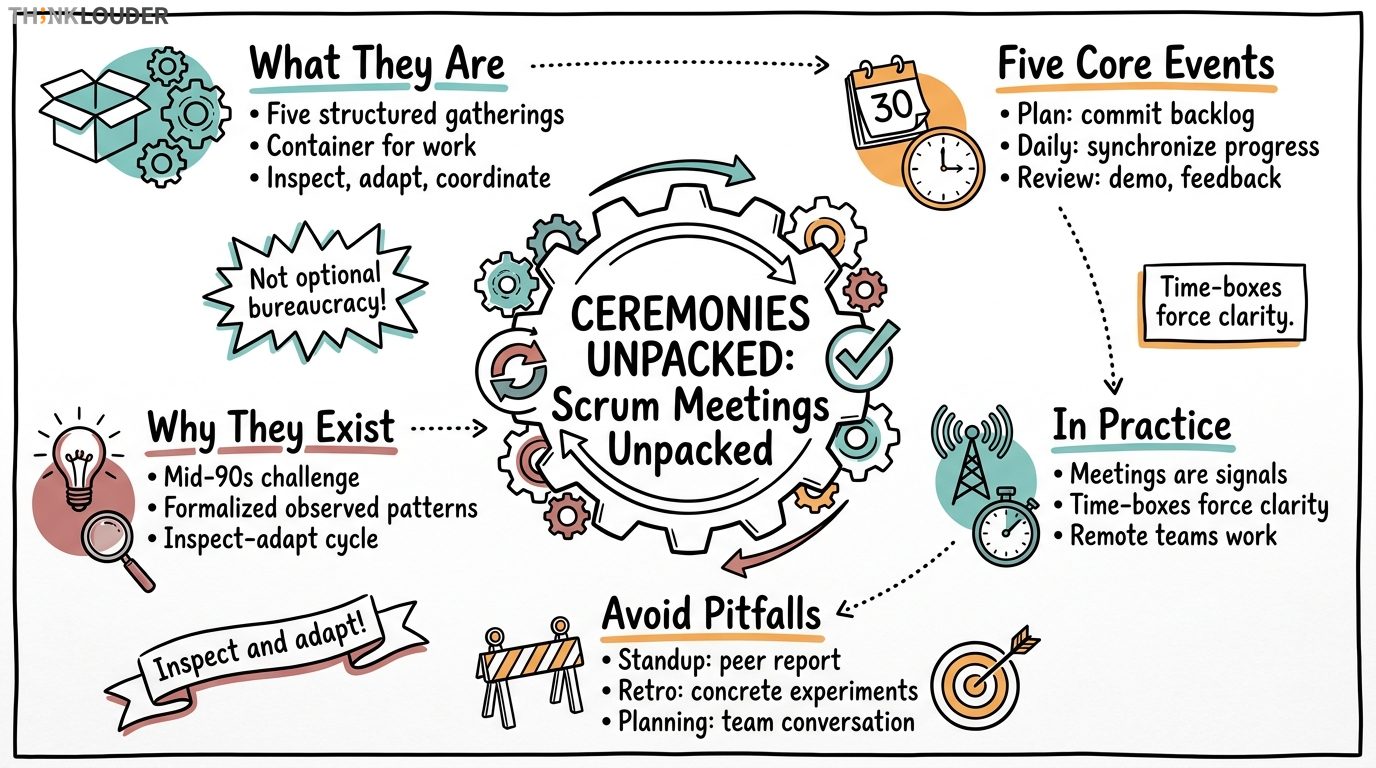
Scrum meetings, also called ceremonies, are the five structured gatherings that make a sprint work. They're not optional add-ons or bureaucracy. They're the container that holds your team's work, keeps everyone aligned, and surfaces problems before they spiral.
Here's the simplest definition: Agile Scrum meetings are time-boxed events where your team coordinates work, inspects progress, and adapts. Nothing more. The Scrum Guide (2020 version published by Ken Schwaber and Jeff Sutherland) defines four core ceremonies, plus one meta-event that wraps them all: the Sprint itself.
Why does this matter on Monday morning? Because most teams run meetings that feel like theater. Scrum meetings, when done right, replace that theater with signal. You walk out knowing what's blocked, what's next, and whether you're on track.
The Five Scrum Meetings, and What Each One Does
Sprint Planning kicks off the sprint. Your Product Owner presents prioritized work from the backlog. Your Developers ask questions, estimate effort, and commit to what they can complete in the next two weeks (or one week, or whatever your sprint length is). This isn't a negotiation; it's a conversation about capacity and risk. Time-boxed to two hours per week of sprint length (so four hours for a two-week sprint).
Daily Standup happens every morning for 15 minutes. Each Developer answers three things: What did I finish yesterday? What am I working on today? What's blocking me? The Scrum Master watches for impediments and pulls them out of the standup to solve separately. This is not a status report to the boss. It's the team aligning to each other.
Sprint Review shows finished work to stakeholders and gathers feedback. You demo what's done, not what's almost done. This is your feedback loop from the outside world. Time-boxed to one hour per week of sprint length.
Sprint Retrospective happens after the review, same day. Your team reflects on how you worked together, not just what you built. What went well? What slowed us down? What will we try differently next sprint? Time-boxed to 45 minutes per week of sprint length. This is where continuous improvement actually happens, not in some annual offsite.
The Sprint itself is the container. One to four weeks of focused work, bounded by a start and an end. Everything else hangs inside it.
flowchart LR
  A[Sprint Planning] --> B[Daily Standups]
  B --> B
  B --> C[Sprint Review]
  C --> D[Retrospective]
  D --> E[Next Sprint Begins]
  E --> A
Where This Comes From
Scrum emerged in the mid-1990s when Ken Schwaber and Jeff Sutherland were wrestling with the same problem teams face now: traditional project management (Waterfall, stage-gates, six-month plans) doesn't work when requirements change or you don't know what you don't know. They observed high-performing teams and noticed they had short feedback loops, regular check-ins, and built in time to learn from mistakes. They formalized that pattern into Scrum.
The meetings aren't arbitrary. Each one serves a specific purpose in the inspect-and-adapt cycle. You inspect work (Review), you inspect process (Retrospective), you inspect capacity and commitment (Planning), and you inspect progress daily (Standup). Without these moments, you don't know if you're heading toward a cliff until you're already falling.
How This Shows Up in Practice
Years ago we had 120 developers across 18 teams, all nominally "Scrum" but running meetings like they were checking boxes. Standups lasted 45 minutes. Retros were status reports. Sprint Planning was the Product Owner downloading the backlog into the team. We ran a Scrum Master certification cohort and retrained the Scrum Masters on what these meetings actually do. Within two sprints, standup was 12 minutes. Retros surfaced real friction. Planning became a conversation instead of a lecture.
The shift happened because the Scrum Masters stopped treating ceremonies as meetings and started treating them as signals. A 45-minute standup isn't a communication problem; it's a signal that the team doesn't have a shared understanding of the work or that someone's blocked and the Scrum Master didn't pull it out.
In practice, your meetings will look different depending on team size, domain, and context. A six-person team working on a single product has different dynamics than a 40-person program with dependencies. But the structure stays the same. And the time-boxes matter more than you think. When you say "Daily Standup is 15 minutes," you're forcing clarity. Vague updates get cut. Only what matters surfaces.
Remote teams often worry that Scrum meetings don't work on video. They do, if you're intentional. Cameras on. One person talking at a time. No multitasking. Some of our best retros have been fully distributed, because the async-first tooling (shared doc, voting, breakout rooms) actually surfaces more honest feedback than in-person sometimes does.
Common Pitfalls and How to Avoid Them
Standup as status theater. The Scrum Master or manager sits in and asks "What did you do?" Everyone reports up instead of to each other. Fix: Scrum Master facilitates, doesn't interrogate. Developers talk to Developers. If the Scrum Master hears an impediment, they note it and solve it offline.
Retro as complaint session with no action. Team vents, nothing changes, retro feels pointless. Fix: End every retro with one or two experiments for next sprint. "This sprint we'll try pair programming for high-risk tasks" or "We'll do a 30-minute refinement session before Planning." Something concrete. Make it a hypothesis, not a mandate.
Planning as a Product Owner monologue. PO talks for three hours, team nods, sprint starts with half the team confused. Fix: Product Owner presents the "why" and the top three priorities. Developers ask questions and estimate. If it takes longer than the time-box, you don't have enough clarity in your backlog. That's a backlog refinement problem, not a Planning problem. Refinement happens between sprints, with a smaller group.
Review as a demo, not feedback. You show finished work, stakeholders clap, nothing changes. Fix: Invite people who can actually change direction or give you real feedback. Ask "What surprised you?" and "What would you do differently?" not "Do you like it?" The review is your early warning system. Use it.
Skipping ceremonies when you're busy. "We're too slammed to retro this sprint." That's exactly when you need it most. Fix: Protect the time-boxes. They're not optional. When you skip a retro, you're betting you won't make the same mistake next sprint. You will.
Why This Matters Beyond the Team
If you're managing teams or sponsoring an Agile transformation, Scrum meetings are your leading indicator. A team that has tight, focused ceremonies is a team that's learning. A team that's skipping retros or running 90-minute standups is a team that's either confused about the work or confused about Scrum. Both are fixable, but you need to see it.
For Product Owners especially, the Review and Planning meetings are where you earn trust. Show up with a clear backlog. Listen to what the team tells you about capacity. Adjust based on feedback. You're not pushing a plan down; you're pulling the team forward.
For Scrum Masters, these ceremonies are your primary tool. You're not running meetings; you're protecting them. You're watching for impediments, keeping time, and making sure the team has what it needs to stay focused.
If you're new to Scrum or leading a team through a transition, the ceremonies can feel like overhead at first. That's normal. By sprint three or four, when you see a real problem surface in retro and actually fix it, or when standup catches a blocker before it cascades, you'll understand why these patterns have stuck around for 25 years.
Use your judgment about format. Some teams use a physical board, some use Jira, some use a spreadsheet. The tool doesn't matter. The discipline of the time-box and the honesty of the conversation do.
Related Resources
- Ready to apply your agile skills to career growth? Learn how to build real connections with our PMP Networking Strategy.
- Considering a leadership role in your scrum team? Understand the full CSPO Certification Cost.
How it works in practice
- 1Protect the time-boxes
Standup is 15 minutes, Planning is two hours per week of sprint length, Review and Retro are one hour and 45 minutes respectively. When you enforce the boundary, you force clarity. Vague updates get cut. Only what matters surfaces.
- 2Make the Scrum Master the guardian, not the recorder
The Scrum Master's job is to watch for impediments, keep time, and protect the team's focus. They're not taking minutes or reporting up. If someone says "I'm blocked," the Scrum Master pulls it out and solves it separately.
- 3End every retro with one or two experiments
Don't leave the retro without committing to something concrete you'll try next sprint. "This sprint we'll pair on risky work" or "We'll do 30 minutes of refinement before Planning." Make it a hypothesis, not a mandate.
- 4Use Review as a feedback loop, not a demo stage
Invite people who can actually change direction. Ask "What surprised you?" and "What would you do differently?" The review is your early warning system. Use it to adapt.
- 5Separate Planning feedback from backlog clarity problems
If Planning runs over the time-box, you don't have enough clarity in your backlog. That's a refinement problem, not a Planning problem. Refinement happens between sprints with a smaller group.
One short email, every other Friday. Real-world Scrum lessons, no fluff. Unsubscribe anytime.