What people get wrong about this
Networking is about collecting as many connections as possible. The more people I reach out to, the better my odds.
Networking is about identifying the right people and building genuine relationships. 40 real conversations beat 97 generic connection requests every time.
I'll write one good message and send it to all 97 people with their name filled in. That's efficient.
Generic messages get 3 to 5 percent response rates. Personalized outreach that references something specific about their work gets 40 percent or higher. The extra time upfront saves you time overall.
Networking ends after the initial connection. Once they accept my request, the work is done.
The initial outreach is the beginning. Real relationships require follow-up, genuine engagement, and ongoing value exchange. That's where the actual opportunity lives.
PMP networking isn't about collecting business cards or grinding through LinkedIn connection requests. It's about identifying people who work in your domain, understanding what they're solving, and building relationships where you can genuinely help each other.
When we talk about reaching 97 PMPs in 6 weeks, we're not talking about spray-and-pray outreach. We're talking about a structured approach where you know who you're contacting, why they matter to your goals, and what you're actually offering them beyond "let's connect."
Where This Matters
Years ago, we had a project manager in a financial services firm who needed to transition into a larger leadership role. She had her PMP credential, but her network was thin, mostly people from her current company. Over 8 weeks, she systematically reached out to 73 PMPs across her industry, not to ask for a job, but to learn how they structured their programs and handled complex stakeholder situations. By week 6, she'd had substantive conversations with 31 of them. Three months later, one of those contacts brought her into a transformation initiative at a competitor, and she got the role she was targeting. The credential opened the door. The network got her through it.
That's the difference between having a PMP and using it.
The Real Problem With Generic Outreach
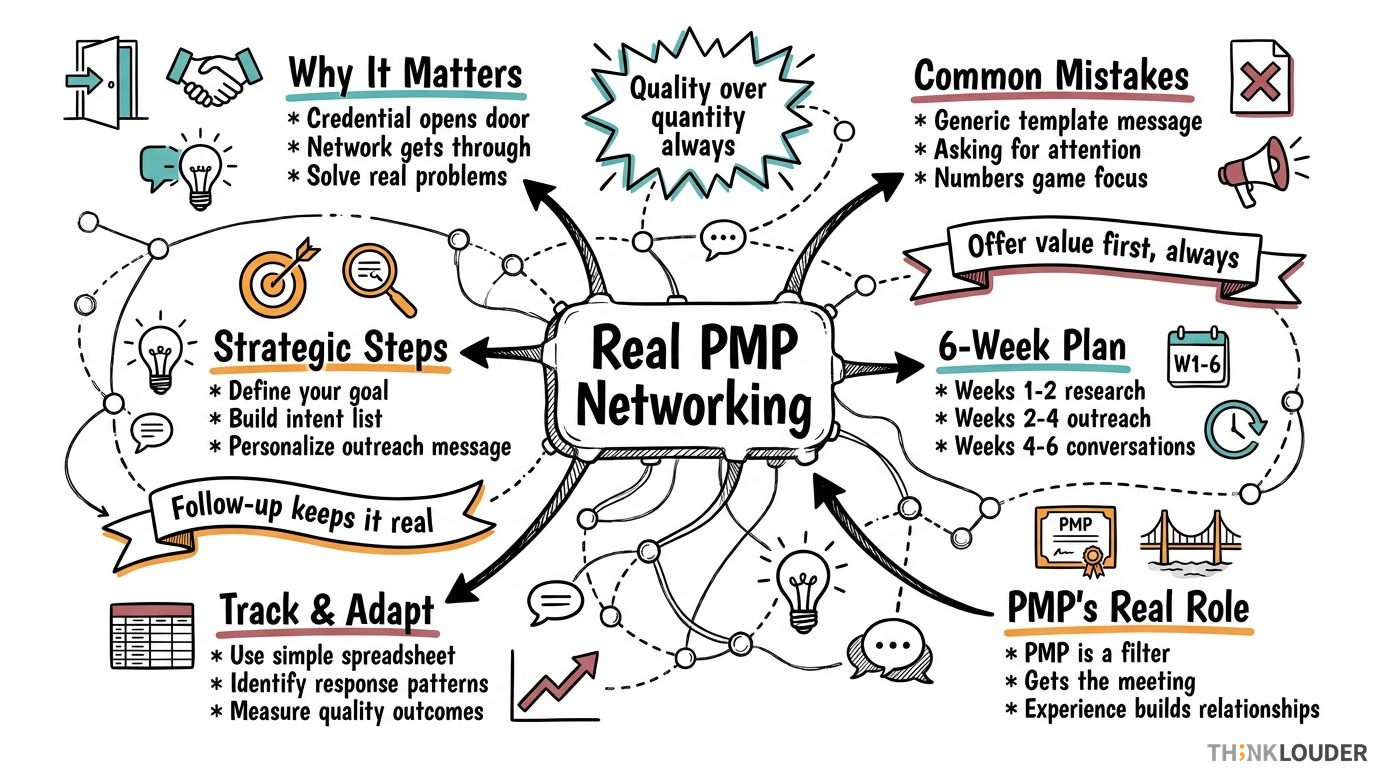
Most people approach this wrong. They build a list of 97 names, write one template message, and send it 97 times. Response rate? Usually 3 to 5 percent. Why? Because a generic "I noticed you're a PMP and I'd love to connect" doesn't give anyone a reason to care. You're not offering value. You're asking for attention.
The move is to flip that. Before you send a single message, you need to know three things about each person: what their role is, what problem they're probably solving, and what you know that might be useful to them. That takes time. But it's the difference between 5 responses and 40.
How to Actually Structure This
Start by defining what "success" looks like for you. Are you trying to land a specific role? Learn how other teams run their programs? Build a referral network? Get feedback on a methodology you're developing? Be honest about this. Your goal shapes who you contact and what you say.
Then, build your list with intent. Don't just grab 97 random PMPs. Use LinkedIn filters to find people in your industry, at companies you admire, or in roles you're targeting. Look at their profiles. Do they post about transformation work? Do they lead large programs? Are they in your geography or open to remote collaboration? Narrow your 97 to people who actually matter to your goal.
For outreach itself, use multiple channels. LinkedIn works, but a personalized email often converts better. A warm introduction through a mutual connection converts best. If you're reaching out cold on LinkedIn, your message should reference something specific: "I saw you led the migration at [Company] and we're facing a similar challenge with vendor consolidation. I'd value 15 minutes to learn how you approached this." That's not generic. That's a reason to respond.
The 6-Week Timeline
Here's how to pace this so you're not burning out or looking like you're mass-mailing:
Weeks 1-2: Build your list. Research each person. Identify 3-4 specific talking points for each. This is the heavy lift, but it's where the quality lives.
Weeks 2-4: Start outreach. Aim for 12 to 15 contacts per week, split across channels. Mix LinkedIn, email, and warm introductions if you can get them. Personalize every single message.
Weeks 4-6: Follow up with people who've engaged. Have the actual conversations. Take notes. Ask for one specific thing: feedback, an introduction, or a 30-minute call. Not "let's stay in touch." Something concrete.
By week 6, you're not trying to have connected with all 97. You're trying to have had real conversations with 30 to 40 of them, and to have identified 5 to 8 people who are genuinely useful to your next move.
What People Get Wrong
They think networking is a numbers game. It's not. A hundred generic connections are worth less than 12 people who actually know your work and believe in what you're doing.
They also think it ends after the initial outreach. It doesn't. The people you talk to in week 3 need a follow-up in week 8. Not a sales pitch, just a genuine check-in: "Thought of you when I saw this article about vendor management. Sending it your way." That's how relationships become real.
Tracking What Works
Set up a simple spreadsheet. For each person you contact, track: their name, company, role, what you asked for, whether they responded, and what happened next. After 30 contacts, you'll see patterns. Maybe people in operations respond faster than people in PMO roles. Maybe email converts better than LinkedIn. Maybe introductions from mutual connections close at 70 percent. Use that data to adjust your approach for the second half of your 6 weeks.
Measure success not by connection count, but by quality conversations and concrete outcomes. Did someone refer you to an opportunity? Did you learn something that changed how you think about your next role? Did you identify a collaborator for a project you're planning? Those are wins.
Why Your PMP Credential Matters Here
Your PMP certification is a filter, not a destination. It tells people you've logged hours, passed an exam, and committed to a professional standard. But the credential alone doesn't build relationships. Your ability to have a real conversation about how you'd approach a complex program does. Use the credential to get the meeting. Use your experience to keep the relationship alive.
If you're not yet certified and you're thinking about it, understand that the 36-month experience requirement and the 35 contact hours of formal education exist for a reason. They're designed so that when you do reach out to other PMPs, you're speaking from a place of legitimate practice, not theory. That credibility matters in networking. People can tell the difference between someone who's done the work and someone who's collected the credential.
Beyond the 6 Weeks
After your initial outreach push, the real networking work begins. Stay visible. Engage with people's posts on LinkedIn. Share articles relevant to their work. Attend professional events where PMPs gather. Offer to speak on a panel or contribute to a discussion. The 97 contacts in 6 weeks is the sprint. The network is the marathon.
If you're managing a team or leading a transformation, consider bringing in an Agile Coach or mentor to help you think through relationship strategy. Sometimes an outside perspective on who matters most to your goals can save you weeks of unfocused effort.
Networking isn't a volume play. It's about identifying the right people, understanding what they care about, and building genuine relationships where both sides benefit. Six weeks is enough time to do that with 97 people if you're intentional about it. Most people aren't. That's why they get poor results.
Related Resources
- To ensure your networking efforts translate into efficient project execution, explore Agile Scrum Meetings.
- Considering other certifications? Get a full breakdown of the CSPO Certification Cost.
How it works in practice
- 1Define your networking goal
Be specific about what success looks like. Are you targeting a role, learning a methodology, building a referral network, or finding collaborators? Your goal shapes who you contact and what you say.
- 2Build your list with intent
Use LinkedIn filters to identify 97 PMPs who actually matter to your goal: same industry, roles you're targeting, or companies you admire. Research each person's profile and recent activity. Don't just grab names.
- 3Personalize your outreach
Reference something specific about their work in every message. Mention a project they led, a post they wrote, or a challenge you know they're solving. Make them understand why you're reaching out to them, not just any PMP.
- 4Pace your outreach across 6 weeks
Weeks 1-2: research and list-building. Weeks 2-4: send 12-15 messages per week across channels. Weeks 4-6: follow up with engaged contacts and have real conversations.
- 5Track responses and outcomes
Use a simple spreadsheet to log contact, response rate, and what happened next. After 30 contacts, look for patterns in what works. Adjust your approach for the second half of your outreach.
- 6Follow up and add value
After initial conversations, stay visible. Share relevant articles, engage with their posts, and offer help when you can. Relationships are maintained, not created and forgotten.
One short email, every other Friday. Real-world Scrum lessons, no fluff. Unsubscribe anytime.