What people get wrong about this
If we just announce that we're using AI, people will figure out how to use it.
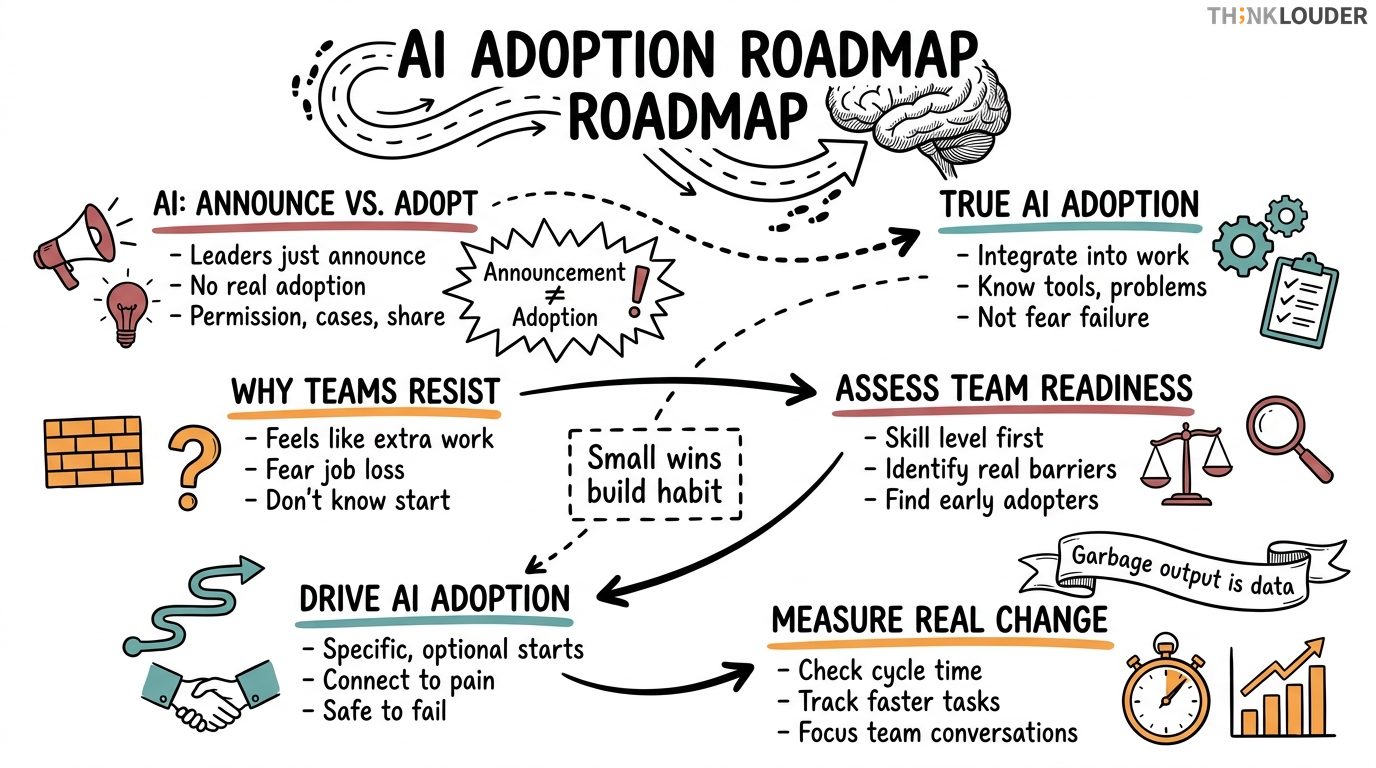
Announcement isn't adoption. Real adoption happens when one person tries a specific tool on a real problem, sees it work, and then shows their teammate. That's peer-to-peer, not top-down.
People don't want to use AI because they're resistant to change.
Most people resist because they don't see how it helps *their* work, or they're worried it means their job is at risk. Show them a concrete 20-minute time savings, and resistance usually turns into curiosity.
We should measure adoption by counting how many people have tried an AI tool.
That's a vanity metric. Measure what changed: Did refinement get faster? Are standups shorter? Are your sprints more predictable? Those are the numbers that matter.
Let me start with what I see happen most often: a leader reads about AI, gets excited, and then sends a Slack message saying "We're using AI now." Two weeks later, three people have tried ChatGPT once, one person's worried about their job, and the rest are waiting for it to blow over.
That's not adoption. That's announcement.
Real adoption looks different. Years ago we had about 180 people across 12 teams at a financial services company. They'd been told to "embrace AI tools" as part of a broader digital transformation. What actually moved the needle wasn't a mandate. It was three things working together: clear permission to experiment, specific use cases that mattered to their daily work, and a way to share what they learned without shame.
What AI Adoption Actually Means
Let me sharpen the language a little bit. We don't mean "everyone uses AI." We mean your team has integrated AI into how they work, they know which tools fit which problems, and they're not afraid to try something and fail. That's adoption.
It's the difference between a Scrum Master who's heard of ChatGPT and a Scrum Master who uses it to draft retrospective prompts, refine user stories, or unblock a stuck conversation in real time. One knows it exists. The other has changed how they work.
Why does this matter on Monday morning? Because your team's productivity, your sprint forecasting, and your ability to ship faster all depend on whether people actually use the tools available to them. Right now, most teams have access to AI and aren't using it, not because it's bad, but because no one showed them why it matters to them.
Where the Resistance Really Comes From
Honest truth: most teams don't resist AI because they're Luddites. They resist because adoption without context feels like extra work. "Learn this new thing" on top of everything else is a tax, not a tool.
The other resistance point is fear of replacement. You'll hear it in retros or one-on-ones: "If AI can write user stories, why do we need a Product Owner?" That's real anxiety, and you can't hand-wave it away with "AI is a tool, not a replacement." You have to show people what actually happens when you use AI well.
Here's what I've seen work: when a team member tries AI on a small, specific task (writing test cases, drafting a sprint goal, brainstorming edge cases) and it saves them 20 minutes, they want to use it again. Fear turns into curiosity. Curiosity turns into habit.
The third resistance point is simpler: people don't know where to start. "Use AI" is too vague. "Use AI to summarize your sprint retrospective notes into action items" is concrete. One is a mandate. The other is a move.
The Readiness Question
Before you roll anything out, you need to know where your team actually stands. Not their openness in theory, but their real readiness to change how they work.
Three things matter:
First, skill level. Do people on your team know how to use basic AI tools? Have they ever written a prompt? Do they understand that AI output is a starting point, not a finished product? If the answer is no across the board, you're starting from scratch. That's fine, but it changes your approach.
Second, the actual barriers. Are people worried about security? (Valid. Your company probably has policy questions.) Are they worried about their job? (Also valid. Acknowledge it.) Are they just busy and this feels like one more thing? (Most common.) You can't solve what you don't name.
Third, the early adopters. Every team has 1-3 people who'll try anything. Identify them. They're your proof of concept. When they show up in a retro and say "I used this prompt to write our sprint goal in five minutes," that moves people more than any training.
Use your judgment here. If your team's mostly skeptical and busy, you don't start with "everyone take an AI certification." You start with one person, one tool, one small win.
How to Actually Get Adoption Moving
Make it specific and optional at first. "Try using AI to draft your user story acceptance criteria this sprint. See if it saves time." Not "integrate AI into your workflow." One is a test. One is a mandate.
Connect it to pain. If your team spends two hours in refinement writing story descriptions, show them how AI can draft those in 10 minutes, leaving more time for conversation about what matters. If your standups are running long, show how AI can summarize the sprint board so you start with a clear picture. Find the itch, then offer the scratch.
Pair AI adoption with sprint planning or retro work. Don't bolt it on to normal work. Build it in. "Next sprint, let's use AI to help us write our sprint goal. We'll try it once, then decide if we keep it." That's how you avoid the "extra work" tax.
Create a safe space to fail. I'm a big believer in this: if someone tries an AI tool and it produces garbage, that's data, not failure. "We tried using AI to estimate story points. It didn't work because it didn't understand our context." That's useful. Share those moments. They build trust faster than success stories.
Share concrete examples. When someone finds a use case that works, have them show the team. Five minutes in a retro. "Here's the prompt I used. Here's what it generated. Here's what I changed." That's adoption fuel. It's specific, it's real, and it's peer-to-peer.
Measuring What Actually Changed
Don't measure adoption by "number of people who've tried AI." That's a vanity metric. Measure the things that matter to your sprint.
Look at cycle time. Are user stories getting refined faster? Are standups shorter? Are retrospectives producing clearer action items? If AI is actually being used well, your team should have more time for the conversations that matter.
Track what got faster. Not everything. Specific things. "We cut refinement time by 30% because AI drafts story descriptions, leaving us time to argue about what matters." That's real.
Listen to the retro. If people are saying "That AI prompt saved me two hours" or "I used that tool to unblock the design team," adoption is working. If they're saying "I tried it once and it was garbage," you've got a training or expectation problem.
Watch for the second wave. Real adoption isn't the first person trying something. It's the second and third person seeing it work, then trying it themselves. That's when it becomes normal.
The Honest Tradeoff
I'll be honest with you: getting a team to adopt AI takes time. It's not a one-meeting thing. It's a three-sprint thing, minimum. You're not just rolling out a tool. You're changing how people think about their work.
And it only works if the team actually wants to get faster or better at something. If your team's content with how things are, adoption will stall. That's not a training problem. That's a motivation problem, and that's different.
The move: start small, show wins, share stories, and give people permission to experiment without penalty. That's how adoption actually happens.
If you're running Scrum ceremonies and want to integrate AI into how your team works, check out the AI adoption strategy post for a deeper framework. Or if you want specific prompts and workflows for planning, refinement, and retrospectives, the AI adoption framework covers the mechanics. But the real learning happens when you and your team try it together and figure out what actually works for your sprint.
How it works in practice
- 1Identify the pain point
Where does your team lose time or struggle? Refinement running long? Standups unfocused? Retros producing vague action items? Pick one. That's your entry point for AI, not a general mandate.
- 2Find an early adopter
Every team has someone who'll try anything. Recruit them. Give them a specific AI tool and a concrete task (e.g., "Draft user story acceptance criteria using this prompt"). Let them go first.
- 3Build it into a ceremony
Don't add AI as extra work. Integrate it into sprint planning, refinement, or retro. "Next sprint, we'll use AI to draft our sprint goal." That's a test, not a tax.
- 4Share the result in public
Five minutes in a retro or standup. "Here's the prompt I used. Here's what it generated. Here's what I changed." Peer-to-peer proof beats any training.
- 5Track what got faster
Measure cycle time, refinement duration, or standup length before and after. Show the team the data. That's adoption fuel.
- 6Rinse and repeat with a new use case
Once one AI workflow sticks, identify the next pain point. Don't try to change everything at once. Three sprints, three small wins, and AI becomes normal.
One short email, every other Friday. Real-world Scrum lessons, no fluff. Unsubscribe anytime.