What people get wrong about this
If we map all our user stories into a CPM schedule, we can predict exactly when the project will finish.
CPM predictions only hold if all your assumptions are correct: estimates are accurate, dependencies don't change, and scope is locked. In Scrum, all three change. Use velocity-based forecasting instead, which adjusts as you learn.
The critical path tells us which work to prioritize in the sprint.
The critical path tells you which tasks will delay the end date if they slip. Your Product Owner prioritizes based on business value. Those are different things. Optimize for value, not for schedule criticality.
CPM is a best practice for all project management.
CPM works for predictable, sequential work like construction or manufacturing. For iterative, discovery-based work like software development, Scrum and iterative planning are the better fit.
The Critical Path Method (CPM) is a project scheduling technique that identifies the longest sequence of dependent activities in a project and calculates the minimum time needed to complete it. It's been around since the 1950s, developed independently by DuPont and Remington Rand to solve a real problem: how do you know which tasks will actually delay your whole project if they slip?
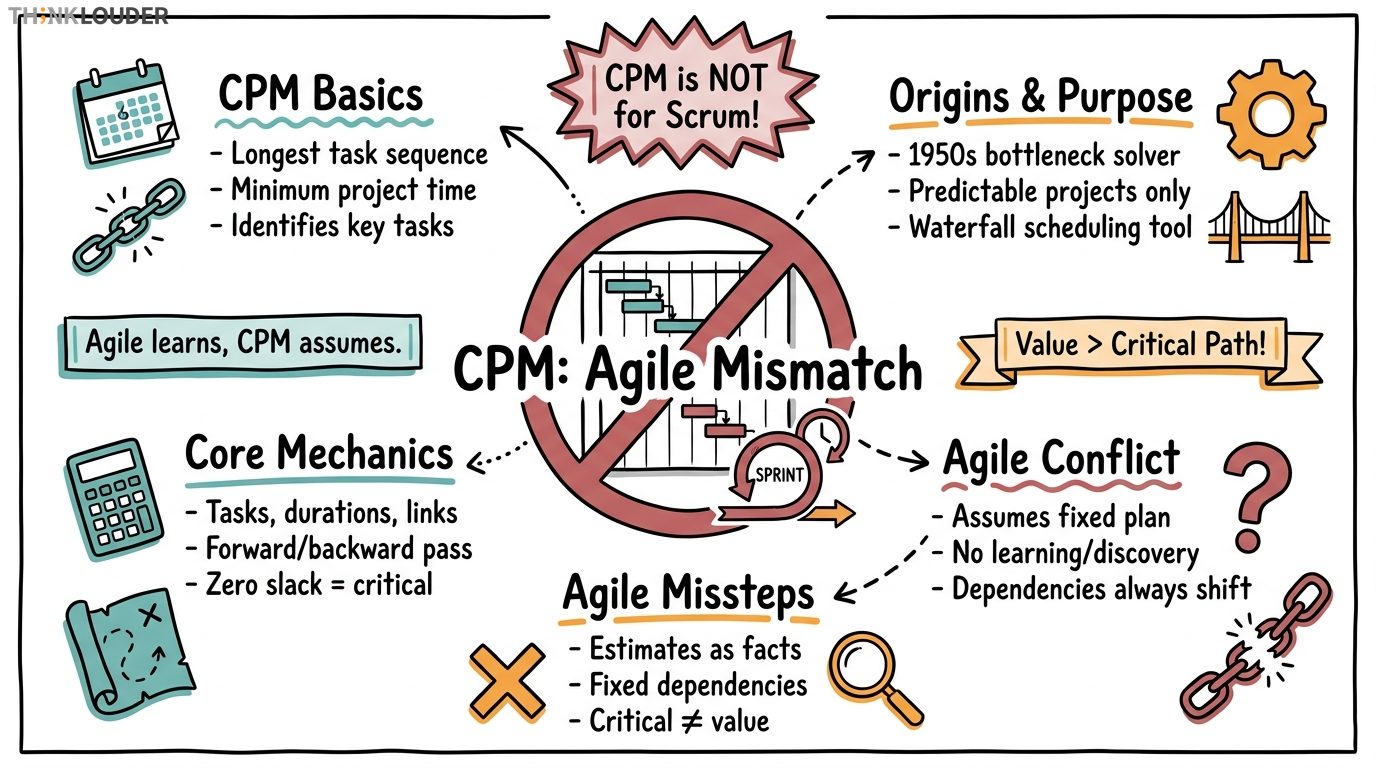
Here's the thing though. If you're a Scrum Master or Product Owner, CPM isn't your tool. It's a waterfall scheduling method, and it assumes you know all your work upfront, that dependencies are fixed, and that you won't learn anything that changes your plan. Scrum teams don't work that way, and if you're hearing CPM in your organization, it's usually a sign that someone's trying to layer command-and-control planning on top of iterative work.
Let me be clear about what CPM actually does, because the concept itself is sound. It maps every task, identifies which ones have "slack" (time you can slip without hitting the deadline) and which ones don't (the critical path), and tells you exactly where to focus your attention if you want to compress the timeline. If you're building a bridge or managing a construction project where tasks genuinely can't overlap and the sequence is locked in, CPM is useful.
But here's where the thinking breaks down in Scrum environments. CPM assumes your project is a directed acyclic graph, right? One path through, everything flows downhill, no loops, no discovery, no "wait, we need to redesign this." Scrum work is messier. You learn as you build. Dependencies shift. Priorities change. And you're delivering value in 2-week increments, not at the end of a 12-month Gantt chart.
Where CPM Comes From and Why It Still Exists
CPM emerged in the 1950s because project managers needed a way to answer a simple question: "If I have 200 tasks and 50 of them could delay the whole project, which 50 should I actually watch?" Before CPM, you'd list everything, estimate it all, and hope. CPM gave you a mathematical way to find the bottleneck.
It worked beautifully for construction, manufacturing, and large government contracts where the work was predictable and sequential. You'd build the network diagram, calculate the earliest start and finish times for each task, find the path with zero slack, and boom, there's your deadline and your risk.
The problem is that CPM got adopted as a universal project management language. By the 1970s and 80s, every project was being squeezed into a Gantt chart. It stuck around because it's teachable, it looks professional (all those boxes and arrows), and it gives executives a false sense of control. You can point to a timeline and say, "We'll be done on March 15th," and nobody questions whether that's actually knowable.
In Scrum environments, CPM shows up as a legacy artifact. You'll see it when an organization is transitioning from waterfall but hasn't fully committed to iterative thinking yet. A Scrum Master will inherit a CPM-based schedule from the PMO, or a Product Owner will be asked to map all user stories into a critical path to "prove" the project will finish on time. It's a category error, but it's persistent.
How CPM Actually Works (And Why It Breaks in Scrum)
CPM uses three core inputs: activities (tasks), durations (how long each takes), and dependencies (which tasks must finish before others start). From there, it calculates:
Forward pass: What's the earliest each task can start and finish? You move left to right through the network, adding durations.
Backward pass: What's the latest each task can start and finish without delaying the end date? You move right to left, subtracting durations.
Slack calculation: The difference between earliest and latest start times. Tasks with zero slack are on the critical path. Those are your pressure points.
The math is clean. The assumption is not. CPM assumes you know all the tasks, their durations are reliable, and dependencies don't change. In Scrum, none of that is true. You don't know all the work upfront because you're learning. Your estimates are probabilistic, not deterministic. And dependencies shift as you discover integration points, technical debt, or changing requirements.
I've watched teams try to run CPM on a sprint backlog. They map out 15 user stories, identify which ones "block" others, calculate the critical path, and then act surprised when the first story takes twice as long as estimated and the whole plan collapses. That's not a failure of CPM. That's CPM being asked to solve a problem it was never designed for.
Common Mistakes with CPM in Agile Contexts
Mistake one: Treating estimates as certainties. CPM calculations are only as good as your duration estimates. In Scrum, you're estimating in story points or T-shirt sizes because you know the estimate has uncertainty built in. CPM treats durations as facts. When you plug in a 5-day estimate and the task actually takes 8 days, the entire critical path shifts, and your schedule is worthless.
Mistake two: Locking dependencies too early. CPM finds the critical path by identifying fixed dependencies. But in iterative work, you discover dependencies as you go. A story you thought was independent turns out to need a database schema change from another story. CPM doesn't account for that flexibility. It assumes the dependency graph is known and static.
Mistake three: Confusing critical path with priority. Just because a task is on the critical path doesn't mean it's the most valuable thing to work on. CPM tells you which tasks will delay the end date if they slip. Scrum tells you which stories deliver the most value to the customer. Those are different questions. A Scrum Master who prioritizes work based on CPM criticality instead of business value is optimizing for the wrong thing.
Mistake four: Using CPM to "prove" a deadline. I've seen this happen in organizations where someone builds a CPM model, calculates that the project will finish on May 15th, and then treats that date as gospel. CPM doesn't predict the future. It calculates the minimum time given your current assumptions. If any assumption changes (scope, resources, technical risk), the date moves. In Scrum, you inspect and adapt every sprint, which means the actual delivery date emerges over time. It's not predetermined.
When CPM Might Actually Be Useful (And When It Isn't)
If you're managing a program with 50 teams and you need to understand cross-team dependencies at a high level, CPM thinking can help you ask the right questions: "Which teams are on the critical path for the program? Where are the bottlenecks?" But you're not building a detailed CPM schedule. You're using the concept to organize your thinking.
If you're running a hybrid model where some work is iterative (Scrum) and some is sequential (infrastructure setup, compliance sign-offs), you might use CPM for the sequential parts and Scrum for the iterative parts. That's legitimate. Just don't try to merge them into a single critical path.
Where CPM genuinely doesn't work: any project with high uncertainty, learning loops, or changing requirements. That includes most software development, product discovery, and organizational change work. If you're in that space, you need sprint planning and iterative delivery, not a critical path.
If your organization is pushing CPM on your Scrum team, the move is to educate them on why it doesn't fit. Bring a concrete example. Show how your sprint estimates have variance. Explain that you're optimizing for value delivery and learning, not for hitting a predetermined date. If they push back, escalate to whoever's sponsoring the Agile transformation and ask them whether the goal is to "follow a plan" or to "deliver value and respond to change." Those require different tools.
For teams that want to get better at planning without falling into the CPM trap, backlog refinement and velocity-based forecasting are your friends. You'll get more accurate timelines because they're based on your actual performance, not on assumptions made months ago. If you're curious about how Scrum compares to other iterative approaches, Agile Kanban offers another model worth understanding, especially if your work doesn't fit neatly into sprints.
Related Resources
- To effectively define project scope before estimating, explore the benefits of a Work Breakdown Structure.
How it works in practice
- 1Identify all activities and dependencies
List every task your project requires and map which tasks must finish before others can start. This works only if your scope is known and fixed upfront.
- 2Estimate task durations
Assign a single-point duration estimate to each task. CPM assumes these are reliable; in Scrum, you'd use ranges or points instead.
- 3Calculate forward pass
Determine the earliest start and finish time for each task by moving left to right through the network, adding durations.
- 4Calculate backward pass
Determine the latest start and finish time for each task by moving right to left, subtracting durations from the project end date.
- 5Identify slack and critical path
Tasks with zero slack (no buffer) form the critical path. Any slip on the critical path delays the entire project. Focus monitoring there.
- 6Monitor and replan if assumptions change
If estimates, dependencies, or scope shift, recalculate the critical path. In practice, this happens often, which is why CPM breaks down in uncertain work.
One short email, every other Friday. Real-world Scrum lessons, no fluff. Unsubscribe anytime.