What people get wrong about this
If we're on schedule, we're on budget, and vice versa.
A project can be on schedule and massively over budget, or under budget and weeks behind. Earned Value shows both at once so you catch cost overruns before they're irreversible.
We should track Earned Value at the sprint level so we know exactly where we are every two weeks.
Sprints are too short for EVA to be meaningful. The month-to-month noise drowns out the signal. Track EVA at the release or program level, and use velocity and burndown for sprint-level health.
If we're 80% done with a feature, we've earned 80% of its value.
In real EVA systems, you earn value only when work is genuinely done: tested, reviewed, integrated, ready to ship. Partial credit inflates your metrics and masks real delays until it's too late to fix them.
Earned Value Analysis (EVA) is a method for measuring how much work you've actually completed on a project relative to what you planned to spend and what you've actually spent so far. It answers a simple question: are we ahead, behind, or on track, and will we finish on budget?
Here's the thing: most teams track time and money separately from progress. You've burned three weeks and $50,000, but nobody knows if you're 30% done or 70% done. Earned value analysis ties those three threads together so you can see the real picture.
What Earned Value Analysis Actually Measures
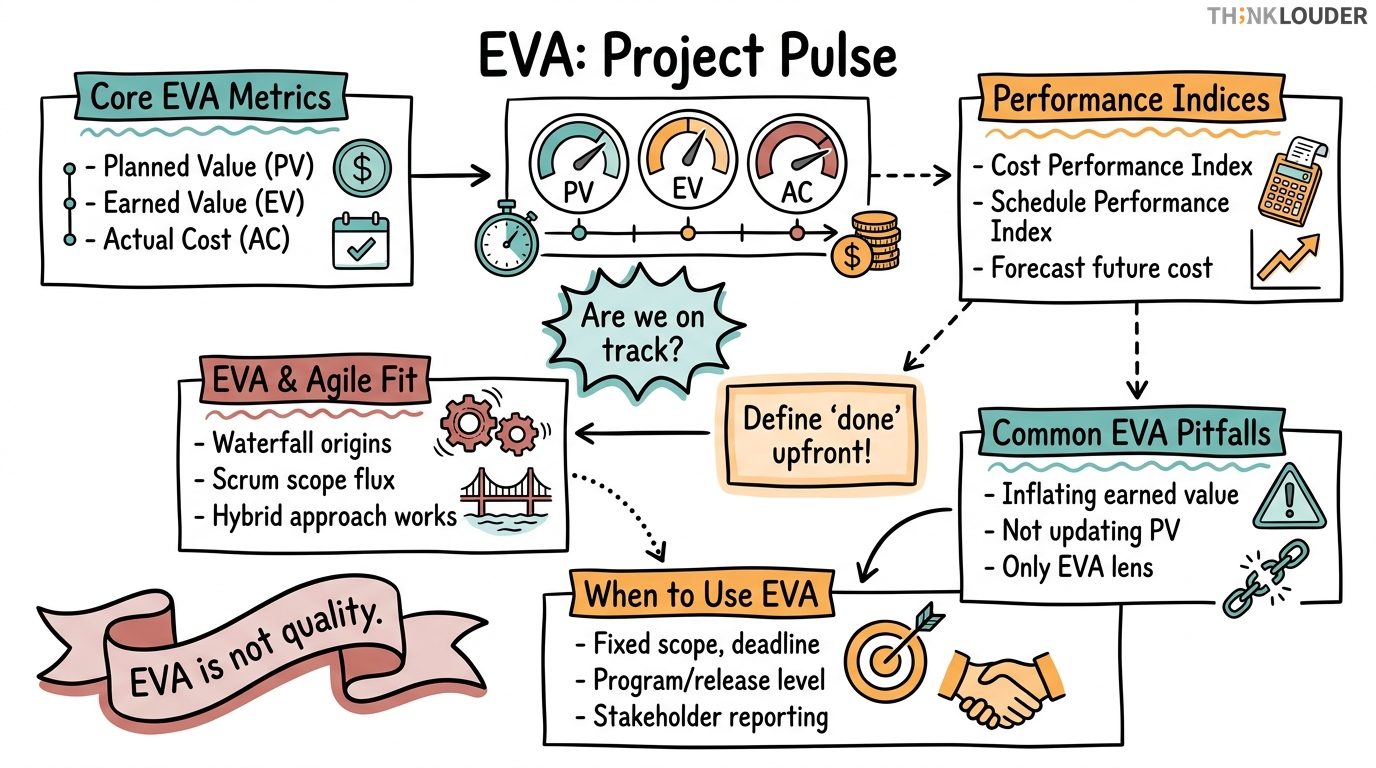
Earned value analysis sits on three numbers. Get these right, and the rest clicks into place.
Planned Value (PV) is what you expected to spend by now. You planned to complete 40% of the work by week 6. That 40% of the total budget is your Planned Value. It's the baseline schedule in dollars (or points, or any unit). It's not what you've actually spent. It's what you said you'd spend if everything went according to plan.
Earned Value (EV) is the value of work you've actually completed, measured at its planned cost. You said 40% of the work would cost $100,000. You've actually finished 35% of the work. Your Earned Value is $87,500. Not what you paid for it, but what it was supposed to cost if you'd planned it perfectly. This is the tricky one: it forces you to define "done" upfront and measure it honestly.
Actual Cost (AC) is exactly what it sounds like. You've spent $110,000 so far. That's your Actual Cost. It's the easiest number to get because accounting already tracks it.
Those three numbers let you calculate two ratios that tell you everything.
How to Calculate Performance Indices
Once you have PV, EV, and AC, two metrics emerge that show whether you're healthy or in trouble.
Cost Performance Index (CPI) is EV divided by AC. If you've earned $87,500 worth of value but spent $110,000, your CPI is 0.795. That means for every dollar you spend, you're earning 80 cents of planned value. A CPI below 1.0 means you're overspending. A CPI above 1.0 means you're spending less than planned. On a $500,000 project, a CPI of 0.795 is a warning. You're burning cash faster than your plan allows.
Schedule Performance Index (SPI) is EV divided by PV. You've earned $87,500 of value, but you planned to earn $100,000 by now. Your SPI is 0.875. That means you're 87.5% of where you should be, schedule-wise. An SPI below 1.0 means you're behind. An SPI above 1.0 means you're ahead. On a 12-month project, an SPI of 0.875 in month 3 tells you something's slowing down.
Here's where it gets useful: you can forecast. If your CPI stays at 0.795, a $500,000 project will cost you $628,931 by the time you're done. You can tell your stakeholders now, not in month 11 when the money's gone.
Why Earned Value Analysis Matters in Scrum (and Why It Doesn't Always Fit)
Earned value analysis comes from waterfall project management. It assumes you can define the full scope upfront, break it into phases, and measure progress as a percentage of that fixed scope. That works great when you're building a bridge. You know exactly what done looks like from day one.
Scrum teams often run into trouble with EVA because Scrum assumes scope will change. Your backlog isn't fixed. Your definition of "done" evolves. You discover new work mid-sprint. If you lock in your planned value at the start and never adjust it, your metrics lie.
Just to adjust the language a little bit: earned value analysis works best in Scrum when you're running a fixed-scope initiative or a release with a hard deadline and a committed feature set. It works less well when you're in continuous discovery mode, where the backlog is genuinely fluid and priorities shift every sprint.
That said, many organizations use a hybrid approach. They run Scrum for day-to-day delivery, but they track earned value at the program or release level to show stakeholders how the overall investment is tracking. You can do both. It depends on what your sponsors need to see. When you're managing work breakdown structures or dealing with strict timelines, this hybrid model often makes sense.
Common Pitfalls That Wreck Your Numbers
Three mistakes kill EVA credibility in real teams.
Inflating Earned Value because you feel good about progress. You're 80% done with a feature, so you mark it 80% complete and earn 80% of its value. That's not how it works. In most earned value analysis systems, you earn value only when work is genuinely done: tested, reviewed, integrated, ready to ship. Partial credit is a trap. It makes your forecasts look better than reality, and by month 4 you're shocked that you're still behind.
Never updating Planned Value when scope changes. Scrum teams especially do this. The backlog grows by 30 items mid-project, but your Planned Value stays the same because "we committed to the original scope." Now your metrics are measuring against a plan that doesn't exist anymore. If you add scope, adjust PV. If you remove scope, adjust PV. Your baseline is only useful if it reflects what you're actually trying to do.
Treating EVA as the only measure of health. A team with a CPI of 1.2 and an SPI of 1.1 looks great on paper. But if your team's burning out, your technical debt is climbing, or your defect rate is spiking, those metrics don't show it. Earned value analysis is a financial and schedule lens. It's not a quality lens. Use it alongside cycle time, defect trends, and team health checks.
When to Use Earned Value Analysis
Earned value analysis works best in three scenarios.
First: fixed-scope, fixed-deadline contracts or releases. You're building a specific product for a specific customer by a specific date with a specific budget. You need to know if you'll hit that target. EVA tells you months before you run out of money.
Second: multi-team programs where you need a single number to show executives. You've got 8 teams working on an 18-month initiative. Each team tracks velocity and burndown, but your CFO wants one metric to decide whether to invest another $2 million. Earned value analysis at the program level gives you that signal.
Third: industries with compliance or contractual requirements. Government contracts, aerospace, healthcare programs. If your contract says you'll report earned value, you report it. You can't opt out.
Earned value analysis doesn't work well if your scope genuinely changes every sprint, if your team is still learning what "done" means, or if you're in discovery mode where the goal is to learn, not to deliver a fixed set of features. In those cases, use throughput and cycle time metrics instead. And if you're working without fixed deadlines, consider whether Kanban's continuous flow might serve you better than trying to force earned value analysis into a fluid delivery model.
How to Start (If It Fits Your Project)
If you decide to implement earned value analysis, start small. Don't try to track it across 15 teams on day one.
Pick one release or one fixed-scope initiative. Define your scope baseline: what are all the deliverables, and what's the total budget? Break it into phases or milestones. Assign a planned cost to each phase based on your historical velocity or team capacity. That's your Planned Value curve.
Each reporting period, usually monthly or at sprint boundaries, ask: what work have we actually completed to definition of done? Measure its planned cost. That's your Earned Value. Pull your actual spend from accounting. That's your Actual Cost.
Calculate CPI and SPI. If CPI is below 0.95, you're overspending and need to talk to your sponsor. If SPI is below 0.90, you're behind schedule and need to replan. Use those signals to make decisions, not to blame the team.
If you're running Scrum at scale, consider embedding earned value analysis reporting at the Program Increment or release level, not at the individual sprint level. Sprints are too short for EVA to be meaningful. The noise drowns out the signal.
The Real Value
Earned value analysis doesn't predict the future perfectly. No metric does. But it tells you something crucial that time and money alone won't: whether you're getting what you paid for. A project can be on schedule and over budget. It can be under budget and late. EVA shows you both at once, and it gives you time to course-correct before it's too late.
If you're managing a fixed-scope initiative and you're not tracking earned value, you're flying blind. Set it up. It takes a week to instrument the first time, then it's automatic.
Related Resources
- To understand another key project management technique, explore Critical Path Methodology in Project Management.
- To further protect your project's health, learn how to document and manage threats with our Risk Register Template.
How it works in practice
- 1Define your scope baseline and total budget
List all deliverables and assign a planned cost to each phase or milestone based on historical velocity or team capacity. This becomes your Planned Value curve.
- 2Measure completed work at planned cost
At each reporting period, identify work that meets your definition of done and calculate its planned cost. This is your Earned Value. Don't award partial credit for in-progress work.
- 3Pull actual spending from accounting
Get your real spend to date from your finance system. This is your Actual Cost. It should be straightforward because accounting already tracks it.
- 4Calculate Cost Performance Index (CPI) and Schedule Performance Index (SPI)
CPI = Earned Value / Actual Cost. SPI = Earned Value / Planned Value. A CPI below 0.95 or SPI below 0.90 signals trouble and requires a conversation with your sponsor.
- 5Forecast final cost and schedule
If your CPI holds steady, divide your total budget by the current CPI to estimate final cost. Use SPI to estimate how much schedule slip you'll see. Share this forecast with stakeholders monthly.
- 6Adjust Planned Value when scope changes
If scope grows or shrinks mid-project, update your Planned Value baseline. Tracking against a plan that no longer reflects reality makes your metrics useless.
One short email, every other Friday. Real-world Scrum lessons, no fluff. Unsubscribe anytime.