What people get wrong about this
A risk register is a compliance document I fill out once and file away.
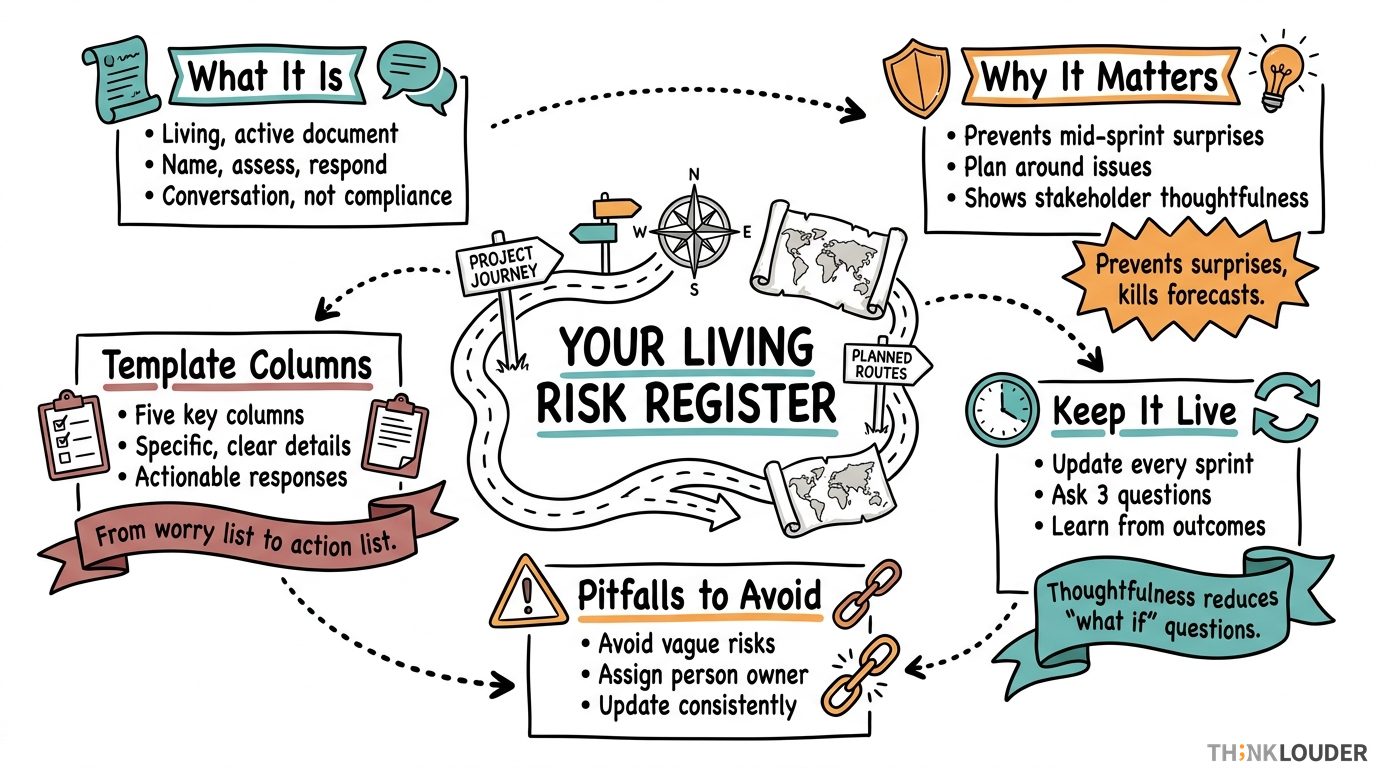
A risk register is a living conversation tool you update every sprint. If you're not looking at it and changing it regularly, it's not working.
The more columns and data I track, the better my risk management.
Five columns (description, likelihood, impact, owner, response) is enough. More data means people stop updating it, and a dead register is worse than no register.
Risks should be assigned to the team or department so everyone's responsible.
Every risk needs a single named owner. A person. If you can't name someone, you don't actually own the risk yet.
Identifying a risk is the hard part. Once it's written down, I can relax.
Identifying the risk is easy. The hard part is actually executing the response. A risk with no action behind it is just worry on a spreadsheet.
A risk register is a living document where your team names every risk that could derail the project, assesses how likely it is and how bad it'd be if it happened, and then writes down what you're actually going to do about it. That's it. Nothing fancy. It's not a spreadsheet that sits in a folder untouched for six months. It's a tool you pull out, look at, and update when things change.
Years ago we had 34 teams across a financial services client, and exactly three of them kept a risk register that anyone actually read. The other 31 had one because someone told them they had to. The difference between the three that worked and the 31 that didn't wasn't the template. It was that the teams using them treated the register as a conversation starter in standup and sprint planning, not as a compliance checkbox. That's the mental model you need to carry forward.
Why a Risk Register Matters on Monday Morning
Imagine you're running a sprint and on Wednesday afternoon your infrastructure team tells you the database migration you've been planning is going to take three weeks longer than expected. Your sprint's in trouble, your release date's at risk, and your stakeholders don't know yet. If you'd identified that risk two sprints ago, named the person who could have flagged it earlier, and planned a backup approach, you wouldn't be scrambling right now. You'd already have a move. That's what a risk register does. It surfaces the things that'll hurt you before they actually hurt you.
In Scrum, this matters because your sprint is a fixed container. If a risk materializes mid-sprint and you haven't thought about it, you've lost your ability to plan around it. The register doesn't prevent risks. It prevents surprises. And surprises kill forecasts.
Here's the other thing: your stakeholders want to see you thinking about what could go wrong. Not panicking about it, but thinking about it. A risk register shows them you're being thoughtful. Scrum Masters who bring a real, updated risk register to a stakeholder conversation get asked fewer "what if" questions because you've already asked them yourself.
What Goes Into a Risk Register Template
A working template has five columns. You don't need more. More columns means more data entry, which means people stop updating it.
Risk description. Write it so a new person on the team understands it immediately. Not "infrastructure issues," but "the API gateway we're depending on hasn't been load-tested above 500 requests per second, and our forecast is 800 by launch." Specific. Named. Clear.
Likelihood. High, Medium, Low. Or 1 to 5 if your org prefers numbers. Don't overthink this. You're not calculating probability to three decimal places. You're making a judgment call. Does this feel like it's probably going to happen, might happen, or is unlikely but possible?
Impact. If this risk happens, what's the damage? Does it delay the release by a week? Kill a feature? Break the product? Again, High, Medium, Low works. Or you can use dollar amounts if that's how your org talks about risk.
Owner. Name the person who's tracking this and will raise the alarm if it starts to materialize. Not "the team," not "infrastructure." A person. Sarah. Marcus. Whoever. If you can't name someone, you don't own the risk yet.
Response. What are you going to do about it? Are you going to test the API gateway early? Hire a contractor? Reduce scope? Have a backup plan? Write it down. This is where the register stops being a worry list and becomes an action list.
That's the template. Five columns. Anything else is decoration.
How to Keep It Real, Not Dead
The biggest mistake is treating the risk register like a one-time artifact. You fill it out in sprint planning, stick it in a shared folder, and never look at it again. Three sprints later, half the risks are resolved, two new ones have emerged, and the old register's still sitting there looking like it matters.
Instead, spend five minutes at the start of each sprint looking at it. Ask three questions: Did any of these risks happen? Are any of them more or less likely than we thought? Are there new risks we didn't see coming? Then update it. That's it. Five minutes. It becomes part of your rhythm.
When a risk does materialize, mark it as "occurred" and write down what actually happened versus what you thought would happen. That's gold. That's how your team learns to forecast better. Over time, you'll notice patterns: the risks you always underestimate, the ones that never happen, the ones that cascade into other problems.
One more thing: if you're running a scaled Scrum program with multiple teams, each team keeps its own register, but the Scrum of Scrums (or the release train architect, depending on your structure) pulls up the high-impact, high-likelihood risks from each team's register into a program-level register. That's where cross-team dependencies and systemic risks live. Don't skip that layer.
Common Pitfalls
First: writing risks so vague they don't mean anything. "Timeline risk." "Resource risk." Useless. You need to know what specifically could go wrong and why.
Second: assigning ownership to "the team" or "engineering." Ownership has to be a person. People take accountability. Departments don't.
Third: never updating it. A risk register that's three sprints old is worse than no register at all because it gives you false confidence. You think you're managing risk when you're actually ignoring it.
Fourth: confusing the risk register with the impediment log. They're different. An impediment is something blocking you right now. A risk is something that might block you. The impediment log is for today's problems. The risk register is for next week's.
Fifth: not actually doing anything about the risks you identify. You write down the response, but then nobody executes it. The register becomes a place where risks go to be acknowledged and then ignored. If you identify a risk and your response is "monitor it," fine. But "monitor it" means someone's actually checking on it, not hoping it goes away.
Putting It Into Your Sprint Cycle
Risk identification happens early. In sprint planning, after you've pulled stories into the sprint, spend ten minutes asking: "What could prevent us from finishing these stories? What dependencies are we making? What assumptions are we betting on?" That's when you add new risks to the register.
Risk review happens in standup and sprint review. In standup, if someone says "we're blocked waiting on the design system," that's a flag to check the risk register. Is that dependency already logged? Is it owned? What's the response? In sprint review, when you're showing work to stakeholders, you can mention the top three risks you're tracking. It shows you're thinking ahead.
Risk closure happens when the sprint that was supposed to mitigate the risk is done. You tested the API gateway, and it handled 1000 requests per second. Risk resolved. Mark it closed. That's a win.
The register is also your bridge to Product Owner conversations. If your PO doesn't know about the risks you're tracking, they can't make informed decisions about scope or timeline. Bring the register to refinement. Say, "Here's what could go wrong with this epic. Here's what we're doing to prevent it. Here's what we need from you if it happens anyway." That's a conversation that builds trust.
flowchart LR
  A[Sprint Planning] -->|Identify risks| B[Risk Register]
  B -->|Track in standup| C[Daily Standup]
  C -->|Review at end| D[Sprint Review]
  D -->|Update likelihood| B
  B -->|Close resolved| E[Risk History]
  E -->|Learn from| A
Making the Template Yours
Don't copy a generic template from the internet and call it done. Spend an hour with your team and ask: "What risks have actually bitten us in the past three projects? What would we have wanted to know earlier?" Build your template around those. If you're in software, you might weight technical risks heavily. If you're in events, you might weight vendor and logistics risks. The structure's the same. The risks you care about are different.
Also, don't make it a monster spreadsheet with 15 columns and conditional formatting. You'll maintain it for two weeks and then it'll die. Simple wins. Five columns, plain text or a Google Sheet, updated every sprint. That's the move.
If you're leading a team through Agile transformation, the risk register is one of the first things that signals you're serious about planning. Not just executing, but thinking. Not just hoping things work out, but naming what could go wrong and doing something about it.
Start this sprint. Spend 30 minutes building a five-column register. Name three to five real risks your team faces. Assign owners. Write responses. Then update it every sprint. Six weeks from now, you'll have a picture of what your team's actually worried about and what you're doing about it. That's the register working.
Related Resources
- To understand how other project management approaches identify critical tasks, read our guide on Critical Path Methodology.
- To track real progress and not just time spent, learn about Earned Value Analysis.
How it works in practice
- 1Build your five-column template
Create columns for risk description, likelihood, impact, owner, and response. Use High/Medium/Low for likelihood and impact. Keep it simple so your team will actually use it.
- 2Identify risks in sprint planning
Spend ten minutes asking what could prevent you from finishing the sprint's stories. What dependencies are you making? What assumptions are you betting on? Add three to five risks to the register.
- 3Assign a single owner to each risk
Name the person who's tracking this risk and will raise the alarm if it starts to materialize. Not a team, a person. Ownership drives accountability.
- 4Write a concrete response
What are you going to do about this risk? Test something early? Hire help? Reduce scope? Have a backup plan? Write it down so everyone knows the move.
- 5Review and update every sprint
Spend five minutes at the start of each sprint reviewing the register. Did any risks happen? Are any more or less likely? Are there new ones? Update it. Close resolved risks.
- 6Bring high-impact risks to stakeholder conversations
Mention your top risks in sprint reviews and to your Product Owner in refinement. It shows you're thinking ahead and helps them make informed decisions about scope and timeline.
One short email, every other Friday. Real-world Scrum lessons, no fluff. Unsubscribe anytime.