A project manager walks into a stakeholder meeting with a 6-month timeline, a budget that's already been cut twice, and three different executives who want different things. By end of day, she's realigned priorities, reset expectations, and the team knows what Monday looks like. That's the job. Not the theory of it. The actual day-to-day.
If you're thinking about stepping into a project manager career path, you're asking the right questions: What do I actually do? How much does it pay? How do I get there? And is it worth the shift?
What Project Managers Actually Do
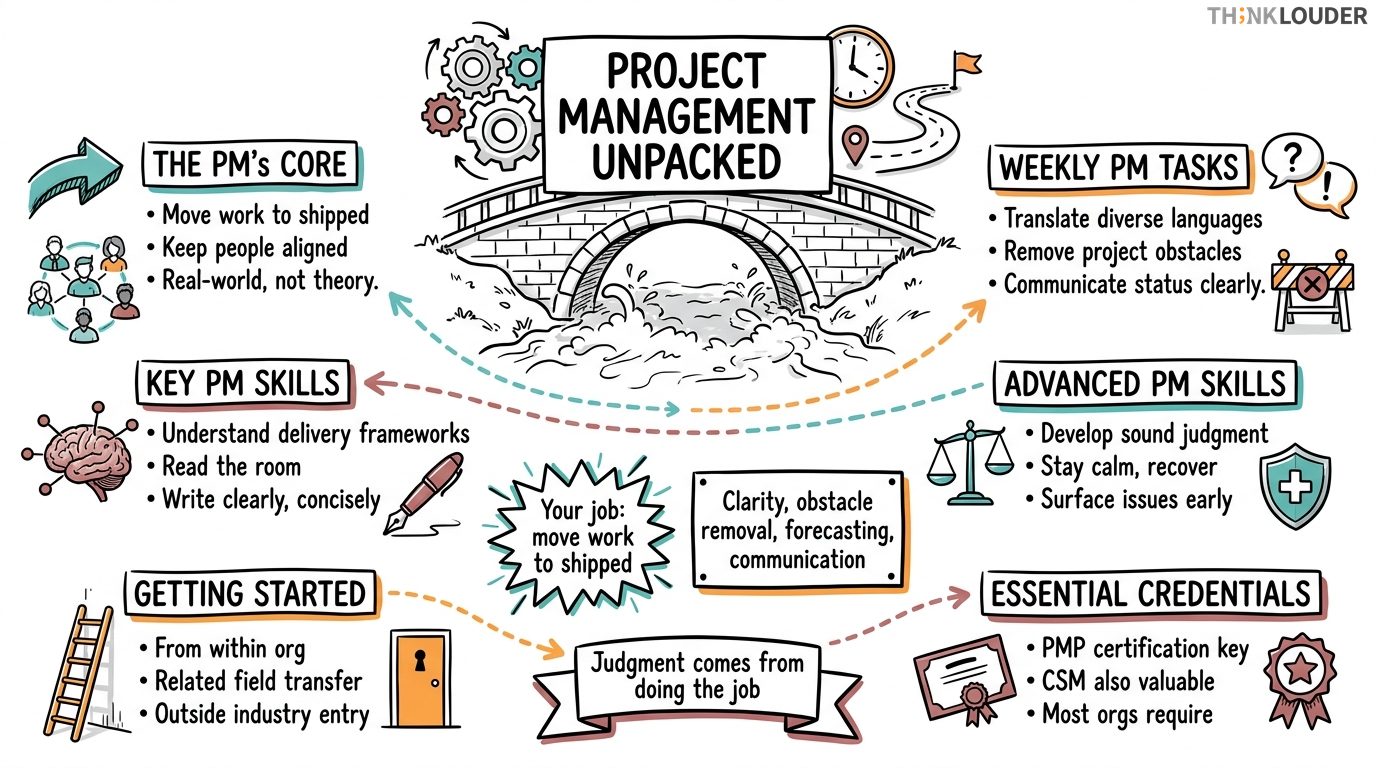
Your job is to move work from "we need this" to "we shipped this," and keep the people involved from killing each other in the process.
That breaks into four things you'll do every week. First, you're translating. Executives talk in business outcomes. Engineers talk in technical constraints. Stakeholders talk in deadlines. You sit in the middle and make sure everyone's using the same language. Second, you're removing obstacles. A developer's blocked waiting on design feedback. A stakeholder's unhappy with the scope. The budget approval's stuck in procurement. You find it, you fix it, or you escalate it fast enough that it doesn't tank the timeline. Third, you're forecasting. Not predicting the future (you can't), but saying "here's what we know, here's what we don't, here's the risk if we don't address X by Friday." Fourth, you're communicating status without theater. Your team doesn't need a 30-slide deck. Your executives do. You're writing two versions of the same truth.
On a typical Tuesday, you're running a status check with the core team, you're in a one-on-one with someone who's overwhelmed, you're writing a risk summary for leadership, and you're troubleshooting why a dependency from another team didn't land on time. You're not writing code. You're not designing. You're making sure the people who do those things have what they need and know what done looks like.
The role scales, right? In a 6-person startup project, you might wear three hats. In a Fortune 500 program with 80 people across four teams, you're managing managers. But the core stays the same: clarity, obstacle removal, forecasting, communication.
Skills You'll Need (and How to Build Them)
Technical project management skills are table stakes. You need to understand your delivery framework. If your org runs Scrum, you need to know what a Scrum Master actually does because you'll either be working with one or doing parts of that job yourself. If it's Kanban, you need flow metrics. If it's waterfall (yes, some orgs still run it), you need phase gates and earned value analysis to track real progress.
But here's what actually separates competent project managers from the ones people want on their team: you need to read a room. You need to hear "we're on track" from a developer and know whether they mean it or they're just hoping the problem solves itself. You need to see a stakeholder's face during a demo and know whether the question they're about to ask is genuine curiosity or a sign they're about to pull the plug. That's not a skill you learn in a course. That's judgment, and it comes from doing the job.
You also need to write clearly. Not fancy. Clear. Your status report should take 90 seconds to read. Your risk summary should fit on one page. Your email should say what you need and when you need it by. Most project managers fail not because they can't manage timelines, but because they can't communicate them.
And you need to stay calm when the timeline breaks. Because it will. You'll have a plan that looked solid on Monday, and by Wednesday you're explaining to leadership why the launch is slipping two weeks. Your job isn't to prevent that (sometimes it's unavoidable). Your job is to surface it early, explain it clearly, and have a recovery plan ready.
How to Get Into Project Management
There are three common entry points.
From within. You're already in the organization. You're a strong individual contributor, you've shown you can coordinate across teams, and someone notices. You move into a project coordinator or assistant PM role first. That's usually 6 to 18 months of learning the systems, the politics, and how your org actually works (not how the org chart says it works). Then you step up to PM. This path is fastest because you skip the "learn our culture" tax.
From a related field. You're a Scrum Master, a business analyst, or a technical lead. You've been managing work and people. You move into a PM role and you're already half-trained. You know how to run a standup, you know how to spot scope creep, you know how to say no. You're missing some of the business and stakeholder management pieces, but you can learn those in 3 to 6 months of real work.
From the outside. You're coming from another industry entirely. You get a PM certification (usually PMP or CAPM if you don't have 3+ years of project experience yet), you take a project coordinator role, and you spend 18 to 24 months learning the craft. This path takes longest, but it's doable.
Whichever path you take, you need a credential. Most organizations won't hire a PM without one. The two that matter most are PMP (Project Management Professional) and CSM (Certified Scrum Master). PMP takes 3+ years of project management experience to qualify, costs about $555 for the exam, and takes 4 to 6 months of study to pass. CSM takes 2 days in a classroom (or online), costs around $395 including the exam, and is a faster entry if you're just starting. CAPM (Certified Associate Project Manager) is the junior version of PMP, requires no experience, and costs $225.
If your org runs Scrum, CSM is probably the move. If it runs traditional waterfall or mixed approaches, PMP is the credential that opens doors.
Salary and Career Progression
Median project manager salary in the US sits around $95K to $135K depending on experience level and industry. In tech, it's higher (often $120K to $160K for mid-career). In other industries, it's lower. Senior PMs in big tech companies push $180K to $250K. Program managers (managing multiple PMs and teams) hit $150K to $250K. If you move into executive roles (VP of PMO, VP of Delivery), you're looking at $200K and up.
The progression looks like this: you start as a coordinator or assistant PM ($55K to $75K), you move to PM ($85K to $130K), then senior PM ($120K to $180K), then program manager or director ($150K to $250K), then director or VP ($180K and up). Each step usually takes 2 to 4 years if you're performing.
The jump from coordinator to PM is the hardest. You're proving you can own a project end-to-end, manage stakeholders, and deliver on time and budget. Once you've done that once, the rest follows.
Common Traps and How to Avoid Them
You'll hear project managers say "I'm just an admin" or "I'm just keeping the trains running." That's a trap. You're not just tracking. You're forecasting, removing obstacles, and making decisions that shape the outcome. Own that.
You'll also get pulled into doing work that's not yours. Someone needs a spreadsheet. Someone needs documentation. Someone needs a process map. You can help, but if you're spending 60% of your time on execution and 40% on managing, you're not actually managing. You're a very expensive coordinator. Draw the line.
And you'll face the temptation to be the hero. The timeline's slipping, so you work weekends. The team's stuck, so you jump in and do the work. Stop. Your job is to make the team successful, not to be the most productive person in the room. If you're the bottleneck, you've failed.
Is This Role Right for You?
Project management is right for you if you like seeing things through to done, if you're energized by solving logistical and people problems, and if you can stay calm when plans break. It's not right for you if you need to be the expert in the room, if you hate saying no, or if you need to see the direct technical output of your work.
Your next step: pick a framework and get certified. If you're in a Scrum environment, take a 2-day CSM course and get the credential. If you're in a traditional environment, start studying for PMP. Either way, get into a project coordinator or assistant PM role in the next 6 months. The credential gets you in the door. The role gets you the experience.
After 2 to 3 years as a PM, you'll know whether you want to go deeper (senior PM, program manager, director) or whether you want to pivot to something else. Most people who stick with it move up. The ones who don't usually realize they wanted to stay hands-on technical, and that's fine. But you won't know until you try.
Related Resources
- Discover how AI can streamline your daily tasks and improve efficiency with our guide to AI for User Stories: When to Use It, When Not To.
- Explore how AI is shaping modern project management in our latest article, AI in Agile: What It Actually Means and When It Matters.
One short email, every other Friday. Real-world Scrum lessons, no fluff. Unsubscribe anytime.